Why Are We Accepting Less Healthy, Lower Quality Options From Food Companies?

Living a healthy lifestyle is all about making the healthiest choices. But what if the best choice (or the information needed to make the best choice) wasn’t available to you because the people tasked with looking out for you and your interests don’t have the same high standards and the corporations don’t deliver the same high-quality products in the United States as they do in Europe?

Whether it’s an American corporation introducing organic products in Europe but not in the U.S., the fact that we are denied the opportunity to know what’s in our food or where it came from, or the disproportionate amount of refined sugar and chemicals in our everyday products, it’s disheartening to realize that companies are more than happy to take advantage of corporate friendly, health-indifferent attitudes in the United States. For every company claiming that a safer, healthier way of producing food isn’t “cost-effective,” it is interesting to see what they’re doing in other countries. It’s becoming increasingly clear that cost is not the only reason they’re giving consumers in the U.S. less than their best.

Organic Fast Food is Finally an Option – But Not For Everyone

Let’s look at McDonald’s, one of the largest fast food chains and a worldwide symbol of the United States. They’ve been experiencing a decline in sales numbers as consumers make better lifestyle choices and become more health-conscious. The United States is now the largest organic market in the world, and McDonald’s corporate attempt to grab a piece of that pie is their new pledge to use only cage-free eggs by 2025. They’re also introducing a hamburger made entirely of organic meat.

McDonald’s promised the European Union they would only use cage-free eggs by 2011. Now they make the same promise to U.S. citizens with a 10-year target date? And yes, they will be offering an organic burger – but only in Germany, the second-largest organic market.

McDonald’s also sells organic milk at their U.K. locations. Many consumers in the United States are not aware that McDonald’s can and does make more animal welfare friendly and environmentally sustainable choices in other countries even though we are the largest organic market in the world.

Three Little Letters

Countless activists in the United States are fighting for the right to mandate labeling genetically modified foods. Opponents claim labeling all of these products will raise the cost of food, a cost they will be forced to pass on to the consumer. But this argument ignores the fact that the European Union, Japan, Brazil, Australia, and China are among the 64 countries that currently require GMO labeling. If so many countries already require labeling, why not simply extend that consideration to the United States? Obviously, corporations are aware of the rising numbers of health-conscious Americans that will choose a more environmentally conscious and healthy option.

A Little Something Extra

When looking at the way food corporations treat consumers in the United States, it’s also interesting to note the unhealthy things they add to our food. The FDA seems content to let corporations treat us like guinea pigs, sitting back and claiming there is a lack of concrete evidence to remove ingredients until something forces their hand.

For example, the majority of pigs in the United States are still raised using the muscle drug ractopomine, which is banned in the European Union, China, and Russia. The U.S. has been claiming there is no evidence for this ban in science, while China, the largest consumer of pork worldwide, sees it as a threat to food safety. It seems odd that the pork companies in the U.S. argue that there is no science supporting concern when other nations have clearly found evidence to the contrary.

This isn’t the only time products in the United States have added a little something extra that can compromise our health. Companies in the U.S. can sell “bromated bread” which contains potassium bromate. Since the 1980s, that additive has been considered carcinogenic, but the FDA only asks that it be eliminated on a voluntary basis. Unfortunately, this is not the only potentially dangerous food additive that the FDA is unwilling to take a stand on, leaving U.S. consumers at the whims of companies trying to make the most profit possible.

Consumer Action

You’re a consumer in the United States who has done the research, and you’ve decided that you want to lead a healthier, more sustainable, eco-friendly life. It’s hard enough to change old habits and learn to appreciate healthy choices without having to sift through misinformation. As you become more informed and discover the extent to which you need to protect your own health, you may become furious with the American food system. You’d have every right to be. More and more companies show they are willing to accommodate stricter international standards while taking full advantage of lax regulations in the United States.

Let’s face it, corporations run America. Despite the fact that 90% of Americans want GMOs labeled, The DARK Act has passed Congress. Our crops and our soil are poisoned with glyphosate. And it’s not just our food industry that is corrupt. Our personal care products are filled with ingredients that are banned overseas. Our water is contaminated with fluoride. Until we face the fact that our government officials are bought and owned by corporate interests, and we make real change in the electoral process and how we protect consumers, we will have to provide our own due diligence to protect our health.

Recommended Reading:
Sources:


Celebrities Against GMOs

Monsanto has spent a lot of money trying to fight state labeling laws. Despite millions of dollars and deceitful ad campaigns, they haven’t been entirely successful. Laws mandating GMO labeling came close to passing in Oregon, California, and Washington. Vermont successfully passed a GMO labeling law, and initiatives to label genetically modified foods are being introduced all over the country.

Monsanto needed a federal solution to their problem, a federal law that could overturn the people’s will in Vermont and in other states. Unfortunately, Congress agreed. The bill is titled the Safe and Accurate Food Labeling Act of 2015. It is better known by its critics as the DARK Act (which stands for Denying Americans the Right to Know). Despite vocal opposition from the public, independent scientists, and celebrities, the bill has passed the House and it is currently in the Senate’s agriculture committee. This bill, and California’s failed attempt to pass a GMO labeling law, motivated public responses from world-class celebrities. Refusing to passively accept corporate rule, many stars have become outspoken and have begun to use their fame in order to make it clear that they want to know what is in their food. Neil Young tells us in song.

Neil Young

If you don’t like to rock Starbucks A coffee shop
Well you better change your station ’cause that ain’t all that we got
Yeah, I want a cup of coffee but I don’t want a GMO
I like to start my day off without helping Monsanto

… From the fields of Nebraska to the banks of the Ohio
The farmers won’t be free to grow what they want to grow
When corporate control takes over the American farm
With fascist politicians and chemical giants walking arm in arm

… When the people of Vermont wanted to label food with GMOs
So that they could find out what was in what the farmer grows
Monsanto and Starbucks through the Grocery Manufacturers Alliance
They sued the state of Vermont to overturn the people’s will

Chuck Norris

Chuck Norris Flu Shot MemeIn 2007 alone, the agricultural sector applied between 180 million and 185 million pounds of glyphosate to crops in this country. The home and garden sector applied 5 million to 8 million pounds, and industry, commerce, and government applied 13 million to 15 million pounds of glyphosate. It was the most widely used herbicide in U.S. agriculture and second-most widely used herbicide in the home and garden sector.

The reason it should be on our radar now is that glyphosate is under a standard registration review by the Environmental Protection Agency. The agency is determining whether glyphosate use should continue as is or be limited or even halted.

For years, various interest groups, as well as researchers and scientists from several countries, have complained that heavy use of glyphosate is causing problems for plants and animals, including humans. Studies have been conducted, and findings have been made.

…What do I believe when I read that even the EPA’s technical fact sheet on glyphosate states, for example, that chronic long-term exposure can cause kidney damage and reproductive effects?

And when an MIT study argues that glyphosate’s “negative impact on the body is insidious and manifests slowly over time as inflammation damages cellular systems throughout the body”?

Do I read this as it sounds – that maybe what is being called insignificant or low-risk in the short term could escalate into having a significant impact on health over the years? Is it something that could shorten a person’s life?

Jennifer Garner

Jennifer GarnerMy friend Gisele [Bundchen] and I are fed up with being kept in the dark about GMO and non-GMO labeling, I got involved because she said, “Do you know what’s happening?” She’s a firecracker. She said, “You have to educate yourself.”

It’s easy for me to shop at places where foods are labeled. Only 3% of the food we produce is non-GMO. But if that 3% is available to you, you kind of take that for granted, but the rest of the country is being fed food—certainly all of the animals that are being turned into our meat, they’re all being fed food that’s been genetically modified.

I cook for my kids, and we have a garden. We try to grow whatever we can, although I can’t say we have the hugest crop in the world, but I do try to pay close attention, and I do my best.

Gwyneth Paltrow

Gwyneth PaltrowNext week I am going to DC to speak with members of the Senate about voting against a law that would let genetically modified organisms into our food supply without any labels! Monsanto and other big food do not want any GMO labeling. 89% of Americans do. And this law, which passed in the house last week, would overturn the states who have passed labeling laws. The evidence suggests that GMO’s are an environmental disaster, both in the long term and in the short. But I am not asking you to weigh in on whether they are good or bad. We just want a label! We have a right to know what is in our food like the 64 other countries who label or don’t allow GMO’s at all.

… Much the way I want to know if my food is farm-raised or wild or if my orange juice is fresh or from concentrate, I also believe I have the right, and we as Americans all have the right, to know what’s in our food. I’m not here as an expert. I’m here as a mother, an American mother, that honestly believes I have the right to know what’s in the food I feed my family.”

Roseanne Barr

The big island of Hawaii made GMOs illegal. We banned them. We worked so hard…Monsatan I call them. We banned their ass from the big island… It was signed into law.

Dave Matthews

Why would you want to know what’s in your food?

…. Here in America you don’t get the right to know if you’re eating genetically modified organisms.

… If there’s nothing wrong with GMOs, why not put it on the label?…MADE WITH GMOS!!

Tom Colicchio

It’s not surprising that as a chef, I want to know what I am feeding my customers. It’s also not surprising that as a father, I want to know what I am feeding my family. What is surprising is that some in Congress are working so hard to keep consumers like me in the dark as to what’s in the food we eat.

More and more consumers are taking an interest in the ingredients in the products they buy from the grocery store, including whether or not the food contains genetically modified organisms. However, in most cases, there is no way to determine whether or not what you buy at the grocery store contains GMOs. Even when packaging reads “All Natural,” it’s no guarantee that the product has not been genetically modified.

Who’s afraid of transparency? Who’s afraid of disclosure? People who have something to hide.

In a recent national survey, more than 90% of Americans favor GMO labeling. We should all be cheered by the fact that consumers want to be more knowledgeable about the foods they eat. That’s why it’s so disturbing that instead of making it easier for consumers to understand what’s in the food they are buying, there are some in Congress who are actively trying to deny us the basic right to know what we are putting in our bodies.

… I just want to know, I want to know what’s in my food. I really want to know what I’m feeding my family.

Eric Ripert

You don’t have to be a chef to know what is in your food.

Sara Gilbert

All we’re asking is to know what we’re eating and what our kids are eating.

Bill Maher

China labels GMOs – they put lead in baby food. We can’t have that in America, you know why? In America, corporations run the show. Even though nine out of ten Americans would at least like foods to be labeled. At least we know they are Frankenfoods. But it would hurt sales, so shut up and eat your mutant chili.

…Throughout the course of food labeling history, giant processed food companies have claimed that giving consumers basic information about their food would raise the cost of food and guess what? It never has. But that hasn’t stopped the chemical and junk food companies from using this faulty argument to mislead Californians into believing that a label to tell them if their food has been genetically engineered will raise the cost to their food. Enough with the scare tactics already don’t buy their BS.

Michael J Fox

I have a right to know what’s in my food, and you do, too.

… Until we know more about these newly invented foods, just label it.

Jack Johnson

I definitely think people have the right to know what’s in their food. I just shot a public service announcement for the Just Label It campaign, and I’m definitely behind Prop 37 [California’s attempt to pass a labeling law] and the idea that we are what we eat, so we should know what we’re eating. We all have the right to know what’s in our food. When you look at the fact that the European Union has completely banned GMOs, I think we have the right to at least know if we’re eating GMOs.

Julie Bowen

Every modern family has the right to know… What is in their food!!!! And I have the right to know what’s in my food! Don’t you want to know?!

James Franco

Large processed food companies have always claimed that giving consumers basic information about their food, using labels, would increase their grocery costs. And every time it’s been a lie.

Now those same companies are at it again, making more outlandish claims that your grocery bill will skyrocket under Proposition 37, which requires labels for GMOs, well it’s not true, and we’re fighting back with the truth.

… Isn’t labeling genetically modified foods just a fair idea?

Jim Carrey

I’m here to plant a seed today, a seed that will inspire you to go forward in your life with enthusiastic hearts and a clear sense of wholeness. The question is, will that seed have a chance to take root or will I be sued by Monsanto?

Ann Heche

We deserve to know what is on our food. The fact is, we are not being told the truth and there are no laws that demand it.

Rob Schneider

CALL YOUR SENATOR! TELL THEM TO VOTE NO ON THE DARK ACT 1599!! DEMAND THE RIGHT TO KNOW WHAT’S IN YOUR CHILD’S FOOD!

More Celebrities Who Have Spoken Out Against GMOs and Monsanto

  • Alexandra Paul
  • Ali Larter
  • Alicia Silverstone
  • Amy Smart
  • Barbara Streisand
  • Bianca Jagger
  • Bill Maher
  • Blue Sky Drive (Band)
  • Chevy Chase
  • Caley Chase
  • Carter Oosterhouse
  • Danny DeVito
  • Darryl Hannah
  • Dave Matthews
  • Elijah Wood
  • Emily Deschanel
  • Emily VanCamp
  • Exene Cervenka
  • Frances Fisher
  • Frank Delgado
  • Gabriel Mann
  • Glenn Howerton
  • Ian Somerhalder
  • James Taylor
  • Jayni Chase
  • Jillian Michaels
  • John Cho
  • Jordana Brewster
  • Josh Bowmen
  • Julie Bowen
  • KaDee Strickland
  • Kaitlin Olson
  • Kimberly Elise
  • Kimberly Van Der Beek
  • Kristin Bauer van Straten
  • Leah Segedie
  • Mariel Hemingway
  • Maroon 5 (Band)
  • Mehcad Brooks
  • Nell Newman, founder, Newman’s Own Organics
  • Nick Wechsler
  • Rashida Jones
  • Roseanne Barr
  • Russell Simmons
  • Sarah Michelle Gellar
  • Suzanne Somers
  • Wilder Valderrama
  • Ziggy Marley

None of these celebrities are presenting themselves as scientists. So far, scientific objections to genetic engineering (which are many, and well founded) have been completely ignored. Instead of raising scientific objections to genetic engineering, these celebrities are objecting to being denied the right to know what is in our food. At the heart of the matter is freedom, the freedom to choose what goes into our bodies. They want to know what is in their food. Don’t you want to know as well?

Recommended Reading:
Sources:


We Like Seeing More Non-GMO and Gluten-Free Labeling – Extra Labels Are a Good Thing!

In the last few days I have read two articles with snide comments about labeling. One was an article slamming a popcorn company for their non-GMO label, the other criticized companies for putting gluten-free labels on foods that never had gluten in them.

The assumption from both of these writers is that the companies are doing something wrong, that by labeling their products with these “trendy” labels, they are somehow duping their customers.

Let’s look at this from the consumer’s perspective.

GMO-Free Label

Consumer A has learned enough about GMOs to know she doesn’t want to eat them or feed them to her family. While the battle rages on in the media with biotech claiming their genetically modified foods are safe, she has learned that study after study has indicated the long-term, third generational effects of genetically modified foods raise serious concerns – among them, disruption of reproduction.

Biotech firms are so powerful they have blocked every attempt to label GM foods. The only way to avoid GMOs in processed foods is to know that every single ingredient in a food is not GMO. Any non-organic food is likely to have GM ingredients, especially if it contains corn syrup. Since an organic or certified organic label means that 95%-99% of the ingredients are organic, there is still a risk of GM ingredients though admittedly small. Only a 100% organic label protects you from GMOs. So, with no mandatory labels stating that GMOs are included, what is wrong with stating a product is GMO-free?

In the case of popcorn, we are told that 90% of the corn grown in the United States is GMO. This is common knowledge. At this time, popcorn is not a genetically modified food, but this fact is not common knowledge. And with the way things are going, popcorn could easily become genetically modified in the future. So let’s applaud a popcorn company that tells its consumers that its products are not genetically modified, even if all popcorn is still non-GMO.

Gluten Free Label

Consumer B cannot eat foods with gluten. Every time he does, he experiences joint pain, muscle pain, painful weeping rashes, and gastrointestinal problems. He has learned through experience that gluten is hidden in many processed foods. He would have to memorize a long list of ingredients to always avoid it. He truly appreciates finding foods with a gluten-free label and the stores that post a gluten free sign on the shelf. Whether a food has ever been gluten free or not does not concern him. He does not feel it is a manipulation to have a gluten free label on a food, he feels it is a welcome consideration.

Are these companies jumping on the bandwagon with these labels? Yes, of course, they are. But what’s wrong with that?

If every non-GMO food producer put a non-GMO label on their packages, we would quickly defeat the biotech industry’s attempt to keep us in the dark about what we are eating.

Other Labels

A few products found in the health food aisles or health food stores use every label that applies to their product and it makes shopping so much easier for those with food restrictions. What about the person who has a life-threatening reaction to nuts? Or the child who gets a nosebleed whenever a trace of a dairy product is eaten? Wouldn’t it be nice to see all of these labels used whenever they apply?

  • 100% organic
  • Gluten free
  • Dairy free
  • Nut-free
  • Vegan

And for meat and dairy:

  • Organic
  • Grass-fed
  • Antibiotic-free
  • Free-range

Conclusion

In the meantime, it is good to remember that processed foods should be limited if not excluded from a healthy diet. A truly healthy diet consists of 80% or more fresh, raw, organic produce – more vegetables than fruits. Check out the 80% Raw Food Diet for more information.

If you suffer from any chronic illness, learn more about gluten and why it may be in your best interest to exclude it from your diet. Gluten, Candida, Leaky Gut Syndrome, and Autoimmune Diseases will address the basic issues and how to heal your gut.

We should commend any food company that provides additional labels to make our purchasing choices easier. And we should encourage all companies who sell GMO-free foods to advertise that choice with a GMO-free label.

Further Reading:


GMO Science – Understanding How GMOs Are Created, and What Prominent Scientists Are Saying

According to the World Health Organization, GMOs are “Organisms in which the genetic material has been altered in a way that does not occur naturally.”

Genetically modified organisms are organisms built with genes from more than one species. The process involves laboratories and scientists followed by regulators, lawyers and lobbyists. There is nothing natural about it. So when biotech argues that the techniques for creating GMO crops are just like traditional crop breeding techniques, those statements are blatantly false.

The First Frankenfoods

One of the first GMO crops to be put on the market was Bt-corn. Bt-corn was made a few decades ago by combining the genes of a bacterium, Bacillus thuringiensis, with the DNA of corn. This genetic modification was engineered to create corn that produces pesticide. Every cell now produces a new protein never before seen in corn, the Bt endotoxin or Bt protein. The toxin is produced in sufficient quantities to kill insects.

The Bt protein or Bt endotoxin must be ingested in order for it to kill. After ingestion, the Bt protein binds to the insect’s digestive tract. It can no longer feed, and in a matter of hours its gut breaks down, and bacteria from its digestive tract flood the insect’s body. It dies of septicemia, eaten from within.

The Bt toxin has been found in human blood and in pregnant women and their fetuses. This means that these toxins are not only making their way into our bodies, our bodies are not fully eliminating them.

Other examples of GMOs include adding a gene from a fish into tomatoes and strawberries to protect them from freezing. Goats have been injected with spider genes in order to produce milk that contains proteins more durable than Kevlar. Also rice has been injected with human genes to manufacture pharmaceuticals.

Methods to Create GMOs

Genetically modifying plants and animals are typically created using one of three methods: the gene gun, the plasmid method, and the vector method.

Gene Gun

The gene gun literally shoots genetic material into the targeted cells. Genetic modification using the gene gun begins with either a young plant, or with cells grown in a culture. The gene gun, using specially prepared bullets, bombards the cultured cells or the young plant. The bullets are coated with microscopic gold or tungsten particles that contain segments of DNA. Once the microscopic particles are inside the nucleus of cells, the DNA can merge into the genes of the young plant or the genes of the cells in a tissue culture.

It is interesting to note that the young plant (now called a chimera) will retain most of its physical characteristics, but the plant grown from a cell culture may grow to look very different from the original plant.

The Plasmid Method

The plasmid method, the most common method, uses bacteria to modify an organism. Plasmids are a type of DNA found in bacteria. The process involves bathing the plasmids in enzymes, encoding the bacteria for antibiotic resistance, and then fusing the plasmids into target bacteria. The culture is then treated with antibiotics that kill all of the unmodified bacteria.

The Vector Method

The vector method uses a modified virus to alter the genes of the target cells. The genes to be modified or removed are isolated. The virus is altered to be less destructive and to carry the genetic payload. The virus then infects the target cells with altered genes. The infection modifies the cells’ genetic structure. As the cells multiply, all copies of the cells will express the modified genes.

Artificial Selection Vs. GMOs

Biotech argues that genetically modifying food is no different than artificial selection. Irrefutably, both processes change the genes of plants and animals.

But artificial selection and natural selection carry genes within populations that are constrained by species. Genetically modified foods have no such constraints. Genes from different species are put together to make new organisms. Let’s take a closer look at artificial selection.

What is Artificial Selection

Artificial selection is a process by which natural evolutionary processes are altered by human intervention. Current estimates place the beginning of life at 3 ½ to 4 billion years ago. This long time span is what accounts for the rich diversity of life on Earth. More than 99.9% of all species that have existed on this planet are now extinct. Of those that remain, the plants and animals most useful to us have been domesticated. Instead of survival of the fittest, think survival of the friendliest and survival of the most nutritious and delicious. With our help, the evolution of these plants and animals was put on fast forward.

Through artificial selection (also called artificial breeding) we have bred plants and animals that are in almost all cases so different from their wild counterparts as to be unrecognizable.

Wild carrots, and wild lettuce are, by today’s standards, inedible. Wild carrots produce natural pesticides, which are good for carrots and bad for us, so we bred that trait out of carrots. Wild carrots also provide fewer calories, and less nutrition than their domesticated counterparts. Wild lettuce contains latex. As you might have guessed, latex tastes horrible, and it irritates our digestive tract.

The main limitation of selective breeding is that the organisms to be bred must be closely related, usually of the same species. If not of the same species, they must be very closely related and share a recent common ancestor, such as dogs and wolves, or wild boars and pigs. Attempts to breed more distant relations such as horses and donkeys or lions and tigers usually produce sterile offspring, or no offspring at all. (A mule is bred from a male donkey and a female horse. A hinny is bred from a female donkey and a male horse. Less commonly known, a liger is an animal bred from a male lion and a female tiger. The progeny of a female lion and a male tiger is called a tigon.)

This radical alteration of plants and animals has been going on for a long time. Selective breeding has a proven track record. It isn’t perfect, and agronomists still have a lot to learn to learn in order to improve upon it, but we have been doing it for thousands of years. Without the domestication of plants and animals we could not support our population, not nationally and definitely not globally.

The changes made to domesticated plants and animals over time do alter genes. Desired traits are selected and undesirable traits are selected against. To say this modifies genes is semantically correct, but so does natural selection, but it is not the same thing as genetic modification.

Despite this limitation, it is incredible what can be achieved via artificial selection. We can produce purple potatoes, black tomatoes, yellow watermelon, over 300 breeds of dogs, and more than 800 breeds of cows. Heirloom fruits and vegetables, commercial cultivars, and hybrids have all been realized through artificial selection.

The GMO Debate and Prominent Scientists

Neil Degrasse Tyson argues that all foods are genetically modified, and that people have an irrational fear of these new foods. Bill Nye echoes the same sentiments. Both have begun publicly supporting GMOs. Neither individuals are experts on genetics, nutrition, health, or biology. Dr. Tyson is an accomplished astrophysicist. Bill Nye earned a bachelor’s degree in mechanical engineering. Both individuals studied under Carl Sagan, and the late Carl Sagan had something very different to say about genetic engineering.

“Fortunately, we do not know, or at least do not yet know…how to assemble alternative sequences of nucleotides…to make alternative kinds of human beings. In the future, we might well be able to put nucleotides together…in any desired sequence…to produce human characteristics we think desirable. A disquieting and awesome prospect.” – Carl Sagan

“Biology is more like history than it is like physics. You have to know the past to understand the present. There is no predictive theory of biology just as there is no predictive theory of history. The reason is the same both subjects are still too complicated for us.” – Carl Sagan

A Geneticist Weighs In – David Suzuki

David Suzuki agrees that biology and genetics (a subfield of biology), are unpredictable. He doesn’t think that GMOs have been adequately tested, and he says that biotech has put us all in great experiment by prematurely introducing GMOs to the food supply.

“The problem is this: geneticists follow the inheritance of genes in what we call a vertical fashion. You breed a male and a female. You follow their offspring. You breed them. You follow it on down, within a species. What biotechnology allows us to do is to take genes from this organism and move it, what we call horizontally, into a totally unrelated species. …What biotechnology allows us to do is to switch genes from one to the other without the biological constraints.” -David Suzuki

“The problem is this you see, it’s very, very bad science. We assume that the principles governing the inheritance of genes vertically applies when you move genes laterally or horizontally. There is absolutely no reason to make that conclusion. We have to do more experimentation.” – David Suzuki

Biotech claims that they are thousands of studies proving the safety of GMOs. Many short-term studies, up to 90 days, do show their products are safe. Many long-term studies, show a very different outcome.

Dr. Goodall’s Informed Opinion

Before Jane Goodall’s work our definition of mankind was “man the toolmaker.” Dr. Goodall has made many important scientific discoveries. She proved that chimpanzees use tools, that they eat meat, and that they have a complex social system. She is a highly respected scientist.

She is well informed on GMOs, so her opinion of them is not borne of ignorance. Dr. Goodall has publically accused GMO supporters of fraud, and says that they are the ones who are “anti science”. She has warned Britain and Europe not to lower GM safeguards, and she has condemned politicians for endorsing “Frankenstein food.”

“I pursued nature to her hiding-places. Who shall conceive the horrors of my secret toil, as I dabbled among the unhallowed damps of the grave, or tortured the living animal to animate the lifeless clay?” Mary Shelley’s Frankenstein

When the GMO Studies Are Not Funded By Industry…

A two-year study in France has shown that rats didn’t get cancer in the first 90 days of being fed GMO corn, they began to get cancer after four months. The journal, which published the study, retracted it.

The scientists stand by their results, and they believe that the editorial appointment of Richard Goodman, a former Monsanto employee, is the reason behind the retraction. The study has been criticized for what kind of rats was used, but these are the same kind of rats used in many Monsanto studies.

There have also been long-term studies that show disruption of reproduction due to GMOs with low fertility and high infant death rates in rats and mice.

And while articles will state that there is no evidence, even anecdotal evidence of disease or problems due to GMO livestock feed, this is another lie. Farmers have complained about their animals’ poor health and sterility due to GMO feed.

GMO Contamination

Biotech said they could contain GMOs, but this was another lie. GMOs contaminate other varieties by cross-pollination. This contamination typically comes from natural sources. Birds, insects, wind, and weather can carry pollen or seeds from GMO crops many miles to other farmer’s fields. When this happens, if the farmer isn’t growing the same GMO crop, he isn’t considered the victim, he is often sued for patent violation. The usual procedure is a settlement agreement that forces the farmer into silence.

GMO wheat was not approved by the FDA, but a field of GMO wheat was found in Montana, well after the GMO crop was ordered to be destroyed.

The South Korean government bans the cultivation of GMO crops, but GMOs have been found growing in their country; especially along shipping routes. South Korea imports animal feed, and they import GMO crops, but they do prohibit growing GMOs. Now they have no choice; GMOs are growing themselves.

Many countries have banned the cultivation of GMOs, and most countries require GMOs to be clearly labeled. Canada and the U.S. do not currently require GMO labeling, except in a few states. There is currently a bill called the Safe and Accurate Food Labeling Act, which would eliminate state’s rights to label GMOs.

The Labeling Double-Standard

Biotech has opposed GMO labeling for consumers, but they are certainly pro-labeling when it comes to their seeds. When farmers buy their seed, they extensively label it, and they explain the many restrictions placed on their seeds. One of the restrictions is that farmers are prohibited from growing non-GMO crops alongside GMO crops, making it impossible to compare yields. Biotech claims GMOs increase yield, but this is another lie as proven by crop yields across the world.

One of the more common genetic modifications renders a plant immune to Round Up. This allows the farmer to spray Round Up in large amounts all over his or her field to kill weeds. Unfortunately, this process has resulted in Round Up resistant weeds, and it increases herbicide residues in the crops. Recently, the World Health Organization said the widespread use of Round Up is a main cause of the rising cancer rates worldwide.

How To Avoid GMOs

Avoiding GMOs won’t be easy for most people who eat prepackaged, processed foods. The NON-GMO project verified label is helpful. It means the ingredients are 99% GMO free. Organic also means 99% GMO free. More than 80% of processed foods contain GMO ingredients. If you buy processed foods, buy organic.

Trader Joe’s sells GMO foods, though their name brand items do not contain them.

Whole Foods talks a good game, but so far they have done nothing except provide some organic options. Exclusively organic restaurants are few and far between, and unfortunately, almost any other restaurant will be serving GMO food. The most common GMOs are canola oil, soy (including milk and oil), corn (including high fructose corn syrup), cottonseed oil, zucchini, yellow squash, papaya, aspartame (which is produced from genetically modified bacteria) and sugar (from sugar beets).

Conclusion

Despite what biotech would have you believe, it is not unscientific to reject GMOs. The rest of the world is not too keen on genetically modified foods, and the scientific community is divided on the issue. The majority of scientists appear to support GMO technology, but there is a lot of money involved in supporting it and nothing but hardship for those who dare oppose it. Many scientists are harshly criticized, censored, and have their funding disappear if they are critical of biotechnology.

Censorship has no place in science, and in order for science to thrive, scientific inquiry must be given free reign. If allowed, science is ultimately self-correcting, but not when scientists are coerced into supporting commercial interests before science. This is exactly what is happening.

The belief that GMOs are harmful to human health certainly has scientific validity. Despite what biotech companies would have us believe, we evolved to eat food, not chemicals. We evolved to eat organisms that came from the earth, not organisms that came from a laboratory.

What We Can Do About It

In a free society, it should be easier to opt out of this GMO experiment. We should have the right to choose what we put into our bodies and not have it chosen for us.

We can vote with our dollars, but not when we are kept in the dark.

Please contact your representative and senators (also check out How To Contact Congress) now and let them know you want to see all GMO foods labeled. Ask them to vote against the Food Safety and Labeling Act, which would deny states the right to require GMO labeling.


Further Reading:
Sources:


GMO Labeling Legislation Introduced In Minnesota

In the dead of winter, the Minnesota State Legislature isn’t letting the snow keep them from reintroducing legislation to label GMOs. At the end of January, HF 351 and SF 335 were proposed in both the House and the Senate. While the state has proposed legislation that would disclose the presence of GMO ingredients to consumers by January of 2017, support for GMO labeling in the state has grown at a fantastic rate. After seeing the Oregon initiative to label GMOs defeated by a mere 812 votes, activists across Minnesota are pushing even more to make sure they get the support they need to pass these bills and let GMO companies know that we want to know what is in our food.

No More GMOs!

Natural News has reported before on the initiatives Minnesotans have been taking to protect themselves from Monsanto toxins. Last December, Minnesota educators started a plan to phase GMOs out of school lunches instead using things like organic squash and hot dogs made from grass fed beef. A month earlier, they had GMO awareness day, distributing information on the lack of proper testing for GMOs and their links to allergies, cancer, autoimmune disorders, and other diseases. Educators took the initiative to distribute flyers to parents detailing the negative effects of GMOs on developing children. The Minnesota state legislature has also proposed bills from both the Senate and the House supporting informed purchasing in the past.

Massive Public Support

Even though bills to labels GMOs have been proposed and defeated before, the local support for these two bills is strong in Minnesota. Polls across the nation have found that the majority of Americans want to know about genetically engineered ingredients in their food. Minnesota is no different. Activists from Minnesota’s Right to Know organization have expanded the number of co-authors on both bills and met with over 45 legislators in their quest to get these bills passed. Local news outlets in St. Paul are reporting on the large number of people who showed up to the first Capitol hearing of this bill. Local businesses are also receiving requests from customers asking that they label their products, and that they support bills like this that will allow for informed purchasing.

Big Business Poses a Threat

While the Minnesota’s Farmer’s Union have also voiced support for these bills, there is always the possibility of Monsanto and others throwing a monkey wrench in these plans. Large agricultural corporations like Hormel, Land o’ Lakes, and General Mills are based in Minnesota. Collectively they spent millions of dollars opposing the labeling of GMOs in California. With plenty of time between now and the informational hearing on these bills in April, Monsanto and these other corporations have plenty of time to spread misinformation and lies to Minnesota voters in an attempt to protect their profits.

Show Your Support

If you or any of your loved ones are in Minnesota, let them know that they can make a difference in the campaign to know what’s in our food. Here are some things that you can do to support these bills. Email or call members of the Minnesota congress. Even if you don’t live in Minnesota, they need to know that this bill could be an important first step in labeling GMOs and boosting the health of our nation. Passing these bills will defiantly affect the rest of the United States, and they need to know that they could be part of history.

You can also support the Minnesota Right to Know campaign on Facebook or Twitter. They have up to date notifications on the bills, are organizing opportunities to speak with members of congress, and have volunteer information available for those who want to get involved. They also have a list of local businesses who support labeling genetically engineered products. By supporting these retailers, you vote with your dollars. Let companies in Minnesota know that the more likely they are to let you make informed shopping decisions, the more likely you are to support them.

Recommended Supplements (These supplements help detoxify GMOs):

Further Reading:
Sources:


The DARK Act – Deny Americans the Right to Know – GMO Labeling

An apathy has descended upon the American people, a combination of, “I don’t care,” and, “What difference would it make, anyway?” We have stood back and allowed so many of our rights to be taken away in the last 15 years. We cannot – we must not – lose the right to know what is in the food we eat.

H.R.4432, also known as The DARK Act (Deny Americans the Right to Know) is a bill that will stop efforts to label GMO foods. It will deny individual states the right to pass laws requiring GMO labeling and will make any previously passed state laws null and void. And the ultimate joke is the full title of the bill: H.R. 4432 – Safe and Accurate Food Labeling Act of 2014.

Of course, the bill is written in such a way that its application is unclear. Yes, it would make sense to have a federal regulation regarding the labeling of GMO foods. Yes, it would be a burden on the manufacturers if each state required a different label. But the truth is, this bill’s ultimate purpose has nothing to do with food safety; it has everything to do with the companies who have spent an estimated 100 million to get it passed – those who benefit from keeping the word GMO off their labels.

So which companies are lobbying for this bill? Well, you’re right if you guessed Monsanto is near the top of the list. They are number three. The first is PepsiCo, followed by the Grocery Manufacturers Association.

There are two things we can do. One is to tell our represented leaders that we demand the right to choose what we eat. We want GMOs labeled. Every time.

The second thing we can do is start boycotting the businesses that are spending millions of dollars to take away our right to know what we are eating. The following is a short list of those lobbying for the bill to pass.

  • PepsiCo Inc
  • Grocery Manufacturers Assn
  • Monsanto Co
  • Land O’Lakes
  • Kellogg Co
  • International Dairy Foods Assn
  • Abbott Laboratories
  • Kraft Foods Group
  • American Farm Bureau
  • American Seed Trade Assn
  • Bayer AG
  • Biotechnology Industry Organization
  • Coca-Cola Co
  • Ohio Farm Bureau
  • Nestle SA
  • ConAgra Foods
  • American Sugarbeet Growers Assn
  • General Mills
  • Dean Foods
  • DuPont Co
  • Hillshire Brands Co
  • Intl Assn of Refrigerated Warehouses
  • Corn Refiners Assn
  • Syngenta AG

The following organizations are lobbying for labeling of GMO’s and are against passing H.R. 4432.

  • Center for Food Safety
  • Consumers Union of the U.S.
  • Environmental Working Group
  • EWG Action Fund
  • National Farmers Union
  • Natural Products Assn

To find your representatives in Congress and learn how to contact them click on this link. Please ask them to vote against this bill!

To find your senators and learn how to contact them click on this link. Let them know you want them to support the labeling of GMO foods.

Remember the greatest power we have is how we choose to spend our money. If we refuse to buy products from companies that use GMOs, promote GMOs, or oppose labeling of GMOs, and we buy only organic foods, they will lose.

Note from the Editor:

When this story was first published, lobbyists that opposed the bill were listed with those that supported it. We apologize for this error.


Two States Ready to Fight for GMO Labeling in November While Industry Pushes Bill to Remove State Rights

(Dr. Mercola) The pesticide and junk food industries continue to cause harm, even deaths, while destroying our rights and indemnifying themselves from liability.

That’s the take-home message from the September 8 article in The Progressive,1 which recounts the travails of residents in Cedar Valley, Oregon. It’s also the take-home message of other related news. And yet there’s hope…

A group of residents of the Cedar Valley area near Gold Beach in Curry County, Oregon say their properties were doused with pesticides by a helicopter aiming for privately-owned timberlands last October,” the featured article states.

In what has been called a ‘severe sanction,’ the pesticide applicator and the aerial spray company he owns have been fined $10,000 each by the state and had their pesticide licenses suspended for a year for providing false information that misled investigators.

But at least one of those affected says this basically amounts to a big traffic ticket, when instead he believes the incident should be considered an act of ‘criminal trespass’ linked to 45 illness reports.”

‘Right to Farm’ Laws Protect Big Ag from Legal Action

At present, the “Farm and Forest Practices Act” prevents the residents from suing for damages. But 17 of those affected by the pesticide dousing are now challenging the constitutionality of that law.

While originally intended to protect small farmers from frivolous nuisance lawsuits by suburban neighbors, today, many of these laws do little more than shield large corporations from being held accountable for large-scale environmental and human harm.

Small farms have been replaced with gigantic warehouse-style factory farms that produce toxic waste on a scale that is simply incomparable to a regular family-run farm.

Yet you still cannot sue them for damages as long as they’re following “generally accepted” farming or foresting practices—including aerial pesticide applications, even though in this case people were doused in their own backyards!

Moreover, Oregon’s Right to Farm law contains a provision stating that if you sue and lose the case, then you are responsible for paying the defendant’s legal fees. This is another effective dissuasion strategy that coddles big industry while leaving regular folk to suffer without effective recourse.

Residents Exposed to Toxic Agent Orange Ingredient

Two residents reporting health problems in this case include John Burns, who is the assistant chief of the local volunteer fire department, and his neighbor, James Welsh.

According to Burns, a total of 45 people have suffered health effects from the exposure. While Burns began feeling progressively worse as the day wore on, Welsh was immediately struck will nausea and breathing problems when the chemicals rained down on him.

Welsh, who had a preexisting heart condition, rapidly deteriorated after the exposure, and died in April. That exposure, it turned out, was a mix of 2,4-D—which was a major ingredient in Agent Orange—and triclopyr, plus an adjuvant.

One of the ingredients was applied “at a rate above the maximum allowed by the label instructions,” according to the Oregon Department of Agriculture.2 As reported in the featured article:

The pesticide spray over Cedar Valley is certainly not the first residential exposure due to aerial pesticide application. Residents of the Triangle Lake area in Lane County say they have been exposed to aerial pesticide drift multiple times in recent years, especially in 2011, as CMD has reported.

Urine tests performed by scientists at Emory University in spring 2011 confirmed 2,4-D in 100 percent of their urine samples and the weedkiller atrazine in most.”

Cedar Valley Residents Challenge ‘Right-to-Farm’ Law

The law firm Craig Law Center has taken on Cedar Valley’s case, challenging the “Right to Farm” law. According to the featured article:

Crag attorney Chris Winter said he was interested in the case because he became ‘concerned that people weren’t able to defend their property rights against toxic chemicals.’

The lawsuit challenges ‘right-to-farm’ under the under the clause of the state constitution that guarantees that every individual will have a legal remedy for the violation of any fundamental legal right…

Winter said, ‘Because toxic chemicals and aerial application are so risky, courts have said there’s a higher standard of care, more than just being reasonably prudent, but being careful that nothing gets on neighbors’ property.’

But because of the ‘right-to-farm’ law, citizens still can’t sue. That means courts have ‘tipped in favor of chemical companies and applicators.’

Winter says that the plaintiffs hope to change the ‘Right to Farm and Forest Law,’ but that additional changes are needed to address structural problems in the state’s regulatory system, like ‘basic standards and guidelines for how pesticides are applied.’”

Judge Declares Idaho’s ‘Ag-Gag’ Law Potentially Unconstitutional

In related, but slightly more optimistic news, a federal judge has ruled that Idaho’s Bill 13373–dubbed the “ag-gag law,” as it criminalizes the secret filming of agricultural practices—may in fact be unconstitutional.

The bill was hastily signed into law in February, after footage of animal abuse occurring in a confined animal feeding operation (CAFO) was aired on TV. The law was quickly challenged by the Animal Legal Defense Fund (ALDF), alleging that politicians ignored the First Amendment simply to protect corporate interests. As reported by the Courthouse News Service:4

Gov. C.L. ‘Butch’ Otter and Attorney General Lawrence Wasden moved to dismiss the complaint in April… but US District Judge B. Lynn Winmill… said the opponents may have a case: First Amendment and equal protection clause.

While the protection of private property is a valid concern, it does not necessarily justify the restriction of free speech, the court found.

‘The First Amendment requires more than the invocation of a significant government interest; it requires that the restriction’s benefits be balanced against the burden on protected speech,’ Winmill wrote. ‘The state therefore must justify a need to serve its interests in protecting private property through targeting protected speech.’”

This is good news, as this law is all about protecting the status quo of industrial farming; turning it into a crime to expose the horrors, cruelties, and dangers associated with big agricultural business… Time will tell if the “ag-gag rule” will be repealed, but at least the issue will be addressed in a court of law.

Help Vermont Defend America’s First No-Strings GMO Labeling Law!

Speaking of courts of law… The Grocery Manufacturers Association of America (GMA), which consists primarily of pesticide producers and junk food manufacturers, is suing Vermont in an effort to overturn H.112—the first no-strings-attached GMO labeling in the US.5, 6, 7 H. 112 was passed by an overwhelming margin,8 and Governor Peter Shumlin signed the historic bill into law on May 8 this year.

The law will require food manufacturers to label genetically engineered (GE) foods sold in Vermont, and prohibits them from labeling foods with GE ingredients as “natural” or “all natural.” The GMA’s lawsuit claims that their members are going to end hunger with their pesticide-laden GMOs, but we already know that the problem with hunger is not production, it’s distribution. There’s more than enough food to go around; it’s just poorly distributed.

Besides, must Americans be kept in the dark about what we’re eating in order for the chemical technology industry to be able to “save the world” with its genetically engineered grains? To help Vermont defend its GMO labeling law against these multi-national giants, please consider making a donation to the Organic Consumers Fund, which has been set up to raise funds for this purpose. The fund has also pledged to help Oregon and Colorado pass their respective GMO labeling initiatives this November.

Beware the ‘DARK’ Act…

The GMA, whose 300-plus members include Monsanto, Coca-Cola, and General Mills, is also pushing a Congressional bill called the “Safe and Accurate Food Labeling Act of 2014.9 The bill, dubbed the “DARK” (Denying Americans the Right to Know) Act, would actually preempt all states from passing GMO labeling laws.10 It would also bar states from enacting laws that make it illegal for food companies to misrepresent their products by labeling GE ingredients as “natural.” Last but not least, the DARK Act would also limit the FDA’s power to force food companies to disclose GE ingredients.

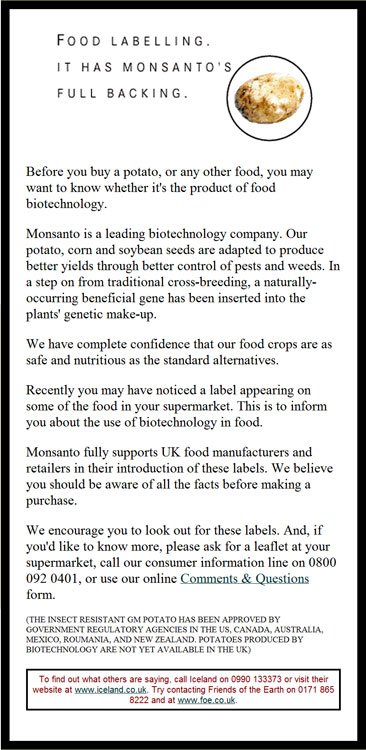
Does any of this make you warm and fuzzy inside? Are these the actions of companies that have your best interest at heart? I would say no. They are trying to HIDE the presence of genetically engineered ingredients, and are pulling out ALL the stops to do so! Ask yourself, why? These companies—the very ones providing much of our food—are actually trying to take awayindividual state’s rights, just to ensure certain food ingredients remain hidden! Curiously enough, Monsanto is more than willing to “support” GMO labeling in other countries.

Here’s a Monsanto ad from the UK, letting British consumers know how much the company supports the mandatory labeling of their goods—even urging Britons to seek such labels out—ostensibly because Monsanto believes “you should be aware of all the facts before making a decision.” What’s the difference between British shoppers and American shoppers? Why does Monsanto support one nation’s right to know but not another? It’s time to put an end to this hypocritical charade and label foods in the US, as has been done in 64 other countries across the globe already!

American state rights were encouraged by our constitution, and the constitution was meant to prevent federal superpowers becoming corrupted and creating an authoritarian, fascist federal government. Sadly, we’ve watched our individual and state rights deteriorate over many decades, succumbing to these enormous industry powers, and this is probably one of the biggest, most blatant overreaches yet, proving that corporate interests are ruling the roost on Capital Hill. As stated by Marni Karlin, director of legislative and legal affairs for Organic Trade Association:11

Consumers, particularly the eight out of ten American families who buy organic products, want to know what is in their food. Rep. Pompeo’s bill ignores this consumer demand for information. Instead, it ties the hands of state governments, the US Department of Agriculture, and the Food and Drug Administration concerning GMO labeling. It is fatally flawed.”

What Happens in Oregon and Colorado in November Could Make or Break the GMO Labeling Movement

In addition to all this legal wrangling, opponents of GMO labeling spent more than $27 million on lobbying in the first six months of this year alone. This is about three times more than they spent during all of 2013, when they shelled out $9.3 million.12 Among the biggest spenders on anti-labeling lobbying were the Grocery Manufacturers Association (GMA) and major food makers such as Coca-Cola Co and PepsiCo Inc., along with chemical industry heavyweights like Monsanto and DuPont.

Undoubtedly, they are well aware that November is going to be a crucial turning-point for the GMO labeling movement. Both Colorado and Oregon have GMO labeling on their November ballots, and it’s absolutely imperative that we make a strong push to make sure these ballots succeed. So please, consider making a generous donation to the Organic Consumers Fund.

I know, it’s an uphill battle, but persistence pays! We cannot and will not give up now. During last year’s I-522 ballot campaign to label GMOs in Washington State, the Grocery Manufacturers Association (GMA) came up with a devious, and illegal, money-laundering scheme to protect the identity of members who donated funds to the opposing campaign. Unfortunately, this illegal move helped the GMA defeat I-522 by a mere one percent margin—ONE PERCENT!

Fortunately, the GMA was caught, and sued by Attorney General Bob Ferguson, who accused them of intentional money laundering and violating state campaign disclosure laws. They had to resort to illegal activity to beat us by one percent the last time… With that in mind, I am firmly convinced that we CAN win in both Colorado and Oregon. But it will take effort. And money, to make sure all the voters are informed enough to make a sound decision. It’s time for truth in labeling. Together, we can make it happen.

I recently named the GMA “the most evil corporation on the planet,” considering the fact that it consists primarily of pesticide producers and junk food manufacturers who are going to great lengths to violate some of your most basic rights—just to ensure that subsidized, genetically engineered and chemical-dependent, highly processed junk food remains the status quo.

The insanity has gone far enough. It’s time to unite and fight back, which is why I encourage you to boycott every single product owned by members of the GMA, including natural and organic brands. To learn more about this boycott, and the traitor brands that are included, please visit TheBoycottList.org. I also encourage you to donate to the Organic Consumers Fund. Your donation will help fight the GMA lawsuit in Vermont, and also help win the GMO labeling ballot initiative in Oregon in November.

Voting with your pocketbook, at every meal, matters. It makes a huge difference. By boycotting GMA Member Traitor Brands, you can help level the playing field, and help take back control of our food supply. And as always, continue educating yourself about genetically engineered foods, and share what you’ve learned with family and friends.

Recommended Supplements (These supplements help detoxify GMOs):

Further Reading: