Monsanto Has Ruined Our Honey – It’s Contaminated With Glyphosates From Roundup

A recent study by researchers from Boston University and Abraxis LLC found significant amounts of glyphosates in a food that you wouldn’t necessarily expect: honey.

Five categories of food items were tested from Philadelphia grocery stores: honey, corn and pancake syrup, soy milk, tofu, and soy sauce. Sixty-two percent of the conventional honeys and 45% of the organic honeys sampled had levels of glyphosates above the minimum established limits.

It’s hard to ignore the presence of glyphosate in a large portion of our food supply. Glyphosate is the main ingredient in Monsanto’s star herbicide, Roundup. It is interesting to note that the level of glyphosates was much higher in honey from countries that permitted GM crops; honey from the U.S. contained the highest levels.

Even the Organic Honey?

So how did so many of the 69 honey samples, including 11 organic samples, tested contain such high levels of glyphosates? There are two reasons for this. Given that a single honeybee can fly over 6 miles to find nectar and bring back a total of 250 pounds of nectar a year, modern life is set up so that it is almost impossible for them to avoid harmful substances. Pesticides, herbicides, and toxins released into the air from factories and cities make it impossible for all but the most remote beehives to maintain 100% purity.

There’s also the issue of the wax that bees use for their hives. Bees are at risk for Varroa mites, an external parasite that reproduces in the hives, so conventional beekeepers frequently use pesticides to get rid of them. Beeswax retains chemicals, so over time, these chemicals build up and make their way into the honey. While the use of pesticides directly on the beehives isn’t an issue for beekeepers using organic methods, the issue is where they source their wax. A survey of pesticide residues in beehives found that over 98% of them contained at least one pesticide. With such a large amount of wax contaminated, it’s likely that organic beekeepers who purchase commercially available wax will be unable to avoid these toxins.

Can I Ever Eat Honey Again?

Is there any way around the amount of herbicides and pesticides in honey? Short answer? Probably not. Countries that don’t allow genetically modified crops have lower levels of herbicides in their honey, but that list of countries is under attack every day that Monsanto and their buddies are in business. With increased use of chemicals in farming, a greater amount of herbicides and pesticides will make it way into beehives, causing a ripple effect throughout bee colonies.

If you’re going to purchase honey, your best bet is to do your research. Talking to local beekeepers at farmer’s markets can give you an idea of the quality of honey available directly in your area. Even though there were glyphosates in the organic honey, there were still more in the conventional honey. You can increase your odds of getting less toxic honey by researching which countries don’t allow GMOs (not a bad solution for other products, either!).

If you find yourself eating honey often, it could be a good idea to do a detox to remove Candida and toxins from your body.

Further Reading:

Sources: 


GMO Labeling Legislation Introduced In Minnesota

In the dead of winter, the Minnesota State Legislature isn’t letting the snow keep them from reintroducing legislation to label GMOs. At the end of January, HF 351 and SF 335 were proposed in both the House and the Senate. While the state has proposed legislation that would disclose the presence of GMO ingredients to consumers by January of 2017, support for GMO labeling in the state has grown at a fantastic rate. After seeing the Oregon initiative to label GMOs defeated by a mere 812 votes, activists across Minnesota are pushing even more to make sure they get the support they need to pass these bills and let GMO companies know that we want to know what is in our food.

No More GMOs!

Natural News has reported before on the initiatives Minnesotans have been taking to protect themselves from Monsanto toxins. Last December, Minnesota educators started a plan to phase GMOs out of school lunches instead using things like organic squash and hot dogs made from grass fed beef. A month earlier, they had GMO awareness day, distributing information on the lack of proper testing for GMOs and their links to allergies, cancer, autoimmune disorders, and other diseases. Educators took the initiative to distribute flyers to parents detailing the negative effects of GMOs on developing children. The Minnesota state legislature has also proposed bills from both the Senate and the House supporting informed purchasing in the past.

Massive Public Support

Even though bills to labels GMOs have been proposed and defeated before, the local support for these two bills is strong in Minnesota. Polls across the nation have found that the majority of Americans want to know about genetically engineered ingredients in their food. Minnesota is no different. Activists from Minnesota’s Right to Know organization have expanded the number of co-authors on both bills and met with over 45 legislators in their quest to get these bills passed. Local news outlets in St. Paul are reporting on the large number of people who showed up to the first Capitol hearing of this bill. Local businesses are also receiving requests from customers asking that they label their products, and that they support bills like this that will allow for informed purchasing.

Big Business Poses a Threat

While the Minnesota’s Farmer’s Union have also voiced support for these bills, there is always the possibility of Monsanto and others throwing a monkey wrench in these plans. Large agricultural corporations like Hormel, Land o’ Lakes, and General Mills are based in Minnesota. Collectively they spent millions of dollars opposing the labeling of GMOs in California. With plenty of time between now and the informational hearing on these bills in April, Monsanto and these other corporations have plenty of time to spread misinformation and lies to Minnesota voters in an attempt to protect their profits.

Show Your Support

If you or any of your loved ones are in Minnesota, let them know that they can make a difference in the campaign to know what’s in our food. Here are some things that you can do to support these bills. Email or call members of the Minnesota congress. Even if you don’t live in Minnesota, they need to know that this bill could be an important first step in labeling GMOs and boosting the health of our nation. Passing these bills will defiantly affect the rest of the United States, and they need to know that they could be part of history.

You can also support the Minnesota Right to Know campaign on Facebook or Twitter. They have up to date notifications on the bills, are organizing opportunities to speak with members of congress, and have volunteer information available for those who want to get involved. They also have a list of local businesses who support labeling genetically engineered products. By supporting these retailers, you vote with your dollars. Let companies in Minnesota know that the more likely they are to let you make informed shopping decisions, the more likely you are to support them.

Recommended Supplements (These supplements help detoxify GMOs):

Further Reading:
Sources:


The DARK Act – Deny Americans the Right to Know – GMO Labeling

An apathy has descended upon the American people, a combination of, “I don’t care,” and, “What difference would it make, anyway?” We have stood back and allowed so many of our rights to be taken away in the last 15 years. We cannot – we must not – lose the right to know what is in the food we eat.

H.R.4432, also known as The DARK Act (Deny Americans the Right to Know) is a bill that will stop efforts to label GMO foods. It will deny individual states the right to pass laws requiring GMO labeling and will make any previously passed state laws null and void. And the ultimate joke is the full title of the bill: H.R. 4432 – Safe and Accurate Food Labeling Act of 2014.

Of course, the bill is written in such a way that its application is unclear. Yes, it would make sense to have a federal regulation regarding the labeling of GMO foods. Yes, it would be a burden on the manufacturers if each state required a different label. But the truth is, this bill’s ultimate purpose has nothing to do with food safety; it has everything to do with the companies who have spent an estimated 100 million to get it passed – those who benefit from keeping the word GMO off their labels.

So which companies are lobbying for this bill? Well, you’re right if you guessed Monsanto is near the top of the list. They are number three. The first is PepsiCo, followed by the Grocery Manufacturers Association.

There are two things we can do. One is to tell our represented leaders that we demand the right to choose what we eat. We want GMOs labeled. Every time.

The second thing we can do is start boycotting the businesses that are spending millions of dollars to take away our right to know what we are eating. The following is a short list of those lobbying for the bill to pass.

  • PepsiCo Inc
  • Grocery Manufacturers Assn
  • Monsanto Co
  • Land O’Lakes
  • Kellogg Co
  • International Dairy Foods Assn
  • Abbott Laboratories
  • Kraft Foods Group
  • American Farm Bureau
  • American Seed Trade Assn
  • Bayer AG
  • Biotechnology Industry Organization
  • Coca-Cola Co
  • Ohio Farm Bureau
  • Nestle SA
  • ConAgra Foods
  • American Sugarbeet Growers Assn
  • General Mills
  • Dean Foods
  • DuPont Co
  • Hillshire Brands Co
  • Intl Assn of Refrigerated Warehouses
  • Corn Refiners Assn
  • Syngenta AG

The following organizations are lobbying for labeling of GMO’s and are against passing H.R. 4432.

  • Center for Food Safety
  • Consumers Union of the U.S.
  • Environmental Working Group
  • EWG Action Fund
  • National Farmers Union
  • Natural Products Assn

To find your representatives in Congress and learn how to contact them click on this link. Please ask them to vote against this bill!

To find your senators and learn how to contact them click on this link. Let them know you want them to support the labeling of GMO foods.

Remember the greatest power we have is how we choose to spend our money. If we refuse to buy products from companies that use GMOs, promote GMOs, or oppose labeling of GMOs, and we buy only organic foods, they will lose.

Note from the Editor:

When this story was first published, lobbyists that opposed the bill were listed with those that supported it. We apologize for this error.


MIT Researcher Reveals the Correlation Between Monsanto’s Roundup and Autism

Dr. Stephanie Seneff, an MIT research scientist, is calling for a ban on Monsanto’s Roundup. During a recent presentation she stated, “At today’s rate, by 2025, one in two children will be autistic.”

She made this statement while presenting her findings of the correlation between the increasing use of Monsanto’s Roundup and the rising rates of autism. While she is unable to prove causation, the correlation on a graph is quite remarkable and does call for further investigation. The number of children with autism has risen from 1 in 5,000 in 1990 to 1 in 68 today.

Glyphosate, the active ingredient in Roundup, builds up in our environment and in our bodies over time. Monsanto claims it is harmless. Senoff says glyphosate kills beneficial bacteria in the gut, which results in shortages of critical neurotransmitters, minerals, and folate. And we know, nine out of ten autistic children suffer from gastrointestinal problems.

In her PowerPoint she wrote, “Adjuvants in pesticides are generally declared as inerts, and for this reason they are not tested in long-term regulatory experiments. It is thus very surprising that they amplify up to 1000 times the toxicity of their APs [Active Principles] in 100% of the cases where they are indicated to be present by the manufacturer.”

Some Of the Markers For Autism and Glyphosate Match

She lists the following markers—the same markers for both autism and glyphosate poisoning:

  • Disrupt gut bacteria; inflammatory bowel
  • Low serum sulfate
  • Methionine deficiency
  • Serotonin and melatonin deficiency
  • Defective aromatase
  • Zinc and iron deficiency
  • Urinary p-cresol
  • Mitochondrial disorder
  • Seizures; Glutamate toxicity in the brain

In addition to autism, she revealed correlations to Alzheimer’s, celiac disease and other intestinal disorders as well as kidney failure of agricultural workers.

Other Correlations To Autism

There is no single cause for autism. It is becoming more and more clear that autism is caused by toxicity, whether than be an accumulation or a single event.

Vaccines can provide that single event. Many parents report that their normal child disappeared right before their eyes after a vaccine, often the MMR. The current vaccine schedule also provides the opportunity for an accumulative reaction.

Our Increasingly Toxic World

The dirt in which we grow our food, the air we breathe, the water we drink, the food we eat, our homes, vaccines and other medications, all combine to create a toxic world.

If we want to protect our children, we must limit toxicity as much as possible in utero, after birth, and as they grow.

Roundup has been banned in other countries.

Recommended Supplements:
Further Reading:
Sources:


U.S.D.A. Approves Modified Potato. Next Up: French Fry Fans

(Cornucopia – New York Times – by Andrew Pollack) A potato genetically engineered to reduce the amounts of a potentially harmful ingredient in French fries and potato chips has been approved for commercial planting, the Department of Agriculture announced on Friday.

The potato’s DNA has been altered so that less of a chemical called acrylamide, which is suspected of causing cancer in people, is produced when the potato is fried.

The new potato also resists bruising, a characteristic long sought by potato growers and processors for financial reasons. Potatoes bruised during harvesting, shipping or storage can lose value or become unusable.

The biotech tubers were developed by the J. R. Simplot Company, a privately held company based in Boise, Idaho, which was the initial supplier of frozen French fries to McDonald’s in the 1960s and is still a major supplier. The company’s founder, Mr. Simplot, who died in 2008, became a billionaire.

The potato is one of a new wave of genetically modified crops that aim to provide benefits to consumers, not just to farmers as the widely grown biotech crops like herbicide-tolerant soybeans and corn do. The nonbruising aspect of the potato is similar to that of genetically engineered nonbrowning apples, developed by Okanagan Specialty Fruits, which are awaiting regulatory approval.

But the approval comes as some consumers are questioning the safety of genetically engineered crops and demanding that the foods made from them be labeled. Ballot initiatives calling for labeling were rejected by voters in Oregon and Colorado this week, after food and seed companies poured millions of dollars into campaigns to defeat the measures.

The question now is whether the potatoes — which come in the Russet Burbank, Ranger Russet and Atlantic varieties — will be adopted by food companies and restaurant chains. At least one group opposed to such crops has already pressed McDonald’s to reject them.

Genetically modified potatoes failed once before. In the late 1990s, Monsanto began selling potatoes genetically engineered to resist the Colorado potato beetle. But the market collapsed after big potato users, fearing consumer resistance, told farmers not to grow them. Simplot itself, after hearing from its fast-food chain customers, instructed its farmers to stop growing the Monsanto potatoes.

This time around could be different, however, because the potato promises at least potential health benefits to consumers. And unlike Monsanto, Simplot is a long-established power in the potato business and presumably has been clearing the way for acceptance of the product from its customers.

Simplot hopes the way the potato was engineered will also help assuage consumer fears. The company calls its product the Innate potato because it does not contain genes from other species like bacteria, as do many biotech crops.

Rather, it contains fragments of potato DNA that act to silence four of the potatoes’ own genes involved in the production of certain enzymes. Future crops — the company has already applied for approval of a potato resistant to late blight, the cause of the Irish potato famine — will also have genes from wild potatoes.

“We are trying to use genes from the potato plant back in the potato plant,” said Haven Baker, who is in charge of the potato development at Simplot. “We believe there’s some more comfort in that.”

That is not likely to persuade groups opposed to such crops, who say altering levels of plant enzymes might have unexpected effects.

Doug Gurian-Sherman, a plant pathologist and senior scientist at the Center for Food Safety, an advocacy group, said that the technique used to silence the genes, called RNA interference, was still not well understood.

“We think this is a really premature approval of a technology that is not being adequately regulated,” he said, adding that his group might try to get a court to reverse the approval of the potato.

He said one of the substances being suppressed in the Innate potatoes appeared to be important for proper use of nitrogen by the plant and also for protection from pests.

The Agriculture Department, in its assessment, said the levels of various nutrients in the potatoes were in the normal range, except for the substances targeted by the genetic engineering. Simplot has submitted the potato for a voluntary food safety review by the Food and Drug Administration.

The company says that when the Innate potatoes are fried, the levels of acrylamide are 50 to 75 percent lower than for comparable nonengineered potatoes. It is unclear how much of a benefit that is.

The chemical causes cancer in rodents and is a suspected human carcinogen, though the National Cancer Institute says that scientists do not know with certainty if the levels of the chemical typically found in food are harmful to human health.

Still, Gregory Jaffe, biotechnology project director at the Center for Science in the Public Interest, a consumer group that deals with nutrition issues, welcomed the approval. “We support clearly trying to reduce consumers’ exposure to acrylamide and if this product helps do that, I think it’s a benefit,” he said.

Last year, the F.D.A. issued draft guidance advising the food industry how to reduce levels of acrylamide, which is also found in some baked goods, coffee and other foods. The agency listed numerous steps that could be taken in the growing, handling and cooking of potatoes. Many food companies no doubt have already taken steps to reduce acrylamide levels and might not need the genetically engineered potatoes.

Whether McDonald’s, which did not respond to requests for comment, adopts the potatoes is somewhat academic for at least another couple of years. Simplot anticipates that only a few thousand out of the nation’s more than one million acres of potatoes will be planted with Innate potatoes next year, far too little to serve fast-food chains.

Instead, the company will focus on sales of fresh potatoes and fresh-cut potatoes to supermarkets and food service companies and to potato chip manufacturers, said Doug Cole, a spokesman for Simplot.

The National Potato Council, which represents potato farmers, welcomed the approval, albeit with reservations.

John Keeling, chief executive of the trade group, said growers wanted new technology. But in comments to the Agriculture Department, the group has expressed concern that exports could be disrupted if genetically engineered varieties inadvertently end up in shipments bound for countries that have not approved the potatoes.

China, for instance, recently turned away shipments of corn containing small amounts of a genetically engineered variety developed by Syngenta that it had not approved for import. Some corn farmers and exporters have sued Syngenta for their losses.

Mr. Cole of Simplot said growers would have to keep the genetically engineered potatoes separate from others and out of exports at least for now. The company plans to apply for approval of the potatoes in the major markets, starting with Canada, Mexico, Japan and then other parts of Asia.


Canola Oil: The #1 Hidden Health ‘Danger’ at the Prepared Food Bar

(NaturalNews – S. D. Wells) Step right up to your favorite food bar, whether at Whole Foods, Harris Teeter or Farm Fresh, and “get you some” potato salad, coleslaw, egg salad, pasta salad, chicken salad, tuna salad, baked goods, or just make your own salad with lots of salad “dressing” and you are most likely getting a few heaping tablespoons of rapeseed oil with each serving, better known these days as canola oil. Now, whether or not there really is any such thing as organic canola oil, well, the jury is still out on that one. Regardless, canola oil is not good for you, and it ALL goes through a “deodorizing” processing stage that removes the “stink” of rapeseed, in case you didn’t know.

Canola oil can have detrimental effects on your health, especially the genetically modified (GM) canola that Monsanto so conveniently manufacturers for the masses to consume. It’s all mixed into those fancy, condiment-loaded, creamy salads at the friendly grocer, and it’s FRESH! Step right up to the fresh bar! Add in some tasty conventional spices and keep it hot or cold in those little bins for those “whole” food enthusiasts. Lots of people pack a few of the canola “mixtures” into plastic (BPA) containers and take them home. What exactly are you taking home, though?

There is no such thing as a canola plant

Wait, did you think there was a canola plant, like corn, soy or sunflower? Did you think making canola is just about pressing seeds? How DOES rapeseed oil magically turn into canola oil? It’s “deodorized” with a chemical component. Do you want to put a “hex” on your health? Insert “hexane” and wait for problems to rear their ugly head. Hexane, a vapor component of gasoline, is used to process oils and has been since World War II. And yes, hexane is flammable. Hexane is a chemical made from crude oil, the mainstream solvent extraction method of the entire Western world. So how is this organic? Good question.

The omega-3 fatty acids of processed canola oil are transformed during the deodorizing process into trans fatty acids. The reason why canola is particularly unsuitable for consumption is that it contains a very-long-chain fatty acid called erucic acid, which under some circumstances is associated with fibrotic heart lesions.

Here’s an interesting fact: In 1985, the Federal Register (official journal of the federal government of the United States) stated that the FDA outlawed canola oil in infant formulas because it retarded growth. So, 25 years ago it was not good for babies, but now it’s suddenly okay for everyone else? (http://www.functionalmedicineuniversity.com)

There’s a “not-so-heart-healthy” nation just below Canada

Just when you think that you’re eating healthy, you get fooled again. It’s the “cash crop” canola con! They’ve exploited that “gray area” so well for years. If you’re not sure, it probably “ain’t pure.” Oh, but its Canada’s top export to the USA by the millions of pounds of seed, oil, and meal per year.

But wait, some fast food chains were bragging recently because they are getting rid of their trans fat oils and switching to canola oil, like it’s some big move toward a “heart-healthy” nation, instead of using that pesticide-ridden soybean oil. So they must have been using that “close by choice” sales trick, where the consumer chooses from a lesser of evils but still falls for the gag. Sounds like two-party politics. So what’s your mayonnaise made with? What is the most prominent ingredient of your salad dressing, meaning what are the first few ingredients listed, because you know food manufacturers must list ingredients from the most first to the least last, right?

Oh, but the backlash will come, because people love their canola! Either that or they have no idea how much they are eating each day. They’re not doing the math. Add up those items from the canola food bar, condiments at home and some baked goods and what have you got? A “little bit” of rapeseed oil is moving through your digestive tract and your cleaning organs, and your body is not happy about it. Do you think Whole Foods uses organic canola for the food bar, or should you ask? Should it say? Everything that is prepackaged says so on the label. Too bad you can’t “Fooducate” the food bar items using the phone app (http://fooducate.com). Would it even matter if it was organic? I mean, can you have organic fibrotic heart lesions?

A biochemist would tell you that canola oil has higher levels of trans fatty acids than soybean oil and other toxic GMO “hybrid” oils that the masses use on a regular basis. This would include the hydrogenated vegetable oils cottonseed, safflower and corn.

Avoid the “All-You-Care-to-Eat” Canola Food Bar!

Take a quick look at the short-term and long-term damage you could be doing to your body by consuming canola regularly:

• Canola depletes vitamin E.
• Canola increases the rigidity of membranes, which can trigger degenerative diseases.
• Because of canola’s high sulfur content, it goes rancid easily, which can exacerbate allergies and compound problems for people with bronchial or asthmatic issues.
• Human studies reveal canola causes an increase in lung cancers.
• Canola can shorten lifespan of animals and lower platelet count.
• Daily canola consumption can raise your triglycerides over 40 percent.
• Canola oil molds quickly and also inhibits enzyme function.
• It opens the door for free radicals, undermining natural antioxidants, and can be linked to increased incidence of many diseases.
• Canola leaves no foul taste when it’s spoiled, so it’s hard to tell if you’re eating rancid erucic acid.

The Harvard School of Public Health stated decades ago that there is no safe level of trans fats, yet still, if there are less than 500 mg per half-cup serving, the FDA allows food manufacturers to use the label saying “no trans fats.” So who measures that half-cup at the food bar? Maybe you’re getting A HALF-CUP of CANOLA for lunch and dinner. Do you know the chemistry of your own cell membranes? Maybe you should. (http://www.bostonglobe.com)

Did you know that canola was man-made by a scientist at a university lab in Canada? The genes of the rapeseed plant were actually bred to produce less toxic erucic acid. Great, design a poisonous crop to meet FDA guidelines, then ship it to the USA! After creating this infamous genetically modified “invention,” this same scientist, Dr. Baldur Steffanson, went to work for Calgene, which was later bought by the biotech giant Monsanto! Who do you think also developed the “Roundup-Resistant” variety of GMO Canola? You guessed it – Dr. Steffanson, the “Father of Canola.” Thanks doc – for your contribution of weed killer and rapeseed oil hidden in our food! (http://timemachine.siamandas.com)

Still want to fill up those handy “to-go” containers at the “whole” foods bar? Still think all those creamy salads are the “bomb”? Think again. Don’t be fooled by canola just because the “debate” isn’t settled. Thanks to the “cloud” around the debate, it infiltrates the “whole food” market. Try grape seed oil or coconut oil for your own salads that YOU put together and can trust. Both of those oils can also tolerate high heat. Organic extra-virgin olive oil is good for you, but only if you don’t cook it at high heat. Stay healthy my friends.

Sources for this article include:
http://www.greencradle.net
http://www.youtube.com
http://www.organicconsumers.org
http://timemachine.siamandas.com
http://www.naturalnews.com
http://www.laleva.cc
http://preventdisease.com
http://www.functionalmedicineuniversity.com
http://www.bostonglobe.com


Two States Ready to Fight for GMO Labeling in November While Industry Pushes Bill to Remove State Rights

(Dr. Mercola) The pesticide and junk food industries continue to cause harm, even deaths, while destroying our rights and indemnifying themselves from liability.

That’s the take-home message from the September 8 article in The Progressive,1 which recounts the travails of residents in Cedar Valley, Oregon. It’s also the take-home message of other related news. And yet there’s hope…

A group of residents of the Cedar Valley area near Gold Beach in Curry County, Oregon say their properties were doused with pesticides by a helicopter aiming for privately-owned timberlands last October,” the featured article states.

In what has been called a ‘severe sanction,’ the pesticide applicator and the aerial spray company he owns have been fined $10,000 each by the state and had their pesticide licenses suspended for a year for providing false information that misled investigators.

But at least one of those affected says this basically amounts to a big traffic ticket, when instead he believes the incident should be considered an act of ‘criminal trespass’ linked to 45 illness reports.”

‘Right to Farm’ Laws Protect Big Ag from Legal Action

At present, the “Farm and Forest Practices Act” prevents the residents from suing for damages. But 17 of those affected by the pesticide dousing are now challenging the constitutionality of that law.

While originally intended to protect small farmers from frivolous nuisance lawsuits by suburban neighbors, today, many of these laws do little more than shield large corporations from being held accountable for large-scale environmental and human harm.

Small farms have been replaced with gigantic warehouse-style factory farms that produce toxic waste on a scale that is simply incomparable to a regular family-run farm.

Yet you still cannot sue them for damages as long as they’re following “generally accepted” farming or foresting practices—including aerial pesticide applications, even though in this case people were doused in their own backyards!

Moreover, Oregon’s Right to Farm law contains a provision stating that if you sue and lose the case, then you are responsible for paying the defendant’s legal fees. This is another effective dissuasion strategy that coddles big industry while leaving regular folk to suffer without effective recourse.

Residents Exposed to Toxic Agent Orange Ingredient

Two residents reporting health problems in this case include John Burns, who is the assistant chief of the local volunteer fire department, and his neighbor, James Welsh.

According to Burns, a total of 45 people have suffered health effects from the exposure. While Burns began feeling progressively worse as the day wore on, Welsh was immediately struck will nausea and breathing problems when the chemicals rained down on him.

Welsh, who had a preexisting heart condition, rapidly deteriorated after the exposure, and died in April. That exposure, it turned out, was a mix of 2,4-D—which was a major ingredient in Agent Orange—and triclopyr, plus an adjuvant.

One of the ingredients was applied “at a rate above the maximum allowed by the label instructions,” according to the Oregon Department of Agriculture.2 As reported in the featured article:

The pesticide spray over Cedar Valley is certainly not the first residential exposure due to aerial pesticide application. Residents of the Triangle Lake area in Lane County say they have been exposed to aerial pesticide drift multiple times in recent years, especially in 2011, as CMD has reported.

Urine tests performed by scientists at Emory University in spring 2011 confirmed 2,4-D in 100 percent of their urine samples and the weedkiller atrazine in most.”

Cedar Valley Residents Challenge ‘Right-to-Farm’ Law

The law firm Craig Law Center has taken on Cedar Valley’s case, challenging the “Right to Farm” law. According to the featured article:

Crag attorney Chris Winter said he was interested in the case because he became ‘concerned that people weren’t able to defend their property rights against toxic chemicals.’

The lawsuit challenges ‘right-to-farm’ under the under the clause of the state constitution that guarantees that every individual will have a legal remedy for the violation of any fundamental legal right…

Winter said, ‘Because toxic chemicals and aerial application are so risky, courts have said there’s a higher standard of care, more than just being reasonably prudent, but being careful that nothing gets on neighbors’ property.’

But because of the ‘right-to-farm’ law, citizens still can’t sue. That means courts have ‘tipped in favor of chemical companies and applicators.’

Winter says that the plaintiffs hope to change the ‘Right to Farm and Forest Law,’ but that additional changes are needed to address structural problems in the state’s regulatory system, like ‘basic standards and guidelines for how pesticides are applied.’”

Judge Declares Idaho’s ‘Ag-Gag’ Law Potentially Unconstitutional

In related, but slightly more optimistic news, a federal judge has ruled that Idaho’s Bill 13373–dubbed the “ag-gag law,” as it criminalizes the secret filming of agricultural practices—may in fact be unconstitutional.

The bill was hastily signed into law in February, after footage of animal abuse occurring in a confined animal feeding operation (CAFO) was aired on TV. The law was quickly challenged by the Animal Legal Defense Fund (ALDF), alleging that politicians ignored the First Amendment simply to protect corporate interests. As reported by the Courthouse News Service:4

Gov. C.L. ‘Butch’ Otter and Attorney General Lawrence Wasden moved to dismiss the complaint in April… but US District Judge B. Lynn Winmill… said the opponents may have a case: First Amendment and equal protection clause.

While the protection of private property is a valid concern, it does not necessarily justify the restriction of free speech, the court found.

‘The First Amendment requires more than the invocation of a significant government interest; it requires that the restriction’s benefits be balanced against the burden on protected speech,’ Winmill wrote. ‘The state therefore must justify a need to serve its interests in protecting private property through targeting protected speech.’”

This is good news, as this law is all about protecting the status quo of industrial farming; turning it into a crime to expose the horrors, cruelties, and dangers associated with big agricultural business… Time will tell if the “ag-gag rule” will be repealed, but at least the issue will be addressed in a court of law.

Help Vermont Defend America’s First No-Strings GMO Labeling Law!

Speaking of courts of law… The Grocery Manufacturers Association of America (GMA), which consists primarily of pesticide producers and junk food manufacturers, is suing Vermont in an effort to overturn H.112—the first no-strings-attached GMO labeling in the US.5, 6, 7 H. 112 was passed by an overwhelming margin,8 and Governor Peter Shumlin signed the historic bill into law on May 8 this year.

The law will require food manufacturers to label genetically engineered (GE) foods sold in Vermont, and prohibits them from labeling foods with GE ingredients as “natural” or “all natural.” The GMA’s lawsuit claims that their members are going to end hunger with their pesticide-laden GMOs, but we already know that the problem with hunger is not production, it’s distribution. There’s more than enough food to go around; it’s just poorly distributed.

Besides, must Americans be kept in the dark about what we’re eating in order for the chemical technology industry to be able to “save the world” with its genetically engineered grains? To help Vermont defend its GMO labeling law against these multi-national giants, please consider making a donation to the Organic Consumers Fund, which has been set up to raise funds for this purpose. The fund has also pledged to help Oregon and Colorado pass their respective GMO labeling initiatives this November.
Beware the ‘DARK’ Act…

The GMA, whose 300-plus members include Monsanto, Coca-Cola, and General Mills, is also pushing a Congressional bill called the “Safe and Accurate Food Labeling Act of 2014.9 The bill, dubbed the “DARK” (Denying Americans the Right to Know) Act, would actually preempt all states from passing GMO labeling laws.10 It would also bar states from enacting laws that make it illegal for food companies to misrepresent their products by labeling GE ingredients as “natural.” Last but not least, the DARK Act would also limit the FDA’s power to force food companies to disclose GE ingredients.

Does any of this make you warm and fuzzy inside? Are these the actions of companies that have your best interest at heart? I would say no. They are trying to HIDE the presence of genetically engineered ingredients, and are pulling out ALL the stops to do so! Ask yourself, why? These companies—the very ones providing much of our food—are actually trying to take awayindividual state’s rights, just to ensure certain food ingredients remain hidden! Curiously enough, Monsanto is more than willing to “support” GMO labeling in other countries.

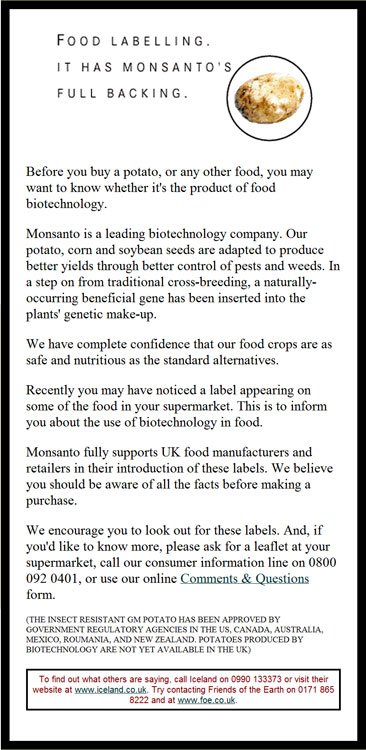
Here’s a Monsanto ad from the UK, letting British consumers know how much the company supports the mandatory labeling of their goods—even urging Britons to seek such labels out—ostensibly because Monsanto believes “you should be aware of all the facts before making a decision.” What’s the difference between British shoppers and American shoppers? Why does Monsanto support one nation’s right to know but not another? It’s time to put an end to this hypocritical charade and label foods in the US, as has been done in 64 other countries across the globe already!
American state rights were encouraged by our constitution, and the constitution was meant to prevent federal superpowers becoming corrupted and creating an authoritarian, fascist federal government. Sadly, we’ve watched our individual and state rights deteriorate over many decades, succumbing to these enormous industry powers, and this is probably one of the biggest, most blatant overreaches yet, proving that corporate interests are ruling the roost on Capital Hill. As stated by Marni Karlin, director of legislative and legal affairs for Organic Trade Association:11

Consumers, particularly the eight out of ten American families who buy organic products, want to know what is in their food. Rep. Pompeo’s bill ignores this consumer demand for information. Instead, it ties the hands of state governments, the US Department of Agriculture, and the Food and Drug Administration concerning GMO labeling. It is fatally flawed.”

What Happens in Oregon and Colorado in November Could Make or Break the GMO Labeling Movement

In addition to all this legal wrangling, opponents of GMO labeling spent more than $27 million on lobbying in the first six months of this year alone. This is about three times more than they spent during all of 2013, when they shelled out $9.3 million.12 Among the biggest spenders on anti-labeling lobbying were the Grocery Manufacturers Association (GMA) and major food makers such as Coca-Cola Co and PepsiCo Inc., along with chemical industry heavyweights like Monsanto and DuPont.

Undoubtedly, they are well aware that November is going to be a crucial turning-point for the GMO labeling movement. Both Colorado and Oregon have GMO labeling on their November ballots, and it’s absolutely imperative that we make a strong push to make sure these ballots succeed. So please, consider making a generous donation to the Organic Consumers Fund.

I know, it’s an uphill battle, but persistence pays! We cannot and will not give up now. During last year’s I-522 ballot campaign to label GMOs in Washington State, the Grocery Manufacturers Association (GMA) came up with a devious, and illegal, money-laundering scheme to protect the identity of members who donated funds to the opposing campaign. Unfortunately, this illegal move helped the GMA defeat I-522 by a mere one percent margin—ONE PERCENT!

Fortunately, the GMA was caught, and sued by Attorney General Bob Ferguson, who accused them of intentional money laundering and violating state campaign disclosure laws. They had to resort to illegal activity to beat us by one percent the last time… With that in mind, I am firmly convinced that we CAN win in both Colorado and Oregon. But it will take effort. And money, to make sure all the voters are informed enough to make a sound decision. It’s time for truth in labeling. Together, we can make it happen.

I recently named the GMA “the most evil corporation on the planet,” considering the fact that it consists primarily of pesticide producers and junk food manufacturers who are going to great lengths to violate some of your most basic rights—just to ensure that subsidized, genetically engineered and chemical-dependent, highly processed junk food remains the status quo.

The insanity has gone far enough. It’s time to unite and fight back, which is why I encourage you to boycott every single product owned by members of the GMA, including natural and organic brands. To learn more about this boycott, and the traitor brands that are included, please visit TheBoycottList.org. I also encourage you to donate to the Organic Consumers Fund. Your donation will help fight the GMA lawsuit in Vermont, and also help win the GMO labeling ballot initiative in Oregon in November.

Voting with your pocketbook, at every meal, matters. It makes a huge difference. By boycotting GMA Member Traitor Brands, you can help level the playing field, and help take back control of our food supply. And as always, continue educating yourself about genetically engineered foods, and share what you’ve learned with family and friends.

Recommended Supplements (These supplements help detoxify GMOs):

Further Reading: