Yes, Organic Foods are Different from “Natural” Foods

(NaturalPapa – Derek Markham) For those of us who believe strongly in the benefits of eating organic foods (for both our own bodies and for the health of the soil and air and water), the Certified Organic label is a key indicator of foods make the cut for our grocery shopping.

But there’s a lot of confusion out there, because marketers and designers have been labeling food and personal care products with all sorts of meaningless language, including “natural”, “all-natural”, and “contains natural ingredients”, which don’t require meeting any standards to use.

And if a product fits the general description as a “natural” food item, it will probably end up on the shelves of a natural foods store, where many shoppers may be led to believe that either it’s an organically grown food product, or that it doesn’t contain GMO ingredients, or that it’s good for them, none of which may be the case.

After working for years in the natural and organic food industry, as well as being the main grocery buyer for my family during that time, I got to be a pretty keen label reader and a labeling skeptic, and have always tried to debunk label claims for friends and family (much to the dismay of those who found out their “natural” foods choices weren’t really any healthier than those found in mainstream grocery stores).

At a very basic level, in order to be labeled as such, organic foods are subject to stringent environment and animal welfare standards enforced by USDA, while the label of “natural” has no official definition, and little to no enforcement of its misuse.

A new public education campaign aims to clear up some of that confusion around organic foods and natural foods claims, and help consumers make an educated choice when it comes to the food they buy and eat. This isn’t just a little issue, either, as more than $20 billion of products with claims of being “natural” are sold every year, including many with GMOs, pesticide residues, synthetic food additives, and high fructose corn syrup.

http://www.youtube.com/embed/AftZshnP8fs
“Foods made with the use of toxic persistent pesticides and even genetically engineered ingredients are being labeled as natural. Only organic guarantees that food is produced without the use of toxic persistent pesticides, hormones, antibiotics or genetically engineered ingredients. Only organic gives you complete piece of mind.” – Gary Hirshberg, Chairman of Stonyfield Farm.

Find out more about the difference between organic foods and those that claim to be “natural” foods, at Only Organic.


Sports and Energy Drinks are ‘Essentially Sodas Without Carbonation,’ State Researchers Exploring Health Risks of Sugary Beverages

(NaturalNews – L.J. Devon) Professional athletes who rely on popular sports drinks like Gatorade and Powerade are really doing themselves a disservice, impairing their performance potential. Once in the body, these dye-filled “Kool-Aid-like” drinks actually acidify the cellular environment, restricting oxygenation of cells while limiting ATP energy production from the mitochondria. Still, drinks like these are promoted by athletes and marketed as replenishing sports beverages that enhance athletic performance.

According to a new report by UC Berkeley, these sports drinks aren’t much different from soda. After exploring their sugar content and related health risks, the researchers described the beverages as “essentially sodas without the carbonation.” In the study, 21 popular drinks with health claims were investigated, as researchers compared flowery marketing with the drinks’ actual compositions.

“We often see labels on energy and sports drinks that tout health benefits, but the sugar levels in these products rival that of sodas,” said lead author Patricia Crawford, director of the Atkins Center for Weight and Health. “They are essentially sodas without the carbonation, but they give the misleading impression that they are healthy,” she said.

Synthetic vitamins, fake energy, and loads of dyes and refined sugar

The beverage industry tries to convince the public that drinks like these are healthy, but they are often loaded with sugar; in one drink, there were 18 teaspoons of sugar in the container. Other drinks are fortified with vitamins, but these often go unused by the body, because they are often synthetic derivatives that aren’t readily broken down, absorbed and utilized by the body. Vitamin and herb content of some of these energy drinks fools some people into thinking that they are getting a fair share of nutrition for the day, when in reality, they are being inundated with nothing but loads of refined sugar that acidify the cells.

The researchers concluded that common sports drinks on the market are also contributing to diabetes and obesity in youth, because they contain so much added sugar. Energy drinks provide short-term energy with heightened caffeine levels, but that energy is quickly lost, addicting youth to want more of the beverages which give nothing but headaches and heart arrhythmia.

A true energy drink is simply fresh fruit and vegetable juice, which neutralizes excess hydrogen in the cells as it enters the body. The OH molecules from the juice combine with excess hydrogen in the acidic environment to form water (H2O); thus flushing the cells, reducing edema and allowing mitochondria to produce more longer-lasting ATP energy.

Study debunks marketing claims of sports and energy drinks, highlights their negative effects

A marketing analysis conducted at Yale University’s Rudd Center picked apart the beverages’ marketing claims and refuted them here in a simple, straightforward chart.

For example, the researchers showed that Gatorade G Series Recover is marketed as “providing hydration and muscle-recovery benefits with its specially designed protein replenishment formula,” but the researchers refuted, saying, “Water is the optimal beverage of choice for hydration. The average diet is already high in protein and adequately supports physically active adolescents’ muscle rebuilding and growth.”

Energy drinks like the popular “RockStar” claim that the beverages are “Double Strength, Double Size. Bigger. Better. Faster. Stronger,” but according to the researchers, the level of caffeine and guarana in these beverages “stimulate the cardiovascular and nervous system, and can have detrimental effects (such as tachycardia).” On top of that, the researchers correlated energy drinks with increased stress, nervousness, anxiety, headaches, insomnia and reduced academic performance. They were even found to cause hallucinations, tremors and seizures.

In fact, the researchers found that all the drinks have one thing in common: explicit sugar content. Anything from popular fruit drinks to flavored water and from sports drinks to flavored teas all contained deleterious amounts of sugar and were determined to be fueling the increase of obesity and diabetes in today’s culture.

Sources for this article include:
http://newscenter.berkeley.edu
http://www.publichealthadvocacy.org
http://www.publichealthadvocacy.org [PDF]
http://www.naturalnews.com
http://www.publichealthadvocacy.org [PDF]
http://science.naturalnews.com


Top 10 Destructive Nutrition Lies Ever Told

(Dr. Mercola) There is no shortage of health advice out there, and no shortage of bad advice to go along with it. Some misguided notions are harmless—but others are outright dangerous and can lead you down the road to chronic health problems and may even trim years off your life.

It is critically important to decipher fact from fiction. Many nutrition myths get repeated over and over until they are mistaken for truth, especially when perpetually spread by public health authorities.

But the good news is that slowly, the real truth finally appears to be reaching mainstream audiences, as evidenced by the eagerness of satirists to take a jab at the food industry, as in the clever Coca-Cola parody featured above.

In an article addressing destructive nutrition lies, Kris Gunnars of Authority Nutrition1 is among those admirably trying to bust the dangerous dietary myths that continue being spread by so many nutritionists. I agree with the majority of his points, but have added a few others that I believe to be important. Read on for my own top 10 list, which builds upon his.

Lie #1: Breakfast Is the Healthiest Meal of the Day, and You Should Eat Many Small Meals a Day

There is now a good deal of research supporting the health benefits of intermittent fasting—which is what you are really doing whenever you zip out of the house in the morning without breakfast.

Recent studies suggest that intermittent fasting can provide the same health benefits as constant calorie restriction which many studies have shown to dramatically increase life span in animals. It may also be helpful for those who cannot successfully reduce their everyday calorie intake.

Besides turning you into an efficient fat burner, intermittent fasting can also boost your level of human growth hormone production (aka the “fitness hormone”) by as much as 1,200 percent for women and 2,000 percent for men.

Intermittent fasting and continuous calorie restriction have both been shown to produce weight loss and improve metabolic risk markers. However, intermittent fasting tends to be slightly more effective for reducing insulin resistance.

Other benefits include reducing inflammation, improving blood pressure, and increased lean body mass. Intermittent fasting can also improve your brain function by increasing levels of BDNF, a protein that protects your brain cells from the changes associated with Alzheimer’s and Parkinson’s disease.

There are several types of intermittent fasting to choose from, so I recommend experimenting to see what style works best for you. One of the easiest, however, is to simply skip breakfast, and limit your eating to a narrow window of time each day—say between 11am and 7pm, to start. You can review my more comprehensive article on intermittent fasting for more details.

The advice to “eat six small meals per day” comes from seemingly logical principles (portion control, keeping your energy up, stabilizing blood sugar, etc.), but in reality, eating this way has not been shown to provide these benefits. We seem to need periods of fasting for optimal metabolic function.

And if you think about it, our ancient ancestors never had access to a grocery store 24/7 and they went through regular periods of feast and famine. The problem is that most of us are in 24/7 feast mode. Implementing intermittent fasting is the quickest way I know of to jump start your body into burning fat as its primary fuel again.

Lie #2: Saturated Fat Causes Heart Disease

The dangerous recommendation to avoid saturated fat, which arose from anunproven hypothesis from the mid-1950s, has been harming people’s health for about 40 years now. As recently as 2002, the “expert” Food & Nutrition Board issued the following misguided statement, which epitomizes this myth:

“Saturated fats and dietary cholesterol have no known beneficial role in preventing chronic disease and are not required at any level in the diet.”

Similarly, the National Academies’ Institute of Medicine recommends that adults get 45-65 percent of their calories from carbohydrates, 20-35 percent from fat, and 10-35 percent from protein. This is the polar opposite of an ideal fat to carb ratio and virtually guarantees you a heightened risk of disease.

Most people benefit from a diet where 50-85 percent of daily calories are derived from healthful fats. However, you need very few, if any, carbohydrates for optimal health. Although that amount of fat may seem like a lot, fat is very calorie-dense, and will therefore still constitute the smallest amount, in terms of volume, on your plate.

The truth is, saturated fats from animal and vegetable sources provide the building blocks for your cell membranes and a variety of hormones and hormone-like substances, without which your body cannot function optimally.

Fats also serve as carriers for the fat-soluble vitamins A, D, E, and K and are required for converting carotene into vitamin A, absorbing minerals, and a host of other important biological processes. Saturated fat is also the preferred fuel for your heart! Good sources of healthy fats to add to your diet include:

Avocados Butter made from raw grass-fed organic milk Raw dairy Organic pastured egg yolks
Coconuts and coconut oil Unheated organic nut oils Raw nuts, especially macadamia, and raw seeds Grass-fed and finished meats

Lie #3: High Omega-6 Seed and Vegetable Oils Are Good for You

Of all the health-destroying foods on the market, those made with highly processed vegetable and seed oils are some of the worst. When consumed in large amounts, as they are by most Americans, they seriously distort your important omega-3 to omega-6 ratio. In a perfect world, this ratio is 1:1—but the average American is getting 20 to 50 times more omega-6 fats than omega-3 fats. Excessive omega-6 fats from processed foods significantly increase your risk for heart disease, cancer, Alzheimer’s, diabetes, rheumatoid arthritis, and many other illnesses.

The cholesterol found in arterial plaque is oxidized, damaged cholesterol, which your immune system identifies as bacteria. In response, your immune system sends out macrophages to attack it, which creates inflammation inside your artery walls. A major factor driving heart disease is this oxidized cholesterol, which you introduce into your body every time you consume vegetable oils, or foods cooked in them.

Many vegetable and seed oils are also genetically engineered, which only compounds their health risk. More than 90 percent of US canola oil is GE. So what’s the best oil to cook with? Of all the available oils, coconut oil is the one of choice for cooking because it’s close to a completely saturated fat—meaning, much less susceptible to heat damage. And coconut oil is one of the most nutritionally beneficial fats. For more information about coconut oil, please see our special report. Olive oil, while certainly a healthful oil, is easily damaged by heat and is best reserved for drizzling cold over salad.

Lie #4: Artificial Sweeteners Are Safe Sugar Replacements for Diabetics, and Help Promote Weight Loss

Most people use artificial sweeteners to lose weight and/or because they are diabetic and need to avoid sugar. The irony is that nearly all of the studies to date show that artificial sweeteners cause even MORE weight gainthan caloric sweeteners. Studies also show that artificial sweeteners can be worse than sugar for diabetics.

In 2005, data gathered from the 25-year long San Antonio Heart Study showed that drinking dietsoft drinks increased the likelihood of serious weight gain much more so than regular soda.2 On average, each diet soda the participants consumed per day increased their risk of becoming overweight by 65 percent within the next seven to eight years and made them 41 percent more likely to become obese. There are several possible reasons for this, such as:

  • Sweet taste alone appears to increase hunger, regardless of caloric content
  • Artificial sweeteners appear to perpetuate a craving for sweets, and overall sugar consumption is therefore not reduced, leading to further problems with weight control3
  • Artificial sweeteners may disrupt your body’s natural ability to “count calories,” as evidenced by multiple studies. For example, a Purdue University study found that rats fed artificially sweetened liquids ate more high-calorie food than rats fed high-caloric sweetened liquids4

The list of health risks associated with artificial sweeteners, particularly aspartame, continues to expand. I maintain an ongoing list of studies related to the detrimental effects of aspartame, which I recommend you review for yourself if you are still on the fence. I invite you to watch my aspartame video, as well.

Lie #5: Soy Is a Health Food

The meteoric rise of soy as a “health food” is a perfect example of how a brilliant marketing strategy can fool millions. But make no mistake—unfermented soy products are NOT healthful additions to your diet, regardless of your age or gender. I am not opposed to all soy—properly fermented and preferably organic soy, such as tempeh, miso, and natto, offer great health benefits, courtesy of the beneficial bacteria (probiotics) the fermentation process produces.

Thousands of studies have linked unfermented soy to a number of health problems, however. More than 90 percent of American soy crops are also genetically engineered, which only compounds its health risks.5 If you find this information startling, then I would encourage you to review some of the articles on my Soy Page. The following table lists a number of the damaging health effects science has linked to unfermented soy:

Breast cancer Brain damage and cognitive impairment Heart disease
Thyroid disorders Kidney stones Immune dysfunction
Severe, potentially fatal food allergies Malnutrition Digestive problems
Problems with pregnancy and breastfeeding Reproductive disorders and impaired fertility Developmental abnormalities in infants

Lie #6: Whole Grains Are Good for Everyone

The use of whole grains is an easy subject to get confused about, especially for those with a passion for health and nutrition. For the longest time, we’ve been told that whole grains are highly beneficial. Unfortunately, ALL grains can elevate your insulin and leptin levels, even whole grains and organic varieties—and elevated insulin/leptin increases your risk of chronic disease. This is especially true if you already struggle with insulin/leptin resistance, which would manifest as high blood pressure, distorted cholesterol ratios, being overweight, or diabetes).

It has been my experience that more than 85 percent of Americans have trouble controlling their insulin and leptin levels and have one or more of the symptoms listed above. You may be one of those if you struggle to maintain an ideal body weight and body composition, tend to accumulate fat around you belly, or have a suboptimal lipid profile. In fact, insulin/leptin dysregulation is a common indicator for many of the diseases so prevalent today, such as diabetes, heart disease, dementia, and cancer.

Many whole grains also contain gluten, which is a common trigger for allergies and sensitivities. Subclinical gluten intolerance is far more common than you might think, with symptoms that are not always obvious. I strongly recommend eliminating or at least restricting grains from your diet, as well as sugars/fructose, especially if you have any of the conditions listed above. As a general rule, the higher your insulin levels are, the greater your grain restriction should be.

Lie #7: Genetically Engineered Foods Are Safe and Comparable to Conventional Foods

Genetic engineering (GE) of our food may be the most dangerous aspect of our food supply todayI strongly recommend that you avoid ALL GE foods. Since more than 90 percent of the corn and 95 percent of the soy grown in the US are GE, then you can count on virtually every processed food having at least one GE component if it doesn’t bear the “USDA 100% Organic” or non-GMO label.  Perhaps the most dangerous aspect of them is that the crops are saturated with one of the most dangerous herbicides on the market, glyphosate, to the tune of nearly a billion pounds per year. This toxic chemical can’t be washed off as it becomes integrated into nearly every cell of the plant, and then gets transferred into your body.

No one knows exactly what will be the ultimate impact of these foods on your health, particularly over the long term. Animal studies have pointed to increased disease, infertility, and birth defects as the top contenders. The first-ever lifetime feeding study showed a dramatic increase in organ damage, cancer, and reduced lifespan. It’s important to realize that, unless you’re buying all organic food or growing your own, you’re probably consuming GE foods on a daily basis. In order to avoid as many GE foods as possible, be aware that the following common crops are likely to be GE unless otherwise labeled:

Corn Canola Alfalfa
Soy Cottonseed Sugar from sugar beets
Zucchini Crookneck squash Hawaiian papaya

Lie #8: Eggs Are Bad for Your Heart

Eggs are one of the most demonized foods in the US… thanks to the cholesterol myth. The misguided belief that cholesterol, such as in egg yolks, will give you heart disease is simply untrue (see Lie #1). Studies have shown that eggs do NOT have a detrimental impact on cholesterol levels and are actually one of the most healthful foods you can eat. In one Yale study,6 participants were asked to consume two eggs daily for six weeks. Researchers found that this egg consumption did not spike cholesterol levels and did not have a negative effect on endothelial function, a measure of cardiac risk.

Choose pasture-raised organic eggs, and avoid “omega-3 eggs” as this is not the proper way to optimize your omega-3 levels. To produce these omega-3 eggs, the hens are usually fed poor-quality sources of omega-3 fats that are already oxidized. Omega-3 eggs are also more perishable than non-omega-3 eggs. Some of the many nutritional benefits of eggs are summarized for you in the table below.

One egg contains six grams of high quality protein and all nine essential amino acids Beneficial for eye health due to lutein and zeaxanthin, antioxidants in your lens and retina that help prevent eye diseases such as macular degeneration and cataracts Good source of choline, a member of the vitamin B family (essential for nervous system, cardiovascular system, and prenatal brain development)
Vitamin D: eggs are one of the few foods that contains naturally occurring vitamin D (24.5 grams) Sulfur (essential component of glutathione, also promotes healthy hair and nails) Many other vitamins and minerals (B vitamins, vitamins A and E, calcium, copper, iodine, iron, magnesium, potassium, selenium, and zinc)

Lie #9: Low-Fat Foods Prevent Obesity and Heart Disease

Conventional recommendations over the past 40 years or more have called for drastically decreasing the overall fat in your diet, but this fat aversion is a driving force behind today’s metabolic dysfunction, obesity, and ill health. As discussed earlier, most people need between 50 and 85 percent of their calories from fats—a far cry form the less than 10 percent from saturated fat recommended by the USDA!7 Kris Gunnars stated it quite nicely:8

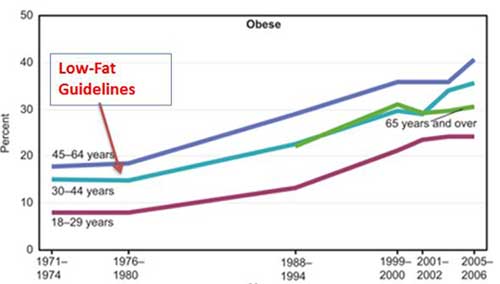
“The first dietary guidelines for Americans were published in the year 1977, almost at the exact same time the obesity epidemic started. Of course, this doesn’t prove anything (correlation does not equal causation), but it makes sense that this could be more than just a mere coincidence.

The anti-fat message essentially put the blame on saturated fat and cholesterol (harmless), while giving sugar and refined carbs (very unhealthy) a free pass. Since the guidelines were published, many massive studies have been conducted on the low-fat diet. It is no better at preventing heart disease, obesity or cancer than the standard Western diet, which is as unhealthy as a diet can get.”

Let’s face it, if low-fat diets worked, the United States would be the healthiest nation on the planet—folks have been following them since the late 1970s! But if you look at the following graph, you can see that America’s waistline has done nothing but expand since then. There’s no telling how many people have been prematurely killed by following these flawed guidelines. Yet, despite mounting research to the contrary, low-fat diets are stillbeing pushed as “heart healthy” by the majority of nutritionists, cardiologists, and the like.
Lie #10: Carbs Should Be Your Biggest Source of Calories

I have already covered how insulin resistance is a key factor in disease (see Lie #4). A diet high in non-fiber carbohydrates—particularly processed grains and sugar—leads directly to insulin and leptin resistance. When your highest percentage of calories comes from healthful fats, these problems just don’t exist. Most high-carb diets are high in sugar and starch, not vegetables. When the low-fat mantra swept over the country, the high-carb craze soon followed. When fat was removed from foods, something had to be added back in to make foods more palatable—and that something was sugar. Particularly, highly concentrated forms of fructose, such as high fructose corn syrup, which spell metabolic disaster for your body.

With fat being the identified villain (albeit falsely accused), sugar was completely ignored—even though sugar was the realculprit behind inflammation, metabolic dysfunction, diabetes, and heart disease. America’s love of sugar was a boon to the processed food industry—which added fructose to practically everything from soup to nuts… literally. If you want to see what effects this had on the country’s health and belt size, just turn on your national news.

A high-carb diet disrupts your insulin and leptin signaling, and over time may very well result in type 2 diabetes. By contrast, a diet higher in beneficial fats corrects these metabolic issues. Recent research has demonstrated that the ketogenic diet—one marked by carbohydrate restriction and substantial healthful fats—extended the lifespan of mice by 20 percent, because it optimized their insulin sensitivity and other metabolic processes. There is evidence that low carbohydrate diets, combined with appropriate amounts of protein, can even slow down Alzheimer’s disease and cancer.

Now for the #1 Truth…

The more you can eat like your ancestors, the better—fresh whole foods, locally and sustainably raised, and foods that are minimally processed or not processed at all. These are the types of foods that your genes and biochemistry are adapted to and will provide you with the ability to reverse and prevent most diseases. You will find these at your local farmer’s market, food co-op, or in your own backyard garden. And you will be amazed at the positive changes you’ll see in your health when you “clean up” your diet!  Be wary of nutritional advice from mainstream “experts” as it may not be based on science—or based on bad information that is several decades outdated. Truthful, accurate information is your number one weapon in taking control of your health.

Recommended Reading:


Natural Ways to Help Your Child Focus

(NaturalPapa – Derek Markham) Approximately 20 percent of ADHD cases in the United States are misdiagnosed, which leads to many kids being medicated when they do not need it. One reason for these children being misdiagnosed is the age difference within school classes. Children who are in the same grade can be born 364 days apart, so the younger children are bound to have a different level of maturity than the older ones. In many cases, the misdiagnoses are the result of a teacher recommending that the parents have their child tested and doctors treating the symptoms, rather than the underlying cause. This is becoming an epidemic in this country, but there are things that parents can do to eliminate the need for this medication by treating the symptoms naturally.

The Numbers

When you look at the numbers, you cannot help but be somewhat startled by what is happening in the United States. In the last 10 years, the number of ADHD diagnoses has increased by 41 percent. Since 2007, the number of children who are on drugs to treat the symptoms of ADHD has increased by 28 percent. In Louisiana, 9.2 percent of all children are taking ADHD medication, which is leading to a generation of medicated children. Keep in mind that the youngest children in a kindergarten class are 60 percent more likely to receive this diagnosis than the older children in that class, due to the difference in age and maturity.

The Problem with Medication

When a child is diagnosed with ADHD, he or she may be given Ritalin to treat the symptoms. This medication is meant to help the child focus. Unfortunately, there are side effects that many parents might not consider when agreeing to put their child on Ritalin. For example, this drug increases a child’s heart rate by 8.1 beats per minute and blood pressure increases by 6 percent. It can also hinder a child’s growth rates, as children who take this medication are 8.36 pounds lighter and 0.76 inches shorter, on average. This slowed growth rate is not reversible, so it is something that your child will struggle with for the rest of his or her life.

Omega 3 Fatty Acids

Whether your child has ADHD or not, you might want to come up with some natural ways to help him or her focus. For example, omega 3 fatty acids can help with a child’s memory, behavior and focus. These fatty acids are found in olive oil, flax oil and fatty fish, so make sure that your child consumes plenty of these foods. If you cannot get your child to eat fish on a regular basis, try purchasing some supplements, as they are available in tablet form and have been shown to improve children’s attention span and mood.

Overall Nutrition

The foods that your child eats can have an impact on his or her ability to focus. Try eliminating gluten, artificial flavors, sweeteners, refined sugars, food coloring and preservatives from your child’s diet. Limiting the carbs that the child consumes can also help, while allowing him or her to eat an abundance of healthy proteins like eggs, lean meats and chicken.

Natural Herbs

It has been suggested that adding certain herbs, such as ginseng, ginkgo, lemon balm, chamomile and bacopa to your child’s diet can help him or her to focus better. The idea is that these herbs can create an antioxidant effect in the brain, which can enhance the brain’s neurotransmitters. While more research is needed on the effectiveness of these herbs, they are certainly worth trying.

Echinacea Extract

Those who suffer from ADHD are more likely to have stress and anxiety, which can make the symptoms of the disorder even worse. Taking Echinacea extract supplements can have an influence on your child’s mood by relieving anxiety and, therefore, improving your child’s ability to concentrate. Echinacea triggers calm feelings in those who take it and does not come with any side effects, making it perfectly safe for children.


Raising Children on TV Disrupts Their Ability to Pay Attention and Learn

(NaturalNews – PF Louis) It’s almost intuitively obvious to most that too much TV viewing is conducive to physical deterioration and not conducive to mental development. But what types of viewing at what ages affects children’s ability to pay attention over amounts of time and assimilate actual learning from experience or studying has been a topic of several studies.

One of those studies even considered background TV as a major distraction. That is leaving the TV on most of the time even when not watching it for a specific purpose while a child is doing homework, or if parents watch a specific TV show while the kids are around doing whatever.

This study has determined that a TV show’s momentary distractions from whatever a child is doing helps promote a poor attention span or a tendency to be easily bored. It’s a sort of “there’s something more important or interesting on the tube” tendency.

The study’s paper was titled “Background television in the homes of American children.”

Background TV is like secondhand cigarette smoke; it pollutes others

The University of Iowa (UI) publication Iowa Now interviewed one of the lead authors of that study, Deborah Linebarger, associate professor in the UI College Education’s Department of Teaching and Learning. Locally, she worked with two UI graduate students in her department and networked with others in different universities.

The other university study contributors were Mathew Lapierre at the University of Pennsylvania’s Annenberg School for Communication and Jessica Piotrowski of the University of Amsterdam in the Netherlands.

Linebarger and her UI grad student associates conducted lengthy telephone surveys, often close to an hour long, among 1,454 households with children just under one year old to eight years old. Here are some of her comments from the Iowa Now interview:

“We discovered that the average American child was exposed to 232.2 minutes of background television on a given day. Using multiple regression analyses, we determined that younger children, children living in single-parent homes, and African-American children were exposed to significantly more background television than their older, multi-parent, and non-African-American peers.”

Linebarger added, “What was really distressing was the fact that the youngest kids, the ones under 2, were exposed to 5.5 hours of background TV per day.”

By calculating expected active TV watching and adding to the background TV, the researchers found that children two years and younger are exposed to six or seven hours of TV media daily.

And if we examine content of what’s going on with TVs that are simply kept on most of the time, there’s a lot of advertising of bad foods and bad medicine or a lot of bad or silly news, all in short visual clips and in sound bites.

This is how kids and are being programmed, and perhaps you were, or are, too. Moderate active viewing can be interesting, exciting or even occasionally uplifting or informative. Even then, too much is simply debilitating at any age. The younger the child, the more impressionable. This includes video gaming as well, which are often violent and addictive into later years.

It disrupts physical playing and social intercourse even within families. The tube has too much influence, which is why researchers recommend less active TV time and no background TV. It’s an enticing consciousness pollutant, and it can be the model of behavior to greater or lesser extent among children.

Regarding parents’ attitudes about background TV, Linebarger, who has four children of her own, explained: “[P]arents tend to leave the TV on all day even when no one is actively watching it. When I come into my house and no one is there, I like to turn on the TV to keep me company. And it’s easy to forget to turn it off… you get up and leave the room with it still there and on in the background.”

Sources for this article include:
http://now.uiowa.edu
http://psychcentral.com


4 Reasons Why Farmers’ Markets Boost Health, Body and Soul

(DrFrankLipman – Frank Lipman) In the last decade or so, hundreds if not thousands of farmers’ markets have opened their gates, creating a thriving alternative to industrially produced food and the impersonal food shopping experience. And while they haven’t totally replaced the supermarket, farmers’ markets are definitely taking a bite out of the industrial food business by offering an easy way to connect with beautiful, fresh, healthy food – and I couldn’t be more delighted.

With access to this healthy shopping option now easier than ever, here are four essential reasons why I believe farmers’ markets are fantastic for your body, mind, and spirit – and why everyone should support them.

1. Farmers’ Markets Are … Good for Your Body and the Earth

There’s a lot to like about food from the farmers’ market. For starters, it’s the farms themselves. Most are small, non-industrial, hands-on, often family-run or cooperative operations with close ties to their land. They tend to value and treat their land right, using low-impact, pesticide-free, sustainable farming methods, which are kinder and less poisonous to the soil and the food that’s grown in it. The result is produce that’s pretty close to organic, minus the official USDA certification.

When these nearly-organic foods arrive at the market, they’re fresh and unadulterated, not having been subjected to the preservative and ripening treatments used on much of the picked-too-early, trucked-in-from-2000-miles-away produce found at a typical supermarket. Even if you don’t count the smaller carbon food-print, you can’t ignore the fact that the stuff is fresh, having been picked at its nutritional peak, just a few hours before it’s in your hands – making farmers’ market produce among the healthiest you can buy.

2. Farmers’ Markets Are … an Excellent Way to Shed Extra Pounds

Granted it won’t happen overnight, but buying the majority of your produce, and when possible eggs, meats, and poultry, at the farmers’ market will help you drop weight. How? Simply by preventing you from buying cartfuls of health-sucking, weight-boosting processed crap. You’ll be choosing from whole, healthy, unprocessed foods – virtually nothing in a box, bag, or can.

You won’t fill your car with a trunk-load of added sugars, sodium, chemicals, or preservatives, thoughtfully wrapped in endocrine-disrupting plastic packaging. You’ll be buying and eating clean, nutrient-packed foods, and eliminating a vast majority of the processed food ingredients that have been keeping you fat and sick.

3. Farmers’ Markets Are … an Uplifting Sensory Experience, Not a Depressing Chore

For most of us, a trip to the supermarket is anything but enjoyable; it’s just one more mind-numbing chore on our never-ending to-do lists. A visit to the farmers’ market, however, is an event – and an experience that engages the senses. There are vivid colors to excite the eye, produce to sniff and squeeze for freshness, and at some markets, on-site musicians adding a live soundtrack to the festivities.

There are the wonderful aromas of produce, freshly-picked, presented in the raw, or handmade, baked, churned, cured, or fermented into wonderful, healthful treats for your table, many of which you can ask to sample before you buy. How many supermarkets provide this kind of an experience – and do it all outdoors, no less?

Farmers’ markets deliver not only the freshest, most earth-friendly and nutrient-dense options in town, they also connect us with the simple, pleasures of discovering, tasting, touching and smelling whole, real foods in an atmosphere that’s inviting and exhilarating, not dreary or exhausting.

4. Farmers’ Markets Are … Good-for-the-Soul Social Events

At the supermarket, there’s little opportunity for human interaction, and with the rise of self-serve checkout machines, the shopping experience can wind up being an insular, solitary one as you troll the aisles, stuck in your own head. Not so at the farmers’ market, which can be a daily or weekly opportunity to connect with your neighbors as well as the real, live people who grew your food.

Amazing, isn’t it? The guy (or gal) standing behind your food can tell you about their unique growing processes, how the plants were treated along the way, how to store your purchases and even how to cook them when you get home. When’s the last time that kind of knowledgeable exchange happened at your local supermarket? My guess would be never.

Another bonus is the easy interaction and natural conviviality between like-minded shoppers, foodies, and farmers, all sharing their knowledge and appreciation of nature’s bounty on offer that week. In our fragmented and disconnected and screen-obsessed lives, I think of farmers’ markets as the ultimate antidote. One of my patients describes her local farmers’ market as “a cocktail party minus the cocktails.”  She stocks up on produce, conversation, and social connection every week.

Locate a Local Farmers’ Market

So this weekend, instead of trudging off to the so-called “supermarket,” head outdoors to the market that really is super for you. To find a farmer’s market in your area, check out Local Harvest’s directory of more than 30,000 family farms and farmers markets. Also have a look at the USDA’s database of more than 8,000 farmers’ markets – and don’t forget to bring your own tote bags to carry home all your purchases! 

For more of my favorite healthy food resources – where to find a farmer’s market, get wild fish, find grass-fed meat and more, see my post on “12 Great Food Resources”.


Artificial Food Dyes and Kids: Not a Good Mix

(DrFrankLipman.com – Robyn O’Brien)report released by the National Cancer Institute showed a 9.4% increase in childhood cancer between 1992 and 2007. And today, cancer is now the leading cause of death by disease in kids under the age of fifteen.

Correlation is not causation, but the escalating rates of conditions like cancer, diabetes and food allergies have a lot of parents paying attention to what is in their food.  Some cancer doctors even call it the “doorknob syndrome.”  A patient is diagnosed with cancer, spends hours in the office being walked through procedure options, then as they turn to go, with a hand on the doorknob, turn back into the office and ask, “Is there anything I could be doing differently with my diet?”

We are quickly learning that our food is full of a lot of non-food ingredients.

About 15 million pounds of petroleum-based dyes are used in food each year.  And a certain kind of red food coloring, known as “Red 3,” is a known carcinogen that the FDA banned from our medicines and makeup in 1990, but it’s still used in our foods.

But instead of making the long overdue move to do something serious about getting rid of toxic food dyes so ubiquitous in our food supply, dyes derived from synthetic chemicals that studies have linked to cancer, the FDA, upon learning this, fell back on two simple words: “more research.”

In kitchens across this country, eight dyes, currently being used by manufacturers, can be found in everything from packaged macaroni and cheese to breakfast cereal to practically every piece of candy your child has ever put in his or her mouth. Links are being found to hyperactivity in kids (ADHD), cancer and serious food allergies.

But here is the truly amazing thing, and for those of us who have fed our kids these color-laden foods, perhaps the toughest thing to stomach: Kraft, Coca Cola and Wal-Mart have already removed these artificial food colors and dyes from the same products that they distribute in other countries. Skittles?  Don’t have them.  M&Ms?  Don’t have them either.  Neither do cereals, fruit snacks and just about any food you’d think to put in a kids mouth. They did it in response to consumer demand and an extraordinary study called the Southampton Study.

The Southampton Study was unusual in that it tested children on a combination of two ingredients: tartrazine (yellow #5) and sodium benzoate. The study’s designers knew that a child very rarely has occasion to ingest just a synthetic color or just a preservative; rather, a child who is gobbling up multicolored candies is probably taking in several colors and at least one preservative.

What’s amazing is that in the U.K., the federal food safety agency actually funded the Southampton Study that led to even U.S. corporations eliminating synthetic colors and sodium benzoate from their U.K. products.

And in response, a whole host of companies, including the U.K. branches of Wal-Mart, Kraft, Coca Cola and the Mars candy company (who make M&Ms), have voluntarily removed artificial colors, the preservative sodium benzoate, and even aspartame from their products. Particularly those marketed to kids. Take a close look at the ingredient list for the product below.

Nutri Grain Bars and Food Coloring

Our American companies had removed these harmful ingredients from their products overseas — but not here.

Kraft, Coca Cola and Wal-Mart are living proof that it is possible for giant corporations to make and sell kid-friendly, family-friendly, and healthy processed food without necessarily exposing them to a chemical cocktail that might also give them allergic reactions, brain tumors, or leukemia, or the symptoms of ADHD, as the Center for Science in the Public Interest recently highlighted in their report Rainbow of Risks.

Is it too much to ask the FDA and the processed food companies for the same value to be placed on the lives of the American kids in their cost-benefit analyses that has been placed on the lives of kids in the UK?

We can create that same change here. There are apparently 51 million moms waking up to the dangers that toxins present to the health of our kids, that number is the equivalent to the entire population of Spain. And if what is happening in this food movement or the changing landscape of childhood health is any indication, it is time to get down to business, level the playing field for our kids, and send a message to these companies. We can navigate the grocery store a little bit differently, share information with friends and family or even reach out online to our favorite food companies asking them to support this change.  Because while the American children only represent 30% of our population, they are 100% of our future. So while the FDA may not value their lives accordingly, we can.