Couch Potato Parenting

Imagine your ten-year-old child walks into the living room shedding his coat. He drops it on the floor or on the couch. You tell him to hang it up. He runs across the room to greet the dog. You tell him again, a little louder. He is distracted by the TV show you are watching and sits down, eyes glued to the tube. “Hang up your coat!” you yell, now furious that the little light of your life never does a damn thing you tell him to do until you roar at full volume.

I know we all wish there was a magic fix for this behavior, but there isn’t. And as much as you probably don’t want to hear this, it’s your behavior that has to change if you want your children to mind you the first time you tell them to do something. You have to get up and physically make your child mind–the first time he ignores you. Don’t repeat yourself. Don’t yell. Stop being a couch potato parent.

To change this behavior, never (ever, ever) give your child a command unless you are ready, willing, and able to immediately follow through to see that it is done.

It’s really quite simple. You tell a child to do something once, then you get up off that couch, gently take that little body to where it needs to go, and assist with the process while saying (in the kindest voice you can muster), “I told you to hang up your coat.” And then, even though you helped every step of the way, and contrary to all reason, once the task is done, you thank the little monster for hanging up his coat.

This simple act tells a child that you mean what you say and you will follow through – every single time. Ignoring you will no longer be tolerated. This works, amazingly well, and changes a child’s behavior very quickly, but only if you are consistent.

The major lesson here? You allowed this behavior to develop. You taught your child that he only has to mind you when you lose your temper. If you want to change his behavior, you have to change yours.

The key, and the hardest part, is to kill them with patience and kindness. When you get up off that couch and take those little hands in yours to reach for that coat, be gentle and loving. When you say, “Good job hanging up your coat!” say it with a small amount of enthusiasm (not sarcasm). This can be hard to do, especially if your child is physically or verbally resisting. Most of the time they will. You’ll hear, “Let me go! I can do it myself!” Ignore this. Just follow through taking those hands, picking up the coat together, holding the coat together, and duck-walking to the closet.

If you use this approach from the beginning, your toddler will learn that Mom and Dad say what they mean, mean what they say, and will always follow through.

As Much As Possible, Stop Punishing

Do you punish your child for the same behavior over and over and over again? Doesn’t that make you wonder if your punishment is working?

Again, lose the couch potato approach, though this issue will require mental pushups rather than a physical response. Whenever you think your child’s behavior is worthy of punishment, try to come up with a consequence instead. Here’s the hardest part: make the consequence fit the crime.

You tell your child to stop playing with his food and he continues, don’t argue or take away privileges. Pick up his plate. Dinner is over. If you tell her to pick up her dolls and she throws a fit, the dolls go into the attic for a week. You get the idea.

Consequences work especially well with older children and trust issues. For instance, your child spent the night at a friend’s house, but she was not where she was supposed to be. You tell her you are disappointed in her, remind her of the rules and drop it. She is going to feel like she got away with it. That is, until the next time she asks to spend the night at a friend’s house. You tell her no, the last time she didn’t follow the rules. She has no sleepover until further notice. She will demand that you tell her how long this punishment lasts. You tell her this is not a punishment, it is a consequence of her behavior. “Until I feel I can trust you to be where you say you are, you will not be sleeping over at anyone’s house.” Now the ball is in her court, to win back your trust.

Time outs and loss of privileges may remain your first choice, but the more you stretch your brain power and outmaneuver your child with logic and direct consequences for actions, the more you will prepare your child for the real world and the more they will respect the rules. Again, the key is consistency, patience, and a loving attitude.

Good parenting is a lot like warfare. Be strategic. Know your opponent, and act more than you react. Outmaneuver and anticipate. Always trust your gut instincts. Never make your decisions based on whether or not your kid will like you, make them based on what is best for your child. Start with getting off the couch.


Two States Ready to Fight for GMO Labeling in November While Industry Pushes Bill to Remove State Rights

(Dr. Mercola) The pesticide and junk food industries continue to cause harm, even deaths, while destroying our rights and indemnifying themselves from liability.

That’s the take-home message from the September 8 article in The Progressive,1 which recounts the travails of residents in Cedar Valley, Oregon. It’s also the take-home message of other related news. And yet there’s hope…

A group of residents of the Cedar Valley area near Gold Beach in Curry County, Oregon say their properties were doused with pesticides by a helicopter aiming for privately-owned timberlands last October,” the featured article states.

In what has been called a ‘severe sanction,’ the pesticide applicator and the aerial spray company he owns have been fined $10,000 each by the state and had their pesticide licenses suspended for a year for providing false information that misled investigators.

But at least one of those affected says this basically amounts to a big traffic ticket, when instead he believes the incident should be considered an act of ‘criminal trespass’ linked to 45 illness reports.”

‘Right to Farm’ Laws Protect Big Ag from Legal Action

At present, the “Farm and Forest Practices Act” prevents the residents from suing for damages. But 17 of those affected by the pesticide dousing are now challenging the constitutionality of that law.

While originally intended to protect small farmers from frivolous nuisance lawsuits by suburban neighbors, today, many of these laws do little more than shield large corporations from being held accountable for large-scale environmental and human harm.

Small farms have been replaced with gigantic warehouse-style factory farms that produce toxic waste on a scale that is simply incomparable to a regular family-run farm.

Yet you still cannot sue them for damages as long as they’re following “generally accepted” farming or foresting practices—including aerial pesticide applications, even though in this case people were doused in their own backyards!

Moreover, Oregon’s Right to Farm law contains a provision stating that if you sue and lose the case, then you are responsible for paying the defendant’s legal fees. This is another effective dissuasion strategy that coddles big industry while leaving regular folk to suffer without effective recourse.

Residents Exposed to Toxic Agent Orange Ingredient

Two residents reporting health problems in this case include John Burns, who is the assistant chief of the local volunteer fire department, and his neighbor, James Welsh.

According to Burns, a total of 45 people have suffered health effects from the exposure. While Burns began feeling progressively worse as the day wore on, Welsh was immediately struck will nausea and breathing problems when the chemicals rained down on him.

Welsh, who had a preexisting heart condition, rapidly deteriorated after the exposure, and died in April. That exposure, it turned out, was a mix of 2,4-D—which was a major ingredient in Agent Orange—and triclopyr, plus an adjuvant.

One of the ingredients was applied “at a rate above the maximum allowed by the label instructions,” according to the Oregon Department of Agriculture.2 As reported in the featured article:

The pesticide spray over Cedar Valley is certainly not the first residential exposure due to aerial pesticide application. Residents of the Triangle Lake area in Lane County say they have been exposed to aerial pesticide drift multiple times in recent years, especially in 2011, as CMD has reported.

Urine tests performed by scientists at Emory University in spring 2011 confirmed 2,4-D in 100 percent of their urine samples and the weedkiller atrazine in most.”

Cedar Valley Residents Challenge ‘Right-to-Farm’ Law

The law firm Craig Law Center has taken on Cedar Valley’s case, challenging the “Right to Farm” law. According to the featured article:

Crag attorney Chris Winter said he was interested in the case because he became ‘concerned that people weren’t able to defend their property rights against toxic chemicals.’

The lawsuit challenges ‘right-to-farm’ under the under the clause of the state constitution that guarantees that every individual will have a legal remedy for the violation of any fundamental legal right…

Winter said, ‘Because toxic chemicals and aerial application are so risky, courts have said there’s a higher standard of care, more than just being reasonably prudent, but being careful that nothing gets on neighbors’ property.’

But because of the ‘right-to-farm’ law, citizens still can’t sue. That means courts have ‘tipped in favor of chemical companies and applicators.’

Winter says that the plaintiffs hope to change the ‘Right to Farm and Forest Law,’ but that additional changes are needed to address structural problems in the state’s regulatory system, like ‘basic standards and guidelines for how pesticides are applied.’”

Judge Declares Idaho’s ‘Ag-Gag’ Law Potentially Unconstitutional

In related, but slightly more optimistic news, a federal judge has ruled that Idaho’s Bill 13373–dubbed the “ag-gag law,” as it criminalizes the secret filming of agricultural practices—may in fact be unconstitutional.

The bill was hastily signed into law in February, after footage of animal abuse occurring in a confined animal feeding operation (CAFO) was aired on TV. The law was quickly challenged by the Animal Legal Defense Fund (ALDF), alleging that politicians ignored the First Amendment simply to protect corporate interests. As reported by the Courthouse News Service:4

Gov. C.L. ‘Butch’ Otter and Attorney General Lawrence Wasden moved to dismiss the complaint in April… but US District Judge B. Lynn Winmill… said the opponents may have a case: First Amendment and equal protection clause.

While the protection of private property is a valid concern, it does not necessarily justify the restriction of free speech, the court found.

‘The First Amendment requires more than the invocation of a significant government interest; it requires that the restriction’s benefits be balanced against the burden on protected speech,’ Winmill wrote. ‘The state therefore must justify a need to serve its interests in protecting private property through targeting protected speech.’”

This is good news, as this law is all about protecting the status quo of industrial farming; turning it into a crime to expose the horrors, cruelties, and dangers associated with big agricultural business… Time will tell if the “ag-gag rule” will be repealed, but at least the issue will be addressed in a court of law.

Help Vermont Defend America’s First No-Strings GMO Labeling Law!

Speaking of courts of law… The Grocery Manufacturers Association of America (GMA), which consists primarily of pesticide producers and junk food manufacturers, is suing Vermont in an effort to overturn H.112—the first no-strings-attached GMO labeling in the US.5, 6, 7 H. 112 was passed by an overwhelming margin,8 and Governor Peter Shumlin signed the historic bill into law on May 8 this year.

The law will require food manufacturers to label genetically engineered (GE) foods sold in Vermont, and prohibits them from labeling foods with GE ingredients as “natural” or “all natural.” The GMA’s lawsuit claims that their members are going to end hunger with their pesticide-laden GMOs, but we already know that the problem with hunger is not production, it’s distribution. There’s more than enough food to go around; it’s just poorly distributed.

Besides, must Americans be kept in the dark about what we’re eating in order for the chemical technology industry to be able to “save the world” with its genetically engineered grains? To help Vermont defend its GMO labeling law against these multi-national giants, please consider making a donation to the Organic Consumers Fund, which has been set up to raise funds for this purpose. The fund has also pledged to help Oregon and Colorado pass their respective GMO labeling initiatives this November.

Beware the ‘DARK’ Act…

The GMA, whose 300-plus members include Monsanto, Coca-Cola, and General Mills, is also pushing a Congressional bill called the “Safe and Accurate Food Labeling Act of 2014.9 The bill, dubbed the “DARK” (Denying Americans the Right to Know) Act, would actually preempt all states from passing GMO labeling laws.10 It would also bar states from enacting laws that make it illegal for food companies to misrepresent their products by labeling GE ingredients as “natural.” Last but not least, the DARK Act would also limit the FDA’s power to force food companies to disclose GE ingredients.

Does any of this make you warm and fuzzy inside? Are these the actions of companies that have your best interest at heart? I would say no. They are trying to HIDE the presence of genetically engineered ingredients, and are pulling out ALL the stops to do so! Ask yourself, why? These companies—the very ones providing much of our food—are actually trying to take awayindividual state’s rights, just to ensure certain food ingredients remain hidden! Curiously enough, Monsanto is more than willing to “support” GMO labeling in other countries.

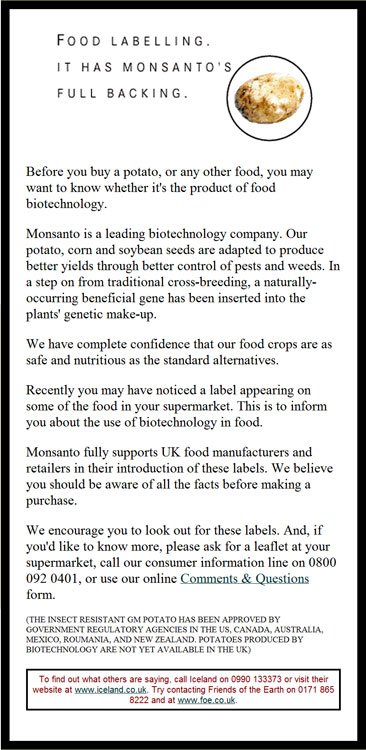
Here’s a Monsanto ad from the UK, letting British consumers know how much the company supports the mandatory labeling of their goods—even urging Britons to seek such labels out—ostensibly because Monsanto believes “you should be aware of all the facts before making a decision.” What’s the difference between British shoppers and American shoppers? Why does Monsanto support one nation’s right to know but not another? It’s time to put an end to this hypocritical charade and label foods in the US, as has been done in 64 other countries across the globe already!

American state rights were encouraged by our constitution, and the constitution was meant to prevent federal superpowers becoming corrupted and creating an authoritarian, fascist federal government. Sadly, we’ve watched our individual and state rights deteriorate over many decades, succumbing to these enormous industry powers, and this is probably one of the biggest, most blatant overreaches yet, proving that corporate interests are ruling the roost on Capital Hill. As stated by Marni Karlin, director of legislative and legal affairs for Organic Trade Association:11

Consumers, particularly the eight out of ten American families who buy organic products, want to know what is in their food. Rep. Pompeo’s bill ignores this consumer demand for information. Instead, it ties the hands of state governments, the US Department of Agriculture, and the Food and Drug Administration concerning GMO labeling. It is fatally flawed.”

What Happens in Oregon and Colorado in November Could Make or Break the GMO Labeling Movement

In addition to all this legal wrangling, opponents of GMO labeling spent more than $27 million on lobbying in the first six months of this year alone. This is about three times more than they spent during all of 2013, when they shelled out $9.3 million.12 Among the biggest spenders on anti-labeling lobbying were the Grocery Manufacturers Association (GMA) and major food makers such as Coca-Cola Co and PepsiCo Inc., along with chemical industry heavyweights like Monsanto and DuPont.

Undoubtedly, they are well aware that November is going to be a crucial turning-point for the GMO labeling movement. Both Colorado and Oregon have GMO labeling on their November ballots, and it’s absolutely imperative that we make a strong push to make sure these ballots succeed. So please, consider making a generous donation to the Organic Consumers Fund.

I know, it’s an uphill battle, but persistence pays! We cannot and will not give up now. During last year’s I-522 ballot campaign to label GMOs in Washington State, the Grocery Manufacturers Association (GMA) came up with a devious, and illegal, money-laundering scheme to protect the identity of members who donated funds to the opposing campaign. Unfortunately, this illegal move helped the GMA defeat I-522 by a mere one percent margin—ONE PERCENT!

Fortunately, the GMA was caught, and sued by Attorney General Bob Ferguson, who accused them of intentional money laundering and violating state campaign disclosure laws. They had to resort to illegal activity to beat us by one percent the last time… With that in mind, I am firmly convinced that we CAN win in both Colorado and Oregon. But it will take effort. And money, to make sure all the voters are informed enough to make a sound decision. It’s time for truth in labeling. Together, we can make it happen.

I recently named the GMA “the most evil corporation on the planet,” considering the fact that it consists primarily of pesticide producers and junk food manufacturers who are going to great lengths to violate some of your most basic rights—just to ensure that subsidized, genetically engineered and chemical-dependent, highly processed junk food remains the status quo.

The insanity has gone far enough. It’s time to unite and fight back, which is why I encourage you to boycott every single product owned by members of the GMA, including natural and organic brands. To learn more about this boycott, and the traitor brands that are included, please visit TheBoycottList.org. I also encourage you to donate to the Organic Consumers Fund. Your donation will help fight the GMA lawsuit in Vermont, and also help win the GMO labeling ballot initiative in Oregon in November.

Voting with your pocketbook, at every meal, matters. It makes a huge difference. By boycotting GMA Member Traitor Brands, you can help level the playing field, and help take back control of our food supply. And as always, continue educating yourself about genetically engineered foods, and share what you’ve learned with family and friends.

Recommended Supplements (These supplements help detoxify GMOs):

Further Reading:


Zero-Calorie Sweeteners May Trigger Blood Sugar Risk By Screwing With Gut Bacteria

Artificial sweeteners don’t have calories — so why are these mice getting fat?

(Cornucopia – The Verge – Arielle Duhaime-Ross) When artificial sweeteners are in the news, it’s rarely positive. In the last few years, sweeteners have been linked to everything from Type 2 diabetes to cardiovascular disease, high blood pressure, and stroke. Still, products like Splenda and Sweet‘N Low remain a cornerstone of many a weight-loss strategy, mostly because doctors don’t quite understand how sweeteners contribute to disease. That may soon change, however, as results from a study, published today in Nature, point to a possible mechanism behind these adverse health effects.

“Our results suggest that in a subset of individuals, artificial sweeteners may affect the composition and function of the gut microbiome” in a way that would lead to high blood-sugar levels, said Eran Elinav, an immunologist at the Weizmann Institute of Health in Israel and a co-author of the study, during a press conference yesterday. This, the researchers say, is bad for human health because when sugar levels are high in the blood, the body can’t break it down, so it ends up being stored as fat.

To reach these conclusions, Elinav and his team first tested the effect of three common artificial sweeteners — aspartame, sucralose, saccharin — on rodents. They found that each of the sweeteners induced a change in blood sugar levels that surpassed that of the mice who consumed actual sugar. And later tests involving the main sweetening agent in Sweet‘N Low, saccharin, yielded similar results in both lean and obese mice.

But mammals don’t actually digest artificial sweeteners — that’s why they’re “calorie-free” — so the reasons why these mice were experiencing blood-glucose alterations was still mysterious, Elinav said. Still, the researchers had an idea: maybe the bacteria that lived in the guts of the mice were interacting with the sweeteners.

So the researchers performed several experiments to test their idea. In one, they gave antibiotics to mice who had been fed sweeteners regularly. Antibiotics kill gut bacteria, and when these mice had their microbial guests cleaned out, their blood sugar levels went back to normal. In another experiment, the scientists transplanted feces — a rich source of gut microbes — from sweetener-fed mice into rodents that had never consumed artificial sweeteners. The procedure caused the recipient mice to experience oddly high blood glucose, like the mice in the sweetener group. Finally, Elinav and his colleagues used genetic analysis to reveal that alterations in the composition of microbial colonies were also accompanied by changes in bacterial function — changes that could very well explain why the mice were experiencing such high blood sugar.

But findings in mice aren’t nearly as convincing as findings in people, so the researchers set out to investigate human sweetener consumption. In the first experiment, the researchers analyzed the blood-sugar levels and gut bacteria colonies of 381 participants. And, as expected, Elinav and his colleagues found that people who consumed sweeteners in large quantities also showed disturbances in several metabolic parameters — including increased weight — as well as distinct microbial changes in their guts.

The results from the second, much smaller human experiment might actually be the most illuminating.

“We followed for a single week a group of seven human volunteers who do not consume sweeteners as part of their normal diet,” Elinav said. During that period, the researchers gave them a single dose of saccharin, and monitored their vitals. After just four days, half the participants showed microbial alterations and increases in blood sugar levels, he explained, “while the other subset had no meaningful effect immediately following the consumption of sweeteners.”

In other words: some people are more susceptible to the effects of artificial sweetener than others.

A causal link

The handful of studies suggest that consuming non-caloric artificial sweeteners boosts the risk glucose intolerance in both humans and mice, as a result of changes in gut microbe function, the researchers wrote in their report. Yet, because of the preliminary nature of their results and the small number of human participants involved, they stopped short of suggesting that people change their eating habits. “By no means are we prepared to make recommendations as to the use and dosage of artificial sweeteners based on the results of this study,” said Eran Segal, a study co-author also at the Weizmann Institute of Health.

Other researchers, however, were more forthcoming.

“People need to be much more mindful of what they are eating and drinking and make efforts to avoid products that have added sweeteners in any form” said Susan Swithers, a behavioral neuroscientist at Purdue University who wasn’t part of the Nature study, in an email to The Verge. The studies showed not only a causal link between the changes in the gut and artificial sweeteners, but that the observed changes happen quickly, she wrote.

Not everyone agrees with the design the researchers used to address the question about artificial sweeteners and weight gain. Christopher Gardner, a food scientist at Stanford University who didn’t participate in the study, says that the fact that the researchers gave the FDA’s maximal acceptable daily intake of saccharin to the human participants — about 5 mg / kg body weight per day — isn’t ideal. In a real-life setting, that dose would be the equivalent to a 150-pound person consuming 42 12-ounce sodas per day, or 8.5 packets of pink Sweet ‘n Low per day. “That may be ‘acceptable’ according to some set of guidelines,” Gardner wrote in an email, “but it should be noted that realistically this is a very high dose they are using and one that wouldn’t be consumed by a typical consumer.”

Still, the idea that we might finally have an explanation for the adverse health effects seen in certain sweetener studies is worth paying attention to. Should the findings prove reproducible, doctors will be tasked with understanding why some people are susceptible to microbiome alterations, while others aren’t. And sweetener companies will have to address the criticism — in addition to rethinking their marketing strategies. “The work is important,” Swithers said, “because it underscores the role that artificial sweeteners may play in contributing to the very problems they were designed to help.”


What’s Ailing You? Could it be Your Mattress?

Are We Paying Attention to What We Let Come into Our Homes?

The average American consumer pays little attention to the detailed minutiae regarding the contents of an ordinary mattress.  More and more attention is being paid to what’s in our food supply and what we are willing to consume, while that which surrounds us and comes into contact with us in some of our most sacred settings, such as in our bedroom, is often overlooked.

Some of the following facts may be worth looking into, however. Being blissfully unaware of these things is not a recipe for a successfully clean, healthful, and organic lifestyle.

Did you know there are a number of known (and probable) carcinogens as well as other toxins in a traditional innerspring or polyurethane mattress? Some of these chemicals include benzene, boric acid, antimony, formaldehyde, and decabromodiphenyl oxide. There are more, but let’s focus on just these few, and take a look at each of these chemicals individually.

The Intruders

Benzene is one of the 20 most commonly used chemicals in the United States. It is a known carcinogen. Benzene can also cause drowsiness, dizziness, rapid heart rate, headaches, tremors, confusion, and unconsciousness; it may be harmful to reproductive organs.

Boric acid is a pesticide commonly used for killing cockroaches. It is used in mattresses as a flame retardant. Many sources deny that it has any ill effects on a person, but some doctors beg to differ. [1].

Antimony is used as a preservative and fire retardant. According to Midwifery Today[2], in baby mattresses especially, this chemical can combine with a common household fungus, arising from a baby’s sweat and spit up, and result in three nerve gasses – phosphine, arsine, and stibine – which can be deadly to infants. Antimony can be found in both baby mattresses and adult mattresses, and in the case of a baby mattress, it is recommended to wrap it with a gas impermeable plastic to keep the gasses from contaminating the sleeping area.

Formaldehyde is used to produce many household products. The EPA lists formaldehyde as a probable carcinogen (with high or prolonged exposure). Some of the adverse effects of formaldehyde may be watery eyes, burning sensations in the eyes, nose, and throat, coughing, wheezing, nausea, and skin irritation.

Decabromodiphenyl oxide is a flame retardant used to protect many different types of products and materials from the risk of fire. Older mattresses (prior to 2009) generally contain this agent as part of the fire barrier; unfortunately, however, many of the alternatives to deca-BDE are arguably just as harmful.

Mattress Off Gassing and Its Extension of the Problem

One of the main ways that a person is affected by the above-mentioned chemicals in their mattress, besides casual contact, is with off gassing. Off gassing from a mattress is when a chemical agent or agents are released as a gas from being dissolved, trapped or absorbed inside of the mattress. There are many VOC’s (volatile organic compounds) that typically off gas inside of a bedroom after a new (traditional-type) mattress is purchased.

A guest book[3] on the website Chem-Tox.com reports the experiences of 235 people who have had some adverse side effects, presumably from the types of chemicals discussed above, found in traditional mattresses and pillows.

Natural Solutions

The outlook isn’t all negative. Happily, there are available natural solutions to the status quo being provided in the marketplace. Some of these include mattresses made from botanical latex sap. Natural latex is hypoallergenic, mold and mildew proof, dust mite resistant, and antibacterial. Other natural ingredients used in mattress cores by natural mattress manufacturers may include wool, cotton, horsehair, flax, tufted hemp, buckwheat hulls, millet hulls, and coconut coir. These are all acceptable alternatives, provided they have not been treated with the same harsh petrochemicals discussed above. Beware of greenwashing. One can usually safely navigate through purported claims of natural and organic by looking out for certifications by reputable governing bodies. GreenGuard certification and USDA Organic certification are just a couple of the more trusted types of certifications that consumers may look for in their search for a healthier mattress.

What's in Your Mattress

Additional Sources:

1. http://articles.mercola.com
2. http://www.midwiferytoday.com
3. http://www.chem-tox.com

Related Products:
Related Reading:


Study Finds Girls Now Enter Puberty Even Earlier Than Previously Thought

A new longitudinal1 study found that girls are developing breasts at an increasingly younger age, which is part of a disturbing trend in the sexual development of our children. American girls (and boys) are hitting puberty earlier than ever before, and upward trends in childhood obesity seem to be playing a major role.

You may be shocked by the latest childhood obesity statistics. As reported byHuffington Post:2

  • 17 percent of children and adolescents are now obese
  • Childhood obesity has nearly tripled since 1980
  • Obesity among kids ages two to five has doubled over the past 30 years, and one in five kids is now overweight by age six
  • More than half of obese children were overweight by their second birthday
  • The food industry spends more than $1.8 billion marketing to kids each year3—and what they’re selling is primarily processed food and junk food

Data for the puberty study, published in the November 2013 issue ofPediatrics,4 came from a cohort of more than 1,200 girls in and around San Francisco, Cincinnati, and New York City between the ages of six and eight.

Researchers found some cultural variability, but overall, concluded that girls are entering puberty earlier than in the past. Early sexual maturation is not a recent development, nor is it a phenomenon limited to United States. It is a global phenomenon, especially in developed nations.5

Obesity May Be More Significant for Early Puberty Than Previously Thought

Maturing at a younger age brings many long-term risks, both in terms of physical and mental health.6 The pace of sexual development has generally been attributed to three primary factors, according to the website for Theo Colborn’sOur Stolen Future:7

  1. Obesity
  2. Social factors (such as family environment, stress, overt sexuality in the media, etc.)
  3. Toxic contamination (environmental chemicals and pollutants, hormones and hormone-mimics, pesticides, chemicals in plastics, etc.)

According to the featured study, obesity appears to be the most significant factor driving early puberty—or perhaps it’s just the easiest to quantify. Overweight and obese girls in this study developed breasts about a year earlier than normal-weight girls (age eight versus age nine, respectively).

Obesity exposes girls to higher estrogen levels because estrogen is both produced and stored in fat tissue. Girls carrying excess body fat have more estrogen and leptin, which can lead to insulin resistance and the development of more fat tissue, which produces even more estrogen, a vicious cycle that can eventually result in premature puberty, among other problems.

Boys are not immune to the effects of estrogenic chemicals—males of all species are becoming more female, including human boys. Childhood obesity is a growing epidemic in developed countries and raises your child’s risk for the following serious health concerns, often persisting into adulthood. However, this is just the tip of the iceberg.8

  • Impaired insulin resistance and type 2 diabetes
  • Cardiovascular disease, asthma, and other respiratory problems
  • Fatty liver disease
  • Joint and musculoskeletal problems, and lower extremity fractures9
  • Gallstones and gastroesophageal reflux (GERD)

Obesity and Toxic Environmental Chemicals: Two Sides of Same Coin?

There is mounting scientific evidence that environmental contaminants have hormone-mimicking properties that may play a role in premature sexual development. However, it is difficult to measure these effects, as strong as their theoretical basis may be. In terms of research, it’s much easier to correlate a child’s age of onset of puberty with her body mass index (BMI) than with her level of exposure to plastics or pesticides.

However, the obesity and contamination factors are likely two sides of the same coin, having been linked in multiple scientific studies.

The same chemicals that contribute to precocious puberty are in fact also significant players in obesity, such as phthalates.10111213 Even low levels of toxic chemicals (dioxins, PCBs, BPA, and phthalates) have been shown to cause metabolic changes in mice.

Perhaps the relationship between endocrine-disrupting chemicals and precocious puberty will be clearer in the near future, as the researchers in this latest longitudinal study plan to tackle the chemical exposure issue next.14 For a list of the top 10 chemicals that can potentially cause early puberty in your child, please refer to my previous article on this topic.

The Age of Onset of Puberty Has Dropped Four Years Since 1920

The age of puberty onset for both girls and boys has been steadily dropping throughout recorded history. According to German researchers,15 the onset of puberty for girls has shown the following disturbing trend over the past 150 years:

Age of Onset of Puberty for Girls
Year Average Age (Years)
1860 16.6
1920 14.6
1950 13.1
1980 12.5
2010 10.5

As you can see, the average age for girls has fallen by four years since 1920 and six years over the last century. The statistics for boys parallel those for girls, with a delay of about one year. According to another study in the journal Pediatrics,16 boys are now beginning sexual development anywhere from six months to two years earlier than the medically accepted standard. While some may shrug off the significance of this trend, it actually has quite profound implications as it can adversely affect your child’s physical and emotional development in a number of ways. Premature puberty has both physical and psychosocial implications that may potentially affect your child well into adulthood—in fact, for the rest of his or her life.

The Physical Consequences of Precocious Puberty

Early onset puberty has been found to have a number of problematic effects. In terms of the physical, your child may have increased risk for the following:

  • Hormone-related cancers later in life for girls reaching puberty early, such as breast cancer, due to the early rise in estrogen
  • Some have suggested early puberty may be linked to thyroid abnormalities, brain tumors, and testicular cancer in boys, although these effects have not been proven1718
  • Short stature as adults—once puberty completes, growth generally stops

Far-Reaching Psychological Effects

Perhaps even more concerning are the psychosocial effects of premature puberty. An article containing an extensive review of the literature about the psychosocial effects of precocious puberty reveals just how potentially damaging early sexual development is to your child. When your child’s physical body matures too early, there is not enough time for her mind to adjust to those changes, often producing feelings of fear, confusion, and social isolation.19 The authors explain:

“Early maturation ignites a series of negative environmental responses that influence the course of future development. For example, precocious maturation may cause peers to behave differently towards early maturing girls, which results in social difficulties and feelings of isolation. Early developing girls may seek out friends who are similarly mature or find themselves attracted to older boys, both of which might result in weakening peer relationships.”

As a result of this increased stress, children experiencing early puberty have been shown to have an increased risk for a variety of social, emotional, and behavioral problems, as outlined in the following table. You will see that the effects are truly far reaching and can forever change the course of your child’s life. This is not intended to scare you or bring doom and gloom, but to raise your awareness in the event your child is an early maturer, so that you can provide her the emotional support needed to deal with it. If she reaches puberty ahead of schedule, you will need to be especially aware of and sensitive to her unique developmental needs and challenges.

Depression and Anxiety: There is a link between early menarche and anxiety, especially panic attacks. Panic attacks have been found to occur more frequently among sixth and seventh grade girls who display early sexual development. Early maturers are also more likely to report psychosomatic symptoms, such as headaches, upset stomachs, and sleep disturbances.
Eating Disorders: Early maturing girls are more likely to report body dissatisfaction and poor self-esteem during adolescence and to engage in excessive dieting and disordered eating. Poor body image seems to persist among early maturers even after same-age peers have achieved puberty. Girls may internalize their changing physical appearance as a way that they are “different” from peers, which may manifest as self-consciousness or attempts to “reduce” their changing bodies. Body dissatisfaction seems to be amplified by concurrent life stressors.
Substance Abuse: Early pubertal development is associated with increased (and earlier onset) smoking, drinking, and illegal drug experimentation with increased likelihood of life-long substance abuse. Conversely, late pubertal maturation predicts abstinence well beyond the end of puberty.
Premature Sexual Activity: Girls who experience earlier menarche begin to date before their peers and tend to be sexually active earlier. By the age of18, girls who have experienced early menarche are more than twice as likely to have given birth or terminated a pregnancy than their peers.
Delinquency: Early menarche has been associated with shoplifting, vandalism, fighting, and weapon possession. Early maturation significantly predicts engagement in violent delinquent behavior (such as burglary, fighting, gang membership, and shooting or stabbing another person), according to one study. Girls who develop early can be targeted by other girls for bullying, and by older boys for unwanted sexual attention.20
Reduced Academic Performance: Early maturing girls are more likely to exhibit poor academic performance in high school than on-time or later maturing peers. Conversely, later maturation has been associated with higher grades. Early maturers are more likely to report getting in trouble at school, absenteeism, and truancy. They report less interest in academic subjects and are less likely to pursue college education and tend to have lower-paying jobs. This effect is magnified in girls experiencing extremely early puberty.

Tips for Preventing Obesity and Reducing Exposure to Hormone-Disrupting Chemicals

As you can see, precocious puberty is much more than an incidental trend. You can minimize problems by taking steps to optimize your child’s physical and emotional health, beginning the day she is born—or failing that, beginning today! In addition to avoiding excess sugar, junk food, and toxic products, make sure your children get adequate exercise, which is crucial in preventing them from becoming overweight or obese. Physical activity is important for both physical and mental health.

You can cut back on your family’s exposure to dangerous chemicals by implementing the following 16 guidelines. Pregnant women and women who may become pregnant should pay particular attention to reducing their exposure as much as possible, in order to protect the health of their unborn babies.

  1. Eat fresh, whole, non-GMO, preferably organic produce and free-range, organic meats to reduce your exposure to added hormones, pesticides, and fertilizers. Also, avoid milk and other dairy products that contain the genetically engineered recombinant bovine growth hormone (rBGH or rBST). Processed, prepackaged foods are a major source of soy and chemicals such as BPA and phthalates.
  2. Rather than eating conventional or farm-raised fish, which are often heavily contaminated with PCBs and mercury (which also has hormone-disrupting effects), supplement with a high-quality purified krill oil, or eat fish that is wild-caught and lab tested for purity. Wild-caught Alaskan salmon is about the only fish I eat for these reasons.
  3. Filter your tap water—both for drinking and bathing. In fact, if you can only afford to do one, filtering your bath water may be more important, as your skin absorbs contaminants. To remove the endocrine disrupting herbicide Atrazine, make sure the filter is certified to remove it.
  4. Avoid non-fermented soy, especially if you’re pregnant. Also, never use soy-based infant formula.
  5. Optimize your (and your child’s) vitamin D levels. A 2011 study found that girls who are vitamin D deficient may be more than twice as susceptible to premature puberty as girls with optimal vitamin D levels.
  6. Store your food and beverages in glass rather than plastic containers, and avoid using plastic wrap and canned foods (which are often lined with BPA-containing liners).
  7. Use glass baby bottles and BPA-free Sippy cups for your little ones, and never, ever, ever microwave your child’s food in plastic containers. (It’s best to avoid microwaving food altogether.)
  8. Make sure your baby’s toys are BPA-free, such as pacifiers, teething rings, and anything your child may put in her mouth.
  9. Use only natural cleaning products in your home to avoid phthalates and other toxic ingredients.
  10. Switch over to natural brands of toiletries such as shampoo, toothpaste, deodorant, and cosmetics. Avoid all fluoride-containing products and fluoridated water. The Environmental Working Group’s Skin Deep Database21 is a great resource for finding personal care products that are free of phthalates, parabens, and other potentially dangerous chemicals.
  11. Avoid using artificial air fresheners, dryer sheets, fabric softeners, and synthetic fragrances.
  12. Replace your non-stick pots and pans with ceramic or glass cookware.
  13. When remodeling your home, look for “green,” toxin-free alternatives in lieu of regular paint and vinyl floor coverings.
  14. Replace your vinyl shower curtain with a fabric one.
  15. When buying new products such as furniture, mattresses, and infant cribs, or carpet padding, ask what type of fire retardant it contains. Be mindful of and/or avoid items containing PBDEs, antimony, formaldehyde, boric acid, and other brominated chemicals—all of which can have an adverse effect on your hormones. As you replace these toxic items around your home, select those that contain naturally less flammable materials, such as leather, wool, and cotton.
  16. Avoid stain- and water-resistant clothing, furniture, and carpets to avoid perfluorinated chemicals (PFCs).


CLUCK U: 5 Things You Need to Know About Chicken

(DrFrankLipman – Frank Lipman) Though America still eats more meat than any virtually other country in the world, consumption at home has been on a downward slide for the past several years. Concerns about factory farming methods and its environmental impact; animal welfare; potential health risks as well as the Meatless Monday movement, all have helped fuel the slide. And while some have cut out meat altogether, many people have simply swapped cows for chicken, thinking it a healthier or earth-friendlier option. Not surprisingly, the switchover to chicken has increased demand and the poultry industry has answered the call, in a way that’s anything but healthy for man or bird. In short, chicken’s got problems – and if you’re a poultry-eater, so do you. Let’s break it down:

Factory-farmed Chicken – It’s For The Birds

Factory-farmed chicken, aka Big Chicken, is the stuff of nightmares: over-stuffed coops, floors covered with excrement and thousands of live animals packed so tightly they’re barely able move, much less engage in comfort behaviors like pecking, wing-stretching or simply walking. The result: stressed-out chickens with reduced immunity to the illnesses that rip through over-crowded facilities. The sick birds (and often the well ones) receive multiple courses of antibiotics, traces of which eventually wind up in our bodies, and over time contribute to antibiotic resistance. In short, nothing good is happening down on the ol’ Big Chicken farm.

Factory-farmed Chicken Poisons People and the Environment
The U.S. raises roughly 10 billion chickens a year, which generate billions of pounds of excrement annually. While some is used as fertilizer, there’s literally tons more waste, which, no matter how well-managed, still tends to “spillover,” contaminating air, land and water. And poultry processing is pretty tough on people too.

Workers face daily exposure to the toxic chemicals used to clean and disinfect poultry, which often trigger severe respiratory problems, sinus troubles, rashes and burns. If that weren’t enough, poultry production is also indefensibly and insanely wasteful: it’s estimated that it takes roughly 700 gallons of water and 6 pounds of grain to produce just 1 pound of chicken meat. Is this any way to spend our precious resources?

What the Cluck? Your Chicken’s Going to China – And Back

In what must be one of the looniest pieces of legislation ever, late this past August, the U.S. Department of Agriculture, perhaps thinking everyone was on vacation and wouldn’t notice, cleared the way for your birds to go on an all-expense paid trip from the U.S. to China and back. In China the chicken will be cooked, packaged, and then shipped back to the U.S for sale. Given China’s questionable track record on food safety, this seems like one of the most wasteful and potentially dangerous chicken-processing schemes ever devised. I urge you to fight back by refusing to buy pre-cooked, ready-to-serve or heat ‘n eat, processed chicken products – no matter how much the kids protest!

Connect With Your Chicken – And Look For Pasture-raised

While raising your own chickens is fantastic for those who can, chances are you’re not one of them. The next best thing is to get to know a local chicken producer from whom you can source fresh, pasture-raised birds. You’ll find them through your local farmers market, health food store, food cooperative or CSA – or visit localharvest.com for lists of small-scale, local and organic farms. An added bonus with these types of extra healthy birds: feel free to eat the skin! For years we’ve been brainwashed into thinking skin is bad but if it’s from healthy, pasture-raised chickens, it’s all good, as they say. If it comes from one of the aforementioned good, clean, toxin-free sources, the saturated fat found in chicken is not bad for you – so enjoy that chicken skin you’ve been denying yourself all these years.

Know Your Chicken Lingo!

If you must go the supermarket route, then bone up on the sometimes confusing terminology and buy the best chicken you can afford:

Certified organic is top of the supermarket health heap and pricey, in part because it means no drugs, antibiotics, chemical additives or pesticides. It also means feed without animal by-products and some daily exercise.

Certified humane and handled means your chicken’s been raised according to standards that require ample space, shelter and gentle handling to limit stress, and it prohibits the use of antibiotics and additives.

Free range means the chickens get to go to an outside, fenced-in pen every day, though there’s no requirement for how much time they spend outdoors.

Raised without antibiotics means just that, but it doesn’t mean drug-free – these chickens are allowed to be dosed with other meds.

Raised without hormones is a label you may often see, but it’s fairly meaningless, as the USDA doesn’t allow their use in chicken in the first place. (Hormones are more commonly used in beef.)

Natural or farm-raised are fairly useless terms, which tells consumers nothing about the way the chicken was raised, what it was fed or if it was treated with meds and antibiotics. Assume these chickens are the most industrial of all!

Take a Page From Grandma and Lighten Up

With the rise of Big Chicken and availability of cheap, plentiful, low-quality factory-farmed birds, we’ve come to expect a chicken in every pot, every day. Look back just a generation or two and you’ll see that for some of our parents and many of our grandparents, poultry was a special occasion treat, not an every day event. Perhaps it’s time we take a page from Granny’s book and start cutting back on chicken consumption to help the environment, the animals, the workers and ourselves. Here are a few suggestions on how to get the ball rolling:

Consider taking part in the Meatless Mondays movement, and add your own Chicken-free Thursdays to help broaden your culinary horizons, be kinder to the earth and to support healthy gut bacteria.

Think of chicken as the side show, not the main event….when you do eat chicken, eat smaller amounts.

Remember, if you are scaling back on animal products, do so without trying to fill up on processed non-meat alternatives, which tend to be full of health-sapping additives and preservatives.

BOTTOM LINE: I encourage you to buy the best, healthiest, freshest, pasture-raised, organic poultry (and meats, too!) possible – and savor every bite.


Plastic bag ban may be signed into law in California

The California state legislature enacted a ban on single-use, plastic bags. Many cities, (several in California, Washington, and Texas) have made it illegal for grocery stores and restaurants to use plastic bags at checkout, but if the bill is signed into law, California would be the first to enact a statewide ban on plastic bags.

Plastic bags take up to 1,000 years to decompose and are causing notorious environmental problems worldwide, from blocking drains that can lead to flooding, to killing animals that become entangled in discarded bags or choke on the plastic. The damage done by plastic bags costs taxpayers millions every year, and considering long term environmental degradation, the cost down the road is staggering.

The senator who sponsored the bill, Alex Padilla, said, “Single-use plastic bags not only litter our beaches, but also our mountains, our deserts, and our rivers, streams and lakes.”

The California Senate voted 22-15 in favor of the bill. It needs to be signed into law by the 30th of September by Governor Jerry Brown, who has yet to identify a position on the measure.

Not only would the bill ban grocery stores from giving out disposable, plastic, grocery bags at checkout, the bill would also provide funds for local plastic bag manufactures to help them retool to make reusable bags.

Despite intense lobbying efforts from plastic bag manufacturers, the tide is turning. It won’t be long before plastic grocery bags are a thing of the past.

Most consumers and environmental experts believe that paper bags are a better option than plastic, though there is some debate on the issue. American Plastic Manufacturing, a company based out of Seattle, states that plastic bags are not made with petroleum; they are made with a byproduct of natural gas refining, that would otherwise be put into the atmosphere. They also state that paper bags require more resources to produce.

While the obvious solution is to bring your own reusable bags, American Plastic Manufacturing also claims that this may not be the smartest environmental choice either. But then again, they sell reusable bags on their website.

If you’re in the mood for some humor in regards to forgetting your reusable bags at the grocery store, check out Canvas Bags.

Sources:

Reuters

abc News