Phosphoric Acid Causes Kidney Disease, Lowers Bone Density, is in Coca-Cola, Despite Label ‘No Artificial Flavors, No Preservatives’

(NaturalNews – L.J. Devon) Coca-Cola’s global sales have dropped for the third straight year. For the first time in 15 years, Coca-Cola’s global soda sales volumes fell in the first quarter of the year. The excitement of the fizzy drinks is begging to fizzle out. Consumers are growing concerned with their waistlines, their diabetes and their overall health, as they gradually shift away from all the sugar, the calories, the caramel colors, the artificial flavors and the preservatives.

That’s why Coca-Cola is coming out with a new marketing campaign targeting the consumers’ health-diligence. Coke executives plan on boosting global marketing spending by one billion dollars over the next three years. The company has already started adorning their bottles and cans of Coke with labels that claim “no artificial flavors, no preservatives added.” While this sounds like a positive step in the right direction for any company, it doesn’t compensate for the fact that the Coke is full of phosphoric acid, which is essentially an artificial flavor and preservative. On top of that, phosphoric acid lowers bone density and causes kidney disease. So is the new Coca-Cola label claim a downright lie?

Class action suit targets Coca-Cola’s misleading new label claims

In October 2013, a man named Paul Merrit filed a class action suit in California challenging Coke’s all-natural label claims. A federal class action suit filed in March 2014 by a man named Ronald Sowizrol follows along with the same challenge against Coca-Cola.

George Engurasoff and Joshua Ogden are now representing a class action suit against Coca-Cola Refreshments USA Inc., claiming the company is falsely advertising their signature beverage. The complaint wants Coca-Cola to label the phosphoric acid as an artificial flavor and preservative instead of pretending that it doesn’t exist. Coca-Cola executives argued that phosphoric acid is not on the FDA’s list of artificial flavors and therefore does not qualify as one.

U.S. District Judge Jeffrey White responded to Coca-Cola, saying that “these lists are not exhaustive” and that “the absence of phosphoric acid on these lists does not mean that the FDA has made a finding that phosphoric acid is not an artificial flavor.” In fact, the Food and Drug Administration (FDA) says artificial flavors are used specifically to add flavor and are anything not derived from natural sources like fruit and vegetable juice, plant materials or dairy products. The industry must admit that phosphoric acid is a non-natural mass-produced chemical added to give soda its tart and tangy flavor.

Facts about phosphoric acid

Phosphoric acid gives beverages like Coca-Cola a strong acidity which is greater than lemon juice or vinegar. Although colorless, odorless and clear, phosphoric acid is not tasteless. It’s the very acidifying agent that gives the beverage a tangy flavor. That same tangy flavor ingredient can also remove rust on vehicles. The American Journal of Clinical Nutrition shows how phosphoric acid chemically robs the bones, lowering human bone density. Furthermore, it’s been linked to kidney stones and kidney disease. Similar phosphate compounds are also found naturally in meat and dairy products, which helps explain why meat, dairy and sodas similarly cause inflammation in the human body. Phosphoric acid is mass-produced in large quantities and is also recognized in the industry as E338, orthophosphoric acid or phosphoric(V) acid.

If Coca-Cola desires to continue selling phosphoric acid poison, then they should at least be honest about it and not pretend that their beverages contain “no artificial flavors [and] no preservatives.”

Sources for this article include:
http://www.courthousenews.com
http://blog.fooducate.com
http://finance.yahoo.com
http://science.naturalnews.com


Two States Ready to Fight for GMO Labeling in November While Industry Pushes Bill to Remove State Rights

(Dr. Mercola) The pesticide and junk food industries continue to cause harm, even deaths, while destroying our rights and indemnifying themselves from liability.

That’s the take-home message from the September 8 article in The Progressive,1 which recounts the travails of residents in Cedar Valley, Oregon. It’s also the take-home message of other related news. And yet there’s hope…

A group of residents of the Cedar Valley area near Gold Beach in Curry County, Oregon say their properties were doused with pesticides by a helicopter aiming for privately-owned timberlands last October,” the featured article states.

In what has been called a ‘severe sanction,’ the pesticide applicator and the aerial spray company he owns have been fined $10,000 each by the state and had their pesticide licenses suspended for a year for providing false information that misled investigators.

But at least one of those affected says this basically amounts to a big traffic ticket, when instead he believes the incident should be considered an act of ‘criminal trespass’ linked to 45 illness reports.”

‘Right to Farm’ Laws Protect Big Ag from Legal Action

At present, the “Farm and Forest Practices Act” prevents the residents from suing for damages. But 17 of those affected by the pesticide dousing are now challenging the constitutionality of that law.

While originally intended to protect small farmers from frivolous nuisance lawsuits by suburban neighbors, today, many of these laws do little more than shield large corporations from being held accountable for large-scale environmental and human harm.

Small farms have been replaced with gigantic warehouse-style factory farms that produce toxic waste on a scale that is simply incomparable to a regular family-run farm.

Yet you still cannot sue them for damages as long as they’re following “generally accepted” farming or foresting practices—including aerial pesticide applications, even though in this case people were doused in their own backyards!

Moreover, Oregon’s Right to Farm law contains a provision stating that if you sue and lose the case, then you are responsible for paying the defendant’s legal fees. This is another effective dissuasion strategy that coddles big industry while leaving regular folk to suffer without effective recourse.

Residents Exposed to Toxic Agent Orange Ingredient

Two residents reporting health problems in this case include John Burns, who is the assistant chief of the local volunteer fire department, and his neighbor, James Welsh.

According to Burns, a total of 45 people have suffered health effects from the exposure. While Burns began feeling progressively worse as the day wore on, Welsh was immediately struck will nausea and breathing problems when the chemicals rained down on him.

Welsh, who had a preexisting heart condition, rapidly deteriorated after the exposure, and died in April. That exposure, it turned out, was a mix of 2,4-D—which was a major ingredient in Agent Orange—and triclopyr, plus an adjuvant.

One of the ingredients was applied “at a rate above the maximum allowed by the label instructions,” according to the Oregon Department of Agriculture.2 As reported in the featured article:

The pesticide spray over Cedar Valley is certainly not the first residential exposure due to aerial pesticide application. Residents of the Triangle Lake area in Lane County say they have been exposed to aerial pesticide drift multiple times in recent years, especially in 2011, as CMD has reported.

Urine tests performed by scientists at Emory University in spring 2011 confirmed 2,4-D in 100 percent of their urine samples and the weedkiller atrazine in most.”

Cedar Valley Residents Challenge ‘Right-to-Farm’ Law

The law firm Craig Law Center has taken on Cedar Valley’s case, challenging the “Right to Farm” law. According to the featured article:

Crag attorney Chris Winter said he was interested in the case because he became ‘concerned that people weren’t able to defend their property rights against toxic chemicals.’

The lawsuit challenges ‘right-to-farm’ under the under the clause of the state constitution that guarantees that every individual will have a legal remedy for the violation of any fundamental legal right…

Winter said, ‘Because toxic chemicals and aerial application are so risky, courts have said there’s a higher standard of care, more than just being reasonably prudent, but being careful that nothing gets on neighbors’ property.’

But because of the ‘right-to-farm’ law, citizens still can’t sue. That means courts have ‘tipped in favor of chemical companies and applicators.’

Winter says that the plaintiffs hope to change the ‘Right to Farm and Forest Law,’ but that additional changes are needed to address structural problems in the state’s regulatory system, like ‘basic standards and guidelines for how pesticides are applied.’”

Judge Declares Idaho’s ‘Ag-Gag’ Law Potentially Unconstitutional

In related, but slightly more optimistic news, a federal judge has ruled that Idaho’s Bill 13373–dubbed the “ag-gag law,” as it criminalizes the secret filming of agricultural practices—may in fact be unconstitutional.

The bill was hastily signed into law in February, after footage of animal abuse occurring in a confined animal feeding operation (CAFO) was aired on TV. The law was quickly challenged by the Animal Legal Defense Fund (ALDF), alleging that politicians ignored the First Amendment simply to protect corporate interests. As reported by the Courthouse News Service:4

Gov. C.L. ‘Butch’ Otter and Attorney General Lawrence Wasden moved to dismiss the complaint in April… but US District Judge B. Lynn Winmill… said the opponents may have a case: First Amendment and equal protection clause.

While the protection of private property is a valid concern, it does not necessarily justify the restriction of free speech, the court found.

‘The First Amendment requires more than the invocation of a significant government interest; it requires that the restriction’s benefits be balanced against the burden on protected speech,’ Winmill wrote. ‘The state therefore must justify a need to serve its interests in protecting private property through targeting protected speech.’”

This is good news, as this law is all about protecting the status quo of industrial farming; turning it into a crime to expose the horrors, cruelties, and dangers associated with big agricultural business… Time will tell if the “ag-gag rule” will be repealed, but at least the issue will be addressed in a court of law.

Help Vermont Defend America’s First No-Strings GMO Labeling Law!

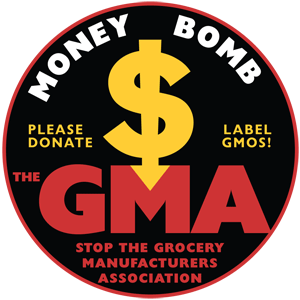
Speaking of courts of law… The Grocery Manufacturers Association of America (GMA), which consists primarily of pesticide producers and junk food manufacturers, is suing Vermont in an effort to overturn H.112—the first no-strings-attached GMO labeling in the US.5, 6, 7 H. 112 was passed by an overwhelming margin,8 and Governor Peter Shumlin signed the historic bill into law on May 8 this year.

The law will require food manufacturers to label genetically engineered (GE) foods sold in Vermont, and prohibits them from labeling foods with GE ingredients as “natural” or “all natural.” The GMA’s lawsuit claims that their members are going to end hunger with their pesticide-laden GMOs, but we already know that the problem with hunger is not production, it’s distribution. There’s more than enough food to go around; it’s just poorly distributed.

Besides, must Americans be kept in the dark about what we’re eating in order for the chemical technology industry to be able to “save the world” with its genetically engineered grains? To help Vermont defend its GMO labeling law against these multi-national giants, please consider making a donation to the Organic Consumers Fund, which has been set up to raise funds for this purpose. The fund has also pledged to help Oregon and Colorado pass their respective GMO labeling initiatives this November.
Beware the ‘DARK’ Act…

The GMA, whose 300-plus members include Monsanto, Coca-Cola, and General Mills, is also pushing a Congressional bill called the “Safe and Accurate Food Labeling Act of 2014.9 The bill, dubbed the “DARK” (Denying Americans the Right to Know) Act, would actually preempt all states from passing GMO labeling laws.10 It would also bar states from enacting laws that make it illegal for food companies to misrepresent their products by labeling GE ingredients as “natural.” Last but not least, the DARK Act would also limit the FDA’s power to force food companies to disclose GE ingredients.

Does any of this make you warm and fuzzy inside? Are these the actions of companies that have your best interest at heart? I would say no. They are trying to HIDE the presence of genetically engineered ingredients, and are pulling out ALL the stops to do so! Ask yourself, why? These companies—the very ones providing much of our food—are actually trying to take awayindividual state’s rights, just to ensure certain food ingredients remain hidden! Curiously enough, Monsanto is more than willing to “support” GMO labeling in other countries.

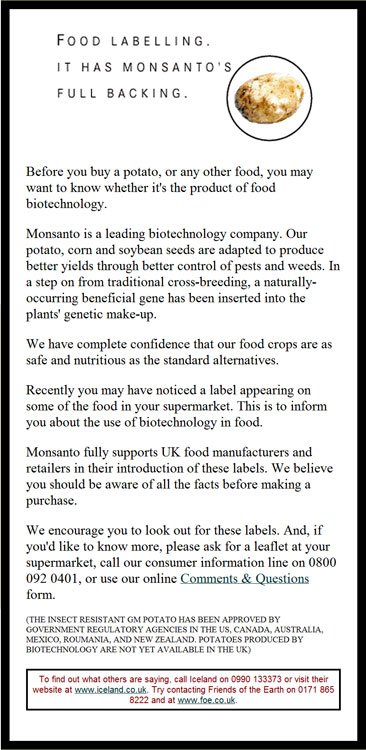
Here’s a Monsanto ad from the UK, letting British consumers know how much the company supports the mandatory labeling of their goods—even urging Britons to seek such labels out—ostensibly because Monsanto believes “you should be aware of all the facts before making a decision.” What’s the difference between British shoppers and American shoppers? Why does Monsanto support one nation’s right to know but not another? It’s time to put an end to this hypocritical charade and label foods in the US, as has been done in 64 other countries across the globe already!
American state rights were encouraged by our constitution, and the constitution was meant to prevent federal superpowers becoming corrupted and creating an authoritarian, fascist federal government. Sadly, we’ve watched our individual and state rights deteriorate over many decades, succumbing to these enormous industry powers, and this is probably one of the biggest, most blatant overreaches yet, proving that corporate interests are ruling the roost on Capital Hill. As stated by Marni Karlin, director of legislative and legal affairs for Organic Trade Association:11

Consumers, particularly the eight out of ten American families who buy organic products, want to know what is in their food. Rep. Pompeo’s bill ignores this consumer demand for information. Instead, it ties the hands of state governments, the US Department of Agriculture, and the Food and Drug Administration concerning GMO labeling. It is fatally flawed.”

What Happens in Oregon and Colorado in November Could Make or Break the GMO Labeling Movement

In addition to all this legal wrangling, opponents of GMO labeling spent more than $27 million on lobbying in the first six months of this year alone. This is about three times more than they spent during all of 2013, when they shelled out $9.3 million.12 Among the biggest spenders on anti-labeling lobbying were the Grocery Manufacturers Association (GMA) and major food makers such as Coca-Cola Co and PepsiCo Inc., along with chemical industry heavyweights like Monsanto and DuPont.

Undoubtedly, they are well aware that November is going to be a crucial turning-point for the GMO labeling movement. Both Colorado and Oregon have GMO labeling on their November ballots, and it’s absolutely imperative that we make a strong push to make sure these ballots succeed. So please, consider making a generous donation to the Organic Consumers Fund.

I know, it’s an uphill battle, but persistence pays! We cannot and will not give up now. During last year’s I-522 ballot campaign to label GMOs in Washington State, the Grocery Manufacturers Association (GMA) came up with a devious, and illegal, money-laundering scheme to protect the identity of members who donated funds to the opposing campaign. Unfortunately, this illegal move helped the GMA defeat I-522 by a mere one percent margin—ONE PERCENT!

Fortunately, the GMA was caught, and sued by Attorney General Bob Ferguson, who accused them of intentional money laundering and violating state campaign disclosure laws. They had to resort to illegal activity to beat us by one percent the last time… With that in mind, I am firmly convinced that we CAN win in both Colorado and Oregon. But it will take effort. And money, to make sure all the voters are informed enough to make a sound decision. It’s time for truth in labeling. Together, we can make it happen.

I recently named the GMA “the most evil corporation on the planet,” considering the fact that it consists primarily of pesticide producers and junk food manufacturers who are going to great lengths to violate some of your most basic rights—just to ensure that subsidized, genetically engineered and chemical-dependent, highly processed junk food remains the status quo.

The insanity has gone far enough. It’s time to unite and fight back, which is why I encourage you to boycott every single product owned by members of the GMA, including natural and organic brands. To learn more about this boycott, and the traitor brands that are included, please visit TheBoycottList.org. I also encourage you to donate to the Organic Consumers Fund. Your donation will help fight the GMA lawsuit in Vermont, and also help win the GMO labeling ballot initiative in Oregon in November.

Voting with your pocketbook, at every meal, matters. It makes a huge difference. By boycotting GMA Member Traitor Brands, you can help level the playing field, and help take back control of our food supply. And as always, continue educating yourself about genetically engineered foods, and share what you’ve learned with family and friends.

Recommended Supplements (These supplements help detoxify GMOs):

Further Reading:


Plastic bag ban may be signed into law in California

The California state legislature enacted a ban on single-use, plastic bags. Many cities, (several in California, Washington, and Texas) have made it illegal for grocery stores and restaurants to use plastic bags at checkout, but if the bill is signed into law, California would be the first to enact a statewide ban on plastic bags.

Plastic bags take up to 1,000 years to decompose and are causing notorious environmental problems worldwide, from blocking drains that can lead to flooding, to killing animals that become entangled in discarded bags or choke on the plastic. The damage done by plastic bags costs taxpayers millions every year, and considering long term environmental degradation, the cost down the road is staggering.

The senator who sponsored the bill, Alex Padilla, said, “Single-use plastic bags not only litter our beaches, but also our mountains, our deserts, and our rivers, streams and lakes.”

The California Senate voted 22-15 in favor of the bill. It needs to be signed into law by the 30th of September by Governor Jerry Brown, who has yet to identify a position on the measure.

Not only would the bill ban grocery stores from giving out disposable, plastic, grocery bags at checkout, the bill would also provide funds for local plastic bag manufactures to help them retool to make reusable bags.

Despite intense lobbying efforts from plastic bag manufacturers, the tide is turning. It won’t be long before plastic grocery bags are a thing of the past.

Most consumers and environmental experts believe that paper bags are a better option than plastic, though there is some debate on the issue. American Plastic Manufacturing, a company based out of Seattle, states that plastic bags are not made with petroleum; they are made with a byproduct of natural gas refining, that would otherwise be put into the atmosphere. They also state that paper bags require more resources to produce.

While the obvious solution is to bring your own reusable bags, American Plastic Manufacturing also claims that this may not be the smartest environmental choice either. But then again, they sell reusable bags on their website.

If you’re in the mood for some humor in regards to forgetting your reusable bags at the grocery store, check out Canvas Bags.

Sources:

Reuters

abc News


Autism and Vaccines: CDC Whistleblower Exposes Vaccine Dangers, Lies, and Cover-ups

According to a study by Focus Autism Foundation, a CDC whistleblower revealed manipulation of scientific data in regards to the MMR vaccine. There was pressure from the top to get CDC (The Center for Disease Control and Prevention) scientists to support government policies on Vaccine Safety, ignoring and hiding the risks involved.

It turns out that the CDC knew about increased autism rates among African-American Boys who received MMR shot earlier than 36 months.

A top research scientist working for the Centers for Disease Control and Prevention (CDC) played a key role in helping Dr. Brian Hooker of the Focus Autism Foundation uncover data manipulation by the CDC that obscured a higher incidence of autism in African-American boys. The whistleblower came to the attention of Hooker, a PhD in biochemical engineering, after he had made a Freedom of Information Act (FOIA) request for original data on the destefano et al MMR (measles, mumps, rubella) and autism study.” – marketwatch.com

Dr. Hooker stated “The CDC knew about the relationship between the age of first MMR vaccine and autism incidence in African-American boys as early as 2003, but chose to cover it up.”

The whistleblower confirmed this.

The CDC whistleblower informant, who has worked for the government agency for over a decade, remarked to Dr. Hooker in phone calls: “We’ve missed ten years of research because the CDC is so paralyzed right now by anything related to autism. They’re not doing what they should be doing because they’re afraid to look for things that might be associated.” The whistleblower alleges criminal wrongdoing of his supervisors, and he expressed deep regret about his role in helping the CDC hide data.” focusautisminc.org

For those who don’t regularly keep up with vaccine news, this may come as a bit of a shock. Most of us that are in the know are aware of the fact that the CDC and vaccine manufacturers know vaccines can increase the risk for autism and other very serious health issues. That’s not really news. The news here lies in the fact that the CDC has been exposed as the fraudulent special-interest organization that people in natural health have suspected them to be for some time now. There are also, obviously, huge racial issues implied as well.

We at OLM are not saying that vaccines do not have any value. They may. The problem is that it’s naive to believe the powers that be when they tell you that there is nothing wrong with injecting yourself with ingredients known to be very toxic. Furthermore, we at OLM advocate a level of health that builds natural immunity. We do not believe that good health is a crapshoot, a roll of the dice. We know that good health is a result of eating right, exercise, getting plenty of clean nutrition and sunlight, and getting enough sleep. Health cannot be found in a pill bottle or a shot. Nature weeds out the weak. We choose to stay strong, and we choose not to trade one disease for another.

We suspect that this is just the tip of the iceberg, and we will keep you updated.

In the meantime, remember this. When there’s a lot of money involved, there is always corruption. And there is a lot of money in vaccinations.

Further Reading:
Sources:


New Data Reflects the Continued Demand for Farmers Markets

WASHINGTON, August 2, 2014 – The U.S. Department of Agriculture’s (USDA) Agricultural Marketing Service (AMS) Administrator Anne Alonzo announced today that USDA’s National Farmers Market Directory now lists 8,268 markets, an increase of 76 percent since 2008. The data reflects continued demand and growth of farmers markets in every region of the country. Alonzo also announced that AMS is developing three new local food directories that will expand USDA’s support for local and regional foods by providing easy access to the most current information about the local food market.

Alonzo made the announcements at the Dane County Farmers Market in Madison, Wisconsin, the country’s largest producer-only market, where she kicked off the 15th annual “National Farmers Market Week”, from August 3 through 9, 2014.

“The National Farmers Market Directory numbers reflect the continued importance of farmers markets to American agriculture. Since its inception, the directory has proven to be a valuable tool for accessing up-to-date information about local farmers markets,” Alonzo said. “Farmers markets play an extremely important role for both farmers and consumers. They bring urban and rural communities together while creating economic growth and increasing access to fresh, healthy foods.”

The USDA National Farmers Market Directory, available at farmersmarkets.usda.gov, provides information about U.S. farmers market locations, directions, operating times, product offerings, and much more. The data is collected via voluntary self-reporting by operating farmers market managers and is searchable by zip code, product mix, and other criteria. The National Farmers Market Directory receives over 2 million hits annually.<

In addition to USDA’s National Farmers Market Directory, AMS is adding:

  • USDA’s National Community-Supported Agriculture (CSA) Enterprise Directory
    A CSA is a farm or network/association of multiple farms that offer consumers regular deliveries of locally-grown farm products during one or more harvest season(s) on a subscription or membership basis.
  • USDA’s National Food Hub Directory
    A Food Hub is a business or organization that actively manages the aggregation, distribution, and marketing of source-identified food products to multiple buyers from multiple producers, primarily local and regional producers, to strengthen the ability of these producers to satisfy local and regional wholesale, retail, and institutional demand.
  • USDA’s National On-Farm Market Directory
    An On-Farm Market is a farm market managed by a single farm operator that sells agricultural and/or horticultural products directly to consumers from a location on their farm property or on property adjacent to that farm.

USDA invites local food business owners who fall within these categories to list their operational details in the new directories www.usdalocalfooddirectories.com. These new directories will be available online early in 2015, giving potential customers, business partners, and community planners easy, one-stop access to the most current information about different sources of local foods.

2014 Directory Highlights

According to USDA’s 2014 National Farmers Market Directory, the states with the most farmers markets reported are California (764 markets), New York (638 markets), Michigan (339 markets), Ohio (311 markets), Illinois (309 markets), Massachusetts (306 markets), Pennsylvania (297 markets), Wisconsin (295 markets), Virginia (249 markets), and Missouri (245 markets). All geographic regions saw increases in their market listings, with the most growth in the South. The 10 states with the biggest increases in the numbers of farmers markets include Tennessee, Louisiana, Texas, Hawaii, Massachusetts, Arkansas, North Carolina, Montana, Florida and Nebraska.  Five of these states – Tennessee, Louisiana, Texas, Arkansas, and North Carolina – are part of USDA’s StrikeForce for Rural Growth and Opportunity, where USDA has increased investment in rural communities through intensive outreach and stronger partnerships.

Farmers market development is a cornerstone of USDA’s Know Your Farmer, Know Your Food Initiative, which coordinates the Department’s policy, resources, and outreach efforts related to local and regional food systems.  Secretary Vilsack has identified strengthening local food systems as one of the four pillars of USDA’s commitment to rural economic development.

USDA Office of Communications


One More Good Reason to Avoid Processed Dairy: it Shockingly Contains Hidden MSG

(NaturalNews – Zach C. Miller) The risks of flavor enhancing food additive MSG (monosodium glutamate) are well known to many NaturalNews readers. MSG should be avoided, considering the fact that it is a dangerous excitotoxin that kills brain cells in the hypothalamus, promotes obesity and liver disease, and is linked to seizures, migraines, ADD/ADHD and heart palpitations. Unfortunately, MSG is hidden in many foods and products, which makes it difficult to avoid even for informed buyers. MSG is difficult to locate on ingredient labels because it goes by names other than “monosodium glutamate.” Worse still, it is shockingly hidden in foods you would never expect, such as dairy products.

Hidden MSG in dairy products

Unfortunately, the pasteurization process used in conventional dairy products actually creates free glutamic acid (MSG). The heat of pasteurization breaks down milk protein which results in the creation of free glutamic acid. This creation of MSG can occur from anything that breaks down protein in a food or product. This effect in exacerbated in “ultra-pasteurized” products due to even higher temperatures. And as you might expect, you’ll see no mention of MSG or free glutamic acid on the ingredient label. Any of the these dairy products may contain MSG: fat-free milk, powdered milk, “ultra-pasteurized” anything, cottage cheese, reduced fat milk, cream or half and half, ice cream, cream cheese and yogurt. In other words, almost all conventional dairy products are suspect. And if you think you’re safe as long as you buy organic dairy, think again; even organic may contain MSG.

Foods and consumer products that potentially contain hidden MSG

In addition to being hidden in conventional pasteurized dairy, MSG is unfortunately and shockingly hidden in tons of products one would never expect. Some products and food containing hidden MSG are:

processed foods
dietary supplements
cosmetics
personal care products
pharmaceuticals
pet and animal food and feed
conventional produce wax
pesticides and herbicides
fertilizers and plant growth enhancers
soaps, shampoo, hair conditioners
cosmetics
protein powders, shakes, drinks and bars
restaurant food (even when claimed to be MSG-free)
beverages
candy
chewing gum
infant formulas, foods
kosher food

MSG by any other name

MSG is found in may food ingredient additives. You can scan you favorite foods for these to find out if you’re unwittingly and unknowingly eating MSG. These are hidden sources of MSG which lurk in dozens of food products:

autolyzed yeast extract
hydrolyzed corn gluten
hydrolyzed pea protein
textured protein
autolyzed plant protein
yeast extract
calcium caseinate
sodium caseinate
protein fortified anything
enzyme modified anything
gelatin
disodium inosinate
disodium guanylate
xanthum gum
natural flavor
barley malt
malt extract
maltodextrin
carrageenan
soy protein isolate
soy protein concentrate
whey protein isolate
whey protein concentrate
protease enzymes
citric acid.

As you can see, MSG shockingly hides almost everywhere and in everything. However, it is better to be informed about this dangerous neurotoxin than not be so that you can reduce your exposure and intake of it.

Sources for this article include:
http://www.truthinlabeling.org/II.WhereIsMSG.html
http://www.rense.com/general92/hidename.html
http://philosophers-stone.co.uk


Organic Family Farms are Likely to Suffer from Wal-Mart’s Foray into Organic Food Industry

(NaturalNews – Julie Wilson) What happens when large, powerful corporations violate the law and are immune from prosecution or accountability? They usually become repeat offenders, and in this situation, Wal-Mart, the culprit, is no exception.

About seven years ago, the big box store was accused of “cheapening the value of the organic label by sourcing products from industrial-scale factory farms and developing countries, including China,” according to a report by The Cornucopia Institute, a farm policy research group that acts as an organic industry watchdog.

Around that time, Wal-Mart also partnered with Horizon Organic, which is owned by dairy giant Dean Foods, and became the largest retailer of organic milk. Wal-Mart then used Aurora Organic Dairy, located in Aurora, Colorado, to package their own private-label organic milk.

Organic watchdog groups bust Wal-Mart for violating USDA food standards in 2005 

In 2005, The Cornucopia Institute blew the whistle on the company’s operations, alleging that it was violating USDA organic rules by confining more than 4,000 dairy cows to their cages, instead of letting them graze freely, as required by federal organic standards.

Understanding that organic consumers are label checkers who genuinely care about the quality of food, and how animals are treated, Wal-Mart deceptively marketed their products to depict happy cows, grazing on lush green pastures, with some campaigns even using graphics of small family farms.

The truth is that the dairy cows used to produce Wal-Mart’s “organic” milk were living short, stressful lives in filthy industrial facilities, exactly the type of environments which organic consumers seek to avoid.

The watchdog’s investigation found that Aurora Organic Dairy “willfully” violated 14 tenets of USDA organic standards and was caught labeling “natural” food as organic.

Despite the findings, Wal-Mart was not prosecuted but agreed to remove fraudulent signage and was allowed to continue operating without being fine a cent.

Now, the big box giant is back at it, preparing to introduce a new line of organic products that the company promises will “drive down organic food prices,” marketing them as 25 percent cheaper than the organic food currently on shelves.

This time, Wal-Mart isn’t revealing the source for their organic products and is instead using a private-label supplier and marketing products under the Wild Oats brand, a former natural foods grocery chain temporarily owned by Whole Foods in 2009 before an antitrust rule forced the company to divest its holdings.

Whole Foods then sold Wild Oats’ licensee rights to Luberski Inc., another food distributor, in 2010. Wild Oats’ physical locations were “parceled out” to buyers like Trader Joe’s and Kroger, Gelsons, according to an LA Times report.

However, Wild Oats made a comeback due to a generous donation from American venture capitalist Ronald Burkle, co-founder and managing partner of The Yucaipa Companies, LLC, a firm specializing in helping underperforming businesses.

Burkle reportedly intends to revamp the company by offering catering and take-out food services, home delivery and phone-in orders.

When Wild Oats CEO Tom Casey was asked how their partnership with Wal-Mart intended to deliver organic products, including pasta and cookies, more cheaply, his reply was, “Bigger can be better,” as paraphrased by NPR.

Considering Wal-Mart’s past with organic food, some experts aren’t convinced.

Michael Pollan, author of The Food Movement, Rising, said in an interview with the St. Paul Pioneer Press that he’s concerned that the expansion of “Big Organic” will lower food quality, weaken standards and hurt small family farms.

Organic food costs more, because it’s more expensive to produce, “and paying farmers a fair price has always been part of the deal,” said the Cornucopia Institute.

Will Wal-Mart tweak its business model in a way that allows them to offer organic foods without premium prices, while still adhering to organic federal standards?

Perhaps, but past behavior is usually a good indicator of future behavior, and Wal-Mart’s track record does little to assure skeptics.

Additional sources:
http://www.cornucopia.org
http://www.npr.org
http://rimcountrygazette.blogspot.com
http://articles.latimes.com
http://science.naturalnews.com