Five Tips to Keeping Your Furry Friend Healthy and Well Fed

(Corucopia – Linley Dixon, PhD) Pet food quality varies significantly and all too often includes dangerous chemical additives. In many cases CONSUMERS get what they pay for, but price doesn’t always indicate high quality. The good news is that discriminating shoppers will soon have a new tool helping them to weed through product labels and separate the good from the bad.

The Cornucopia Institute has completed a thorough analysis of the pet food industry and will release a detailed report this winter.

Our study reveals that many complete DIET products significantly sway from the natural, wild diets of cats and dogs in terms of protein, fat and carbohydrate percentages. The majority of both dog and CAT FOOD product formulations contain too many grains and starches, including corn, wheat, rice, oats, peas, and potatoes. In addition, many products contain questionable and/or unnecessary ingredients.

Meanwhile, among the most common causes of death for both cats and dogs are diseases affiliated with poor diet including obesity, cardiovascular disease, gastrointestinal diseases and cancer.

Cornucopia’s report examines specific ingredients to avoid and includes a web-based buyer’s guide that will help CONSUMERS find high quality and safe pet foods. In the meantime, the following tips will help you get started finding the best food for your cats and dogs.

1. Avoid carrageenan:

You may be unknowingly harming your pets by feeding them wet food, even from the most expensive “premium” brands—despite extra care taken to find formulations high in animal-based proteins, low in fat and carbohydrates, and even USDA certified organic. Our research found that greater than 70% of canned pet foods contain carrageenan, a non-nutritive food stabilizer extracted from red seaweed. Peer-reviewed and published research indicates that carrageenan is known to cause intestinal INFLAMMATION with the potential to lead to cancer, even in small doses.

Carrageenan is a non-nutritive thickener and emulsifier that can easily be replaced by safer alternatives in pet foods, including tomato paste, guar gum, potato starch, pea starch, tapioca, and garbanzo bean flour.

New independent research (published in 2014) at the Jesse Brown VA Medical Center in Chicago, using both human and mouse epithelial cells, further demonstrates the mechanism by which inflammatory responses occur after carrageenan exposure using doses less than the anticipated average daily intake (50 mg/30 g mouse vs. 250 mg/60 kg person). This research demonstrates for the first time that carrageenan-induced INFLAMMATION occurs in both humans and mice, indicating that it is likely to cause a similar reaction in all mammals, including cats and dogs.

Pets that eat primarily wet food with carrageenan will consume daily doses of carrageenan in amounts known to cause INFLAMMATION. In fact, inflammatory bowel disease (IBD) in cats is the most common cause of vomiting and diarrhea.

Unfortunately, policy changes are often years behind the latest scientific research due to corporate lobbying and industry-funded studies that conflict with independent research.

Some pet food brands are now advertising that they do not include carrageenan, such as Zignature dog food and Weruva CAT FOOD. Meanwhile, Hill’s Science DIET contains carrageenan, despite the label stating the brand is “veterinary recommended.”

2. Buy organic (but without carrageenan):

Many high-end “natural” pet foods contain carrageenan—and even Newman’s Own Organics wet cat food (which is not actually certified organic but, rather, “made with” organic ingredients) contains the ingredient. Organic foods should be a safe haven from chemical residues, ANTIBIOTICS and questionable synthetic ingredients. Sadly, in this case, pet owners need to pay extra attention.

There are two USDA Organic wet dog food brands that do not contain carrageenan: Organix and Cocolicious. However, there are no certified organic cat food brands that do not use carrageenan in at least one of their flavors. It is important to read each product label; Organix cat food shredded chicken flavors, for example, contain carrageenan although the majority of the brand’s flavors do not.

3. Don’t fall for non-GMO claims (unless you see the USDA Organic label):

Some pet food brands, such as Wellness, advertise that they are “made with naturally GMO-free ingredients.” This is likely an intentionally misleading claim. Without the USDA Organic label, you can assume that the feed given to the livestock used to produce these pet food products is almost certainly GMO.

Wellness brand products do not display the USDA Organic seal. Over 90% of the soybean and corn currently produced in the U.S. is GMO. Though pet foods can test to be GMO-free, this does not mean that the meat animals were fed GMO-free feed throughout their life.

The USDA Food Safety Inspection Service has only recently approved a non-GMO label for meat only if that producer can prove all the animal feed required to feed the number of animals owned is GMO-free. This label is currently missing from all pet food brands, despite non-GMO claims. Thus, only the presence of the USDA Organic label reliably ensures that meat animals were fed non-GMO grain.

4. Avoid these ingredients, too:

Pet food manufacturers don’t advertise the fact that pet food is composed primarily from food industry waste. Animal fat and animal meat and bone meal (MBM) are common pet food ingredients that are products of rendering (boiling waste products to sterilize them). Animal fat and MBM often come from a mix of different animal species, including expired grocery store meat, animals that died on the farm, and RESTAURANT scraps, including used grease from deep-fat fryers.

Animal fat and MBM are the ingredients in pet food most likely to correlate with the presence of sodium pentobarbital, the drug used by veterinarians and shelters for euthanasia. Needless to say, these are not ingredients you want your dog and cat to be eating.

Corn gluten meal should also be avoided. It is used primarily as a cheap substitute for meat since cats and dogs are carnivorous and should have diets primarily based on meat.

In addition, synthetic preservatives should be avoided, including BHABHT, and propyl gallate, since research has linked them to several health concerns, including cancer. Natural preservatives, such as ascorbic acid (VITAMIN C C), tocopherols (vitamin E), and plant-based oils (such as rosemary oil), are better alternatives.

5. Home-cook your pet’s food:

One way to ensure a HEALTHY DIET for your companion animals is to cook for them yourself. Many chronic problems such as allergies, vomiting, diarrhea, and skin problems can be solved with homemade meals. Cornucopia’s report provides veterinarian-approved recipes and advice for cooking at home for both cats and dogs.

In conclusion, the pet food industry is no different than leading MARKETERS of human food when it comes to cheap substitutes and false health claims. Take matters into your own hands by reading labels and choosing high quality ingredients. Cornucopia’s soon-to-be-released report can help you.


5 Food Policy Lessons the U.S. Could Learn from Latin America

(Cornucopia – CivilEats – by Andy Bellatti) When it comes to nutrition and public health, the U.S. can learn a lot from Latin America. Over the past year, Mexico, Brazil, and several other countries in South and Central America have passed some very progressive policies, often placing public health interests above those of the food industry. This is particularly impressive given the expensive politicking the food industry has engaged in in Latin America against public health policies. Here are five recent efforts we should all be watching:

1. Bold Dietary Guidelines in Brazil

Earlier this year, Brazil broke new ground by releasing ten draft dietary guidelines which warned against processed foods and even addressed deceptive marketing by the food industry. This week, the nation released its final version.

The guidelines are, of course, written in Portuguese, but New York University professor Dr. Marion Nestle translated them into English.

Some examples of the succinct, yet powerful, messaging? “Limit consumption of ready-to-eat food and drinks,” “avoid fast food chains,” and “be critical of the commercial advertisement of food products.”

Our dietary guidelines are apolitical, vague, and meek, by comparison. They read: “Prevent and/or reduce overweight and obesity through improved eating and physical activity behaviors,” “maintain appropriate calorie balance during each stage of life – childhood, adolescence, adulthood, pregnancy and breastfeeding, and older age,” “increase vegetable and fruit intake.” Let’s hope next year’s update takes some cues from Brazil.

Read more about Brazil’s new guidelines in this story we ran in March, shortly after they were announced.

2. Fruit Vending Machines in Argentina

Earlier this month, Buenos Aires mayor Mauricio Macri announced that fruit vending machines will soon be installed at the 35 wellness centers that have opened throughout the country’s capital since June of 2012. These wellness centers–located in various parks and train stations–have doctors, nurses and nutritionists on staff, and provide people with a chance to have their weight, height, blood pressure, and blood sugar checked at no cost. Free nutrition counseling is also available, and some offer free yoga classes and walking groups. As of January 2014, half a million Buenos Aires residents took advantage of this public service.

And, soon enough, they’ll also be able to buy a piece of fruit on their way out, if they so choose. It sure is nice to see real food offered, as opposed to “healthwashed” processed offerings like baked chips, cookies with a dusting of whole grains, and diet sodas.

3. Front-of-package Warning Labels in Chile

Much to the disappointment of many large food producers, Chile has a new front-of-package labeling system that specifically points out what food and beverage products surpass government-established limits for calories, sugar, sodium, and saturated fat (via this black “excess of…” label on the front of packages).

What’s more, any product that is too high in any of those categories may not be sold in schools, and it is forbidden to target ads for said products to children under the age of 14.

There are some valid criticisms to this approach (mainly that by focusing on very specific nutrients “of concern,” food companies can technically reformulate minimally nutritious, highly-processed products in a way that manage to meet criteria without making them truly healthy). But this is nevertheless an important effort, as it is a front-of-package labeling scheme meant to deter the purchase of certain products.

4. Traffic Light Labeling in Ecuador

This small South American country recently instituted a traffic light labeling system for packaged foods. According to the Ecuadorian newspaper El Comercio:

August 29, 2014, was the deadline for 375 large and medium-sized companies to label the amounts of salt, fat, and sugar on their processed foods’ packaging. Labeling consists of a traffic light: red for products high in these values; yellow for medium values, and green for low values.”

Smaller companies have until November 29, 2014, to meet this new requirement.

Industry has long feared traffic light labeling and battled it globally for years with very expensive lobbying campaigns (no company wants its products to carry multiple red lights), so this is certainly a win for public health. The fact that all fat is lumped together is slightly problematic–imagine baked Cheetos getting a green light, while walnuts get a red light!–but at least this means that healthwashed items like children’s cereals with added corn dust for fiber will be called out for their high sugar content.

This image shows a pack of marshmallows available at an Ecuadorian supermarket, with both the traffic light labeling system (“high in sugar,” “low in fat”) as well as a “contains GMOs” (“contiene transgenicos”) label. Ecuador is one of 64 countries that has mandatory labeling of GMOs.

5. Soda Taxes in Mexico

Although domestically we now have a soda tax in Berkeley, CA (proposition E in San Francisco received 54.5 percent of the vote but not the 66.67 percent required to pass), our neighbor to the South passed a nationwide soda tax at the beginning of this year. It was an especially meaningful victory for public health advocates considering that Mexico is the world’s top consumer of soda (on average each person drinks 43 gallons per year), and that Coca-Cola aggressively forced its classic soft drink onto the native population of Chiapas.

Even better? The soda tax has proven effective. As the Wall Street Journal reported earlier this month:

A separate study conducted earlier this year by Mexico’s National Institute of Public Health measured the decline in sugary beverage consumption at 10 percent during the first three months of 2014, compared with the same period last year. That study also reported a 7 percent rise in purchases of beverages that aren’t subject to the new tax, such as plain bottled water and milk.”

When it comes to food policy, the United States should consider looking to “developing nations” for well-developed strategies.


U.S.D.A. Approves Modified Potato. Next Up: French Fry Fans

(Cornucopia – New York Times – by Andrew Pollack) A potato genetically engineered to reduce the amounts of a potentially harmful ingredient in French fries and potato chips has been approved for commercial planting, the Department of Agriculture announced on Friday.

The potato’s DNA has been altered so that less of a chemical called acrylamide, which is suspected of causing cancer in people, is produced when the potato is fried.

The new potato also resists bruising, a characteristic long sought by potato growers and processors for financial reasons. Potatoes bruised during harvesting, shipping or storage can lose value or become unusable.

The biotech tubers were developed by the J. R. Simplot Company, a privately held company based in Boise, Idaho, which was the initial supplier of frozen French fries to McDonald’s in the 1960s and is still a major supplier. The company’s founder, Mr. Simplot, who died in 2008, became a billionaire.

The potato is one of a new wave of genetically modified crops that aim to provide benefits to consumers, not just to farmers as the widely grown biotech crops like herbicide-tolerant soybeans and corn do. The nonbruising aspect of the potato is similar to that of genetically engineered nonbrowning apples, developed by Okanagan Specialty Fruits, which are awaiting regulatory approval.

But the approval comes as some consumers are questioning the safety of genetically engineered crops and demanding that the foods made from them be labeled. Ballot initiatives calling for labeling were rejected by voters in Oregon and Colorado this week, after food and seed companies poured millions of dollars into campaigns to defeat the measures.

The question now is whether the potatoes — which come in the Russet Burbank, Ranger Russet and Atlantic varieties — will be adopted by food companies and restaurant chains. At least one group opposed to such crops has already pressed McDonald’s to reject them.

Genetically modified potatoes failed once before. In the late 1990s, Monsanto began selling potatoes genetically engineered to resist the Colorado potato beetle. But the market collapsed after big potato users, fearing consumer resistance, told farmers not to grow them. Simplot itself, after hearing from its fast-food chain customers, instructed its farmers to stop growing the Monsanto potatoes.

This time around could be different, however, because the potato promises at least potential health benefits to consumers. And unlike Monsanto, Simplot is a long-established power in the potato business and presumably has been clearing the way for acceptance of the product from its customers.

Simplot hopes the way the potato was engineered will also help assuage consumer fears. The company calls its product the Innate potato because it does not contain genes from other species like bacteria, as do many biotech crops.

Rather, it contains fragments of potato DNA that act to silence four of the potatoes’ own genes involved in the production of certain enzymes. Future crops — the company has already applied for approval of a potato resistant to late blight, the cause of the Irish potato famine — will also have genes from wild potatoes.

“We are trying to use genes from the potato plant back in the potato plant,” said Haven Baker, who is in charge of the potato development at Simplot. “We believe there’s some more comfort in that.”

That is not likely to persuade groups opposed to such crops, who say altering levels of plant enzymes might have unexpected effects.

Doug Gurian-Sherman, a plant pathologist and senior scientist at the Center for Food Safety, an advocacy group, said that the technique used to silence the genes, called RNA interference, was still not well understood.

“We think this is a really premature approval of a technology that is not being adequately regulated,” he said, adding that his group might try to get a court to reverse the approval of the potato.

He said one of the substances being suppressed in the Innate potatoes appeared to be important for proper use of nitrogen by the plant and also for protection from pests.

The Agriculture Department, in its assessment, said the levels of various nutrients in the potatoes were in the normal range, except for the substances targeted by the genetic engineering. Simplot has submitted the potato for a voluntary food safety review by the Food and Drug Administration.

The company says that when the Innate potatoes are fried, the levels of acrylamide are 50 to 75 percent lower than for comparable nonengineered potatoes. It is unclear how much of a benefit that is.

The chemical causes cancer in rodents and is a suspected human carcinogen, though the National Cancer Institute says that scientists do not know with certainty if the levels of the chemical typically found in food are harmful to human health.

Still, Gregory Jaffe, biotechnology project director at the Center for Science in the Public Interest, a consumer group that deals with nutrition issues, welcomed the approval. “We support clearly trying to reduce consumers’ exposure to acrylamide and if this product helps do that, I think it’s a benefit,” he said.

Last year, the F.D.A. issued draft guidance advising the food industry how to reduce levels of acrylamide, which is also found in some baked goods, coffee and other foods. The agency listed numerous steps that could be taken in the growing, handling and cooking of potatoes. Many food companies no doubt have already taken steps to reduce acrylamide levels and might not need the genetically engineered potatoes.

Whether McDonald’s, which did not respond to requests for comment, adopts the potatoes is somewhat academic for at least another couple of years. Simplot anticipates that only a few thousand out of the nation’s more than one million acres of potatoes will be planted with Innate potatoes next year, far too little to serve fast-food chains.

Instead, the company will focus on sales of fresh potatoes and fresh-cut potatoes to supermarkets and food service companies and to potato chip manufacturers, said Doug Cole, a spokesman for Simplot.

The National Potato Council, which represents potato farmers, welcomed the approval, albeit with reservations.

John Keeling, chief executive of the trade group, said growers wanted new technology. But in comments to the Agriculture Department, the group has expressed concern that exports could be disrupted if genetically engineered varieties inadvertently end up in shipments bound for countries that have not approved the potatoes.

China, for instance, recently turned away shipments of corn containing small amounts of a genetically engineered variety developed by Syngenta that it had not approved for import. Some corn farmers and exporters have sued Syngenta for their losses.

Mr. Cole of Simplot said growers would have to keep the genetically engineered potatoes separate from others and out of exports at least for now. The company plans to apply for approval of the potatoes in the major markets, starting with Canada, Mexico, Japan and then other parts of Asia.


When It Comes to Food Packaging, What We Don’t Know Could Hurt Us

(Cornucopia – Ensia – by Elizabeth Grossman) It’s almost impossible to imagine life without flexible, transparent and water-resistant food packaging, without plastic sandwich bags, cling film or shelves filled with plastic jars, tubs and tubes, and durable bags and boxes.

While storing food in containers dates back thousands of years, and food has been sold in bottles since the 1700s and cans since the 1800s, what might be considered the modern age of food packaging began in the 1890s when crackers were first sold in sealed waxed paper bags inside a paperboard box. Plastics and other synthetics began to appear in the 1920s and ’30s, shortly after chemical companies started experimenting with petroleum-based compounds and pioneering new materials that could be used for household as well as industrial applications.

Fast forward to 2014: Upwards of 6,000 different manufactured substances are now listed by various government agencies as approved for use in food contact materials in the U.S. and Europe — materials that can legally go into consumer food packaging, household and commercial food containers, food processing equipment, and other products.

Recent analyses have revealed substantial gaps in what is known about the health and environmental effects of many of these materials and raised questions about the safety of others. A study published this past July found that 175 chemicals used in food contact materials are also recognized by scientists and government agencies as chemicals of concern — chemicals known to have adverse health effects. Another published in December 2013 found that more than 50 percent of food contact materials in the U.S. Food and Drug Administration database of such substances lacked accompanying toxicology information filed with the FDA about the amount people can safely eat. This database is publicly available and searchable, but the database itself doesn’t include toxicology information about these substances or any details of the products in which the listed chemicals are used.

Presumably, the primary goal of food packaging is to keep food safe to eat. But what do we actually know about the stuff that surrounds our food? What do we know about how these materials may interact with the food they touch, or their potential effects on human health and the environment?

Plastics, Coatings, Colors, Glues

In the U.S., the FDA regulates food contact materials, classifying them as “indirect food additives.” These materials, which fall under the jurisdiction of the Food Drug and Cosmetic Act, include not only the polymers that make up plastics but also resins and coatings used in can linings and jar lids, pigments, adhesives, biocides and what the FDA charmingly calls “slimicides.” The FDA distinguishes these substances from those added to food itself by explaining that food contact materials are “not intended to have a technical effect in such food,” meaning that these substances are not supposed to change the food they touch.

This categorization makes such substances exempt from food ingredient labeling requirements, explains Dennis Keefe, director of the FDA’s Office of Food Additive Safety. In other words, food packaging need not carry any information about what it’s made of. Any such information is voluntary, often geared toward facilitating recycling and sometimes part of marketing campaigns declaring a product “free of” a substance of concern.

“Food packaging chemicals are not disclosed, and in many cases we don’t have toxicology or exposure data,” explains Maricel Maffini, an independent scientist and consultant who specializes in food additives research. Yet a core component of the FDA’s regulation of food contact materials is based on the assumption that these substances may migrate into and be present in food.

In fact the FDA’s system for approving food contact materials — which it does on an individual basis, with approval granted to a specific company for a particular intended use — depends on how much of a substance is expected to migrate into food. This is assessed based on information a company submits to the FDA; the FDA may come back to a company with questions and do its own literature search, but it doesn’t send the substances to a lab for testing as part of the approval process. The higher the level of migration, the more extensive toxicological testing the FDA requires.

“We’re talking parts per billion,” explains George Misko, partner at Keller & Heckman, a Washington, D.C.–based law firm that specializes in regulation. But that’s a level at which some chemicals used in food packaging have been found to be biologically active.

Beyond the Container

But there’s “more than the threshold of migration” that needs to be considered when assessing food contact material safety, says Jane Muncke, managing director and chief scientific officer of the Zurich-based nonprofit Food Packaging Forum. In addition to the materials themselves, Muncke explains, these substances’ chemical breakdown and by-products need to be considered. This means that there are lots more individual chemicals that may be touching food — and therefore be detectable in food — than those present in the packaging as formulated. For polymers — the large molecules that typically make up plastics — these breakdown and by-products “can be significant,” says Muncke.

These additional breakdown and by-product chemicals also contribute to issues of chemical safety assessment, explains Maffini. Chemical regulations typically consider chemicals one at a time, when in reality we’re exposed to multiple chemicals concurrently, including those present in food. So the individual chemical assessments that determine food contact material approvals may not capture all the ways in which a single substance may interact with food, human bodies or the environment. The list of chemicals measured by the U.S. Centers for Disease Control and Prevention’s National Health and Nutrition Examination survey offers a snapshot of this issue. It includes in its biomonitoring (testing for chemicals in the human body) not only whole chemicals to which people may be exposed, but also numerous compounds that occur only after these chemicals enter and are metabolized by the human body.

As Muncke and other scientists have pointed out, while food contact materials are not intended to alter food, they are not necessarily inert or biologically inactive. This is where the parts-per-billion levels that trigger the FDA’s testing levels for food contact materials quickly gets complicated.

Back in the 1950s when the U.S. government laid the groundwork for current food additive regulations, the scientific assumption was that the higher the level of exposure, the greater a chemical’s biological effect. The focus of concern then was acute effects: birth defects, genetic mutations and cancers. Since the mid-1980s, however, and especially in the last 10 to 15 years, scientific evidence indicating that low levels of exposure — particularly to chemicals that can affect hormone function — can have significant biological effects has been accumulating rapidly. So has evidence that such exposures can lead to chronic effects on metabolic, reproductive, neurological, cardiovascular and other body systems and can set the stage for health disorders that may take years to become apparent. Yet from an FDA regulatory perspective, such low dose effects are very much still under review as they are, for example, for bisphenol A, a building block of polycarbonate plastic that is used widely in food contact products and — as an endocrine disrupter — has become a focal point in the public debate over safety of food contact materials.

Chemicals of Concern

“The last 20 years has seen more innovation in packaging than almost anything else,” says Misko. So where are the scientists who scrutinize food packaging and contact materials looking to better understand potential exposure effects, given the large universe of these materials?

They are looking both at materials used widely in consumer packaging and at materials used commercially to store and process food. While extensive research into health effects of BPA continues, phthalates, another long-used category of chemicals that has also been identified as having hormonal effects, is receiving additional research attention. One use of phthalates — of which there are many different types — is as plasticizers, often with polyvinyl chloride. Numerous studies, including those conducted by scientists at the U.S. National Institutes of Health and Environmental Protection Agency, to name but a very few of those published, have now linked various phthalates to adverse male reproductive hormone effects and have found associations between phthalate exposure and childhood asthma. While the American Chemistry Council says that “phthalates do not easily migrate,” the final report of the U.S. Consumer Product Safety Commission Chronic Hazard Advisory Panel on Phthalates released in July (the panel was convened under the 2008 Consumer Product Safety Improvement Act that also restricted use of certain phthalates in children’s products but doesn’t affect food packaging), found food to be a significant source of phthalate exposure. Recent studies, including those by researchers at the National Institutes of Health, New York University, University of Texas, University of Washington and U.S. EPA, have also found food to be a consistent source of phthalates.

“Food packaging is a big issue,” says Robin Whyatt, professor of environmental health sciences at Columbia University Mailman School of Public Health’s Center for Children’s Environmental Health. Whyatt’s most recent research looks at the potential association between prenatal phthalate exposure and childhood asthma. The positive links found in her first-of-a-kind human epidemiological study will have to be replicated to be confirmed, but when considered in conjunction with other research, particularly that points to food as an ongoing source of phthalate exposure, Whyatt says this indicates a “need for FDA to conduct a total dietary study” for at least one phthalate. Muncke notes that phthalates are often part of plastics used in food processing and other commercial or industrial rather than household applications.

Tip of the Iceberg

Yet BPA and phthalates — chemicals that have found their way into public consciousness — are just the tip of the iceberg. Other materials coming under scrutiny, says Natural Resources Defense Council senior attorney Tom Neltner, include greaseproof papers that use what are called perfluorinated compounds, chemicals known to be environmentally persistent and associated in both animal and human studies with various adverse health effects. While some of these compounds have been phased out of use in the U.S. and EU, Neltner says they appear to be in ongoing — even increasing — use in Asia.

Among the substances the Food Packaging Forum is looking at are printing inks that can become mixed into recycled papers used in food packaging. “This is a big issue in Europe,” says Muncke, pointing out that thousands of different chemicals can be used in these inks. Other substances that are in FDA-listed food contact materials as part of chemical formulations — or that can be released from those materials — include formaldehyde and a category of chemicals known as organotins that have been found in studies to have adverse hormonal effects. Again, because FDA grants approval for food contact materials on a use-by-use basis, the database of these substances doesn’t indicate for which products the FDA has okayed their use.

Environmental impacts

Some forms of packaging pose environmental hazards as well. Plastic bags (or parts thereof) can clog drains, become entangled with aquatic organisms or disrupt the digestive tracts of birds and other animals. Polystyrene — often used for take-out food and beverage containers — can similarly pose physical hazards for marine and aquatic life if it ends up in rivers or ocean environments. Such materials are slow to degrade and so can persist in the environment, including in landfills. Both plastic bags and polystyrene can be recycled for reuse but convenient recycling options are often not widely available.

Virtually any plastic packaging, whether a plastic water bottle or “clamshell” container will persist in the environment to some degree if not put into recycling. Large quantities of this long-lasting debris ends up being washed out to sea where its impacts are now well documented as creating physical and potential chemical hazards in the world’s oceans.

Meanwhile, PVC plastics can release dioxins and furans — both persistent carcinogens — if subjected to incomplete combustion as can happen in environmentally substandard landfills, particularly in places where garbage dumps are routinely burned to reduce volume as they often are in cities in Africa and Asia, for example. Other additives used in plastics — such as plasticizers, stabilizers and flame retardants — can also be released to the environment during disposal as has been documented innumerous studies conducted worldwide. Many of these chemicals, among them phthalates, halogenated flame retardants and organotins, have adverse effects.

The Knottiest Issue

Given the vast number of chemicals that may be used in food contact materials, what’s a consumer to do, particularly since so little information is readily available about these substances? “We don’t want to scare consumers,” says Muncke. At the same time, she says, consumers who want to play it safe can follow some basic practices. Don’t microwave plastic. Minimize purchase of processed food. In general, reduce home contact of food and beverages — including water — with plastic.

Meanwhile, at least one company is working to commercialize food packaging that is safe enough to eat. WikiPearl, an invention of Cambridge, Mass.–based WikiFoods and Harvard University bioengineering professor David Edwards, makes it possible to package ice cream, yogurt and cheese in edible shells durable enough to protect the food from contaminants and moisture loss. Inspired by fruit skins, the packaging is designed in part to reduce plastic packaging, says WikiFoods senior vice president for marketing and sales Eric Freedman. But exactly what the edible shell is made of is proprietary information.

Which points to perhaps the knottiest issue of all: How to provide the information transparency needed to fully inform the public about the health and environmental impacts of the materials they’re exposed to, while providing companies with information protection they need to succeed in a competitive market.

In its 2013 assessment of food additive chemicals — including those used in food packaging — the Pew Charitable Trusts found that the FDA’s method of assessing the safety of these materials is “fraught with systemic problems,” largely because it lacks adequate information. In the absence of labeling requirements and accessible health, safety and life cycle information, what consumers need to know about food contact materials will likely continue to be anything but transparent.


Two States Ready to Fight for GMO Labeling in November While Industry Pushes Bill to Remove State Rights

(Dr. Mercola) The pesticide and junk food industries continue to cause harm, even deaths, while destroying our rights and indemnifying themselves from liability.

That’s the take-home message from the September 8 article in The Progressive,1 which recounts the travails of residents in Cedar Valley, Oregon. It’s also the take-home message of other related news. And yet there’s hope…

A group of residents of the Cedar Valley area near Gold Beach in Curry County, Oregon say their properties were doused with pesticides by a helicopter aiming for privately-owned timberlands last October,” the featured article states.

In what has been called a ‘severe sanction,’ the pesticide applicator and the aerial spray company he owns have been fined $10,000 each by the state and had their pesticide licenses suspended for a year for providing false information that misled investigators.

But at least one of those affected says this basically amounts to a big traffic ticket, when instead he believes the incident should be considered an act of ‘criminal trespass’ linked to 45 illness reports.”

‘Right to Farm’ Laws Protect Big Ag from Legal Action

At present, the “Farm and Forest Practices Act” prevents the residents from suing for damages. But 17 of those affected by the pesticide dousing are now challenging the constitutionality of that law.

While originally intended to protect small farmers from frivolous nuisance lawsuits by suburban neighbors, today, many of these laws do little more than shield large corporations from being held accountable for large-scale environmental and human harm.

Small farms have been replaced with gigantic warehouse-style factory farms that produce toxic waste on a scale that is simply incomparable to a regular family-run farm.

Yet you still cannot sue them for damages as long as they’re following “generally accepted” farming or foresting practices—including aerial pesticide applications, even though in this case people were doused in their own backyards!

Moreover, Oregon’s Right to Farm law contains a provision stating that if you sue and lose the case, then you are responsible for paying the defendant’s legal fees. This is another effective dissuasion strategy that coddles big industry while leaving regular folk to suffer without effective recourse.

Residents Exposed to Toxic Agent Orange Ingredient

Two residents reporting health problems in this case include John Burns, who is the assistant chief of the local volunteer fire department, and his neighbor, James Welsh.

According to Burns, a total of 45 people have suffered health effects from the exposure. While Burns began feeling progressively worse as the day wore on, Welsh was immediately struck will nausea and breathing problems when the chemicals rained down on him.

Welsh, who had a preexisting heart condition, rapidly deteriorated after the exposure, and died in April. That exposure, it turned out, was a mix of 2,4-D—which was a major ingredient in Agent Orange—and triclopyr, plus an adjuvant.

One of the ingredients was applied “at a rate above the maximum allowed by the label instructions,” according to the Oregon Department of Agriculture.2 As reported in the featured article:

The pesticide spray over Cedar Valley is certainly not the first residential exposure due to aerial pesticide application. Residents of the Triangle Lake area in Lane County say they have been exposed to aerial pesticide drift multiple times in recent years, especially in 2011, as CMD has reported.

Urine tests performed by scientists at Emory University in spring 2011 confirmed 2,4-D in 100 percent of their urine samples and the weedkiller atrazine in most.”

Cedar Valley Residents Challenge ‘Right-to-Farm’ Law

The law firm Craig Law Center has taken on Cedar Valley’s case, challenging the “Right to Farm” law. According to the featured article:

Crag attorney Chris Winter said he was interested in the case because he became ‘concerned that people weren’t able to defend their property rights against toxic chemicals.’

The lawsuit challenges ‘right-to-farm’ under the under the clause of the state constitution that guarantees that every individual will have a legal remedy for the violation of any fundamental legal right…

Winter said, ‘Because toxic chemicals and aerial application are so risky, courts have said there’s a higher standard of care, more than just being reasonably prudent, but being careful that nothing gets on neighbors’ property.’

But because of the ‘right-to-farm’ law, citizens still can’t sue. That means courts have ‘tipped in favor of chemical companies and applicators.’

Winter says that the plaintiffs hope to change the ‘Right to Farm and Forest Law,’ but that additional changes are needed to address structural problems in the state’s regulatory system, like ‘basic standards and guidelines for how pesticides are applied.’”

Judge Declares Idaho’s ‘Ag-Gag’ Law Potentially Unconstitutional

In related, but slightly more optimistic news, a federal judge has ruled that Idaho’s Bill 13373–dubbed the “ag-gag law,” as it criminalizes the secret filming of agricultural practices—may in fact be unconstitutional.

The bill was hastily signed into law in February, after footage of animal abuse occurring in a confined animal feeding operation (CAFO) was aired on TV. The law was quickly challenged by the Animal Legal Defense Fund (ALDF), alleging that politicians ignored the First Amendment simply to protect corporate interests. As reported by the Courthouse News Service:4

Gov. C.L. ‘Butch’ Otter and Attorney General Lawrence Wasden moved to dismiss the complaint in April… but US District Judge B. Lynn Winmill… said the opponents may have a case: First Amendment and equal protection clause.

While the protection of private property is a valid concern, it does not necessarily justify the restriction of free speech, the court found.

‘The First Amendment requires more than the invocation of a significant government interest; it requires that the restriction’s benefits be balanced against the burden on protected speech,’ Winmill wrote. ‘The state therefore must justify a need to serve its interests in protecting private property through targeting protected speech.’”

This is good news, as this law is all about protecting the status quo of industrial farming; turning it into a crime to expose the horrors, cruelties, and dangers associated with big agricultural business… Time will tell if the “ag-gag rule” will be repealed, but at least the issue will be addressed in a court of law.

Help Vermont Defend America’s First No-Strings GMO Labeling Law!

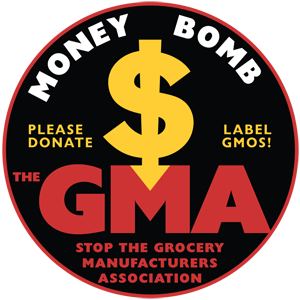
Speaking of courts of law… The Grocery Manufacturers Association of America (GMA), which consists primarily of pesticide producers and junk food manufacturers, is suing Vermont in an effort to overturn H.112—the first no-strings-attached GMO labeling in the US.5, 6, 7 H. 112 was passed by an overwhelming margin,8 and Governor Peter Shumlin signed the historic bill into law on May 8 this year.

The law will require food manufacturers to label genetically engineered (GE) foods sold in Vermont, and prohibits them from labeling foods with GE ingredients as “natural” or “all natural.” The GMA’s lawsuit claims that their members are going to end hunger with their pesticide-laden GMOs, but we already know that the problem with hunger is not production, it’s distribution. There’s more than enough food to go around; it’s just poorly distributed.

Besides, must Americans be kept in the dark about what we’re eating in order for the chemical technology industry to be able to “save the world” with its genetically engineered grains? To help Vermont defend its GMO labeling law against these multi-national giants, please consider making a donation to the Organic Consumers Fund, which has been set up to raise funds for this purpose. The fund has also pledged to help Oregon and Colorado pass their respective GMO labeling initiatives this November.

Beware the ‘DARK’ Act…

The GMA, whose 300-plus members include Monsanto, Coca-Cola, and General Mills, is also pushing a Congressional bill called the “Safe and Accurate Food Labeling Act of 2014.9 The bill, dubbed the “DARK” (Denying Americans the Right to Know) Act, would actually preempt all states from passing GMO labeling laws.10 It would also bar states from enacting laws that make it illegal for food companies to misrepresent their products by labeling GE ingredients as “natural.” Last but not least, the DARK Act would also limit the FDA’s power to force food companies to disclose GE ingredients.

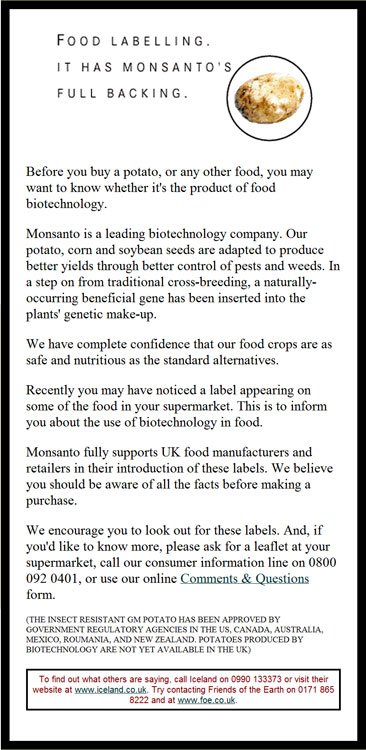
Does any of this make you warm and fuzzy inside? Are these the actions of companies that have your best interest at heart? I would say no. They are trying to HIDE the presence of genetically engineered ingredients, and are pulling out ALL the stops to do so! Ask yourself, why? These companies—the very ones providing much of our food—are actually trying to take awayindividual state’s rights, just to ensure certain food ingredients remain hidden! Curiously enough, Monsanto is more than willing to “support” GMO labeling in other countries.

Here’s a Monsanto ad from the UK, letting British consumers know how much the company supports the mandatory labeling of their goods—even urging Britons to seek such labels out—ostensibly because Monsanto believes “you should be aware of all the facts before making a decision.” What’s the difference between British shoppers and American shoppers? Why does Monsanto support one nation’s right to know but not another? It’s time to put an end to this hypocritical charade and label foods in the US, as has been done in 64 other countries across the globe already!

American state rights were encouraged by our constitution, and the constitution was meant to prevent federal superpowers becoming corrupted and creating an authoritarian, fascist federal government. Sadly, we’ve watched our individual and state rights deteriorate over many decades, succumbing to these enormous industry powers, and this is probably one of the biggest, most blatant overreaches yet, proving that corporate interests are ruling the roost on Capital Hill. As stated by Marni Karlin, director of legislative and legal affairs for Organic Trade Association:11

Consumers, particularly the eight out of ten American families who buy organic products, want to know what is in their food. Rep. Pompeo’s bill ignores this consumer demand for information. Instead, it ties the hands of state governments, the US Department of Agriculture, and the Food and Drug Administration concerning GMO labeling. It is fatally flawed.”

What Happens in Oregon and Colorado in November Could Make or Break the GMO Labeling Movement

In addition to all this legal wrangling, opponents of GMO labeling spent more than $27 million on lobbying in the first six months of this year alone. This is about three times more than they spent during all of 2013, when they shelled out $9.3 million.12 Among the biggest spenders on anti-labeling lobbying were the Grocery Manufacturers Association (GMA) and major food makers such as Coca-Cola Co and PepsiCo Inc., along with chemical industry heavyweights like Monsanto and DuPont.

Undoubtedly, they are well aware that November is going to be a crucial turning-point for the GMO labeling movement. Both Colorado and Oregon have GMO labeling on their November ballots, and it’s absolutely imperative that we make a strong push to make sure these ballots succeed. So please, consider making a generous donation to the Organic Consumers Fund.

I know, it’s an uphill battle, but persistence pays! We cannot and will not give up now. During last year’s I-522 ballot campaign to label GMOs in Washington State, the Grocery Manufacturers Association (GMA) came up with a devious, and illegal, money-laundering scheme to protect the identity of members who donated funds to the opposing campaign. Unfortunately, this illegal move helped the GMA defeat I-522 by a mere one percent margin—ONE PERCENT!

Fortunately, the GMA was caught, and sued by Attorney General Bob Ferguson, who accused them of intentional money laundering and violating state campaign disclosure laws. They had to resort to illegal activity to beat us by one percent the last time… With that in mind, I am firmly convinced that we CAN win in both Colorado and Oregon. But it will take effort. And money, to make sure all the voters are informed enough to make a sound decision. It’s time for truth in labeling. Together, we can make it happen.

I recently named the GMA “the most evil corporation on the planet,” considering the fact that it consists primarily of pesticide producers and junk food manufacturers who are going to great lengths to violate some of your most basic rights—just to ensure that subsidized, genetically engineered and chemical-dependent, highly processed junk food remains the status quo.

The insanity has gone far enough. It’s time to unite and fight back, which is why I encourage you to boycott every single product owned by members of the GMA, including natural and organic brands. To learn more about this boycott, and the traitor brands that are included, please visit TheBoycottList.org. I also encourage you to donate to the Organic Consumers Fund. Your donation will help fight the GMA lawsuit in Vermont, and also help win the GMO labeling ballot initiative in Oregon in November.

Voting with your pocketbook, at every meal, matters. It makes a huge difference. By boycotting GMA Member Traitor Brands, you can help level the playing field, and help take back control of our food supply. And as always, continue educating yourself about genetically engineered foods, and share what you’ve learned with family and friends.

Recommended Supplements (These supplements help detoxify GMOs):

Further Reading:


Zero-Calorie Sweeteners May Trigger Blood Sugar Risk By Screwing With Gut Bacteria

Artificial sweeteners don’t have calories — so why are these mice getting fat?

(Cornucopia – The Verge – Arielle Duhaime-Ross) When artificial sweeteners are in the news, it’s rarely positive. In the last few years, sweeteners have been linked to everything from Type 2 diabetes to cardiovascular disease, high blood pressure, and stroke. Still, products like Splenda and Sweet‘N Low remain a cornerstone of many a weight-loss strategy, mostly because doctors don’t quite understand how sweeteners contribute to disease. That may soon change, however, as results from a study, published today in Nature, point to a possible mechanism behind these adverse health effects.

“Our results suggest that in a subset of individuals, artificial sweeteners may affect the composition and function of the gut microbiome” in a way that would lead to high blood-sugar levels, said Eran Elinav, an immunologist at the Weizmann Institute of Health in Israel and a co-author of the study, during a press conference yesterday. This, the researchers say, is bad for human health because when sugar levels are high in the blood, the body can’t break it down, so it ends up being stored as fat.

To reach these conclusions, Elinav and his team first tested the effect of three common artificial sweeteners — aspartame, sucralose, saccharin — on rodents. They found that each of the sweeteners induced a change in blood sugar levels that surpassed that of the mice who consumed actual sugar. And later tests involving the main sweetening agent in Sweet‘N Low, saccharin, yielded similar results in both lean and obese mice.

But mammals don’t actually digest artificial sweeteners — that’s why they’re “calorie-free” — so the reasons why these mice were experiencing blood-glucose alterations was still mysterious, Elinav said. Still, the researchers had an idea: maybe the bacteria that lived in the guts of the mice were interacting with the sweeteners.

So the researchers performed several experiments to test their idea. In one, they gave antibiotics to mice who had been fed sweeteners regularly. Antibiotics kill gut bacteria, and when these mice had their microbial guests cleaned out, their blood sugar levels went back to normal. In another experiment, the scientists transplanted feces — a rich source of gut microbes — from sweetener-fed mice into rodents that had never consumed artificial sweeteners. The procedure caused the recipient mice to experience oddly high blood glucose, like the mice in the sweetener group. Finally, Elinav and his colleagues used genetic analysis to reveal that alterations in the composition of microbial colonies were also accompanied by changes in bacterial function — changes that could very well explain why the mice were experiencing such high blood sugar.

But findings in mice aren’t nearly as convincing as findings in people, so the researchers set out to investigate human sweetener consumption. In the first experiment, the researchers analyzed the blood-sugar levels and gut bacteria colonies of 381 participants. And, as expected, Elinav and his colleagues found that people who consumed sweeteners in large quantities also showed disturbances in several metabolic parameters — including increased weight — as well as distinct microbial changes in their guts.

The results from the second, much smaller human experiment might actually be the most illuminating.

“We followed for a single week a group of seven human volunteers who do not consume sweeteners as part of their normal diet,” Elinav said. During that period, the researchers gave them a single dose of saccharin, and monitored their vitals. After just four days, half the participants showed microbial alterations and increases in blood sugar levels, he explained, “while the other subset had no meaningful effect immediately following the consumption of sweeteners.”

In other words: some people are more susceptible to the effects of artificial sweetener than others.

A causal link

The handful of studies suggest that consuming non-caloric artificial sweeteners boosts the risk glucose intolerance in both humans and mice, as a result of changes in gut microbe function, the researchers wrote in their report. Yet, because of the preliminary nature of their results and the small number of human participants involved, they stopped short of suggesting that people change their eating habits. “By no means are we prepared to make recommendations as to the use and dosage of artificial sweeteners based on the results of this study,” said Eran Segal, a study co-author also at the Weizmann Institute of Health.

Other researchers, however, were more forthcoming.

“People need to be much more mindful of what they are eating and drinking and make efforts to avoid products that have added sweeteners in any form” said Susan Swithers, a behavioral neuroscientist at Purdue University who wasn’t part of the Nature study, in an email to The Verge. The studies showed not only a causal link between the changes in the gut and artificial sweeteners, but that the observed changes happen quickly, she wrote.

Not everyone agrees with the design the researchers used to address the question about artificial sweeteners and weight gain. Christopher Gardner, a food scientist at Stanford University who didn’t participate in the study, says that the fact that the researchers gave the FDA’s maximal acceptable daily intake of saccharin to the human participants — about 5 mg / kg body weight per day — isn’t ideal. In a real-life setting, that dose would be the equivalent to a 150-pound person consuming 42 12-ounce sodas per day, or 8.5 packets of pink Sweet ‘n Low per day. “That may be ‘acceptable’ according to some set of guidelines,” Gardner wrote in an email, “but it should be noted that realistically this is a very high dose they are using and one that wouldn’t be consumed by a typical consumer.”

Still, the idea that we might finally have an explanation for the adverse health effects seen in certain sweetener studies is worth paying attention to. Should the findings prove reproducible, doctors will be tasked with understanding why some people are susceptible to microbiome alterations, while others aren’t. And sweetener companies will have to address the criticism — in addition to rethinking their marketing strategies. “The work is important,” Swithers said, “because it underscores the role that artificial sweeteners may play in contributing to the very problems they were designed to help.”


New Data Reflects the Continued Demand for Farmers Markets

WASHINGTON, August 2, 2014 – The U.S. Department of Agriculture’s (USDA) Agricultural Marketing Service (AMS) Administrator Anne Alonzo announced today that USDA’s National Farmers Market Directory now lists 8,268 markets, an increase of 76 percent since 2008. The data reflects continued demand and growth of farmers markets in every region of the country. Alonzo also announced that AMS is developing three new local food directories that will expand USDA’s support for local and regional foods by providing easy access to the most current information about the local food market.

Alonzo made the announcements at the Dane County Farmers Market in Madison, Wisconsin, the country’s largest producer-only market, where she kicked off the 15th annual “National Farmers Market Week”, from August 3 through 9, 2014.

“The National Farmers Market Directory numbers reflect the continued importance of farmers markets to American agriculture. Since its inception, the directory has proven to be a valuable tool for accessing up-to-date information about local farmers markets,” Alonzo said. “Farmers markets play an extremely important role for both farmers and consumers. They bring urban and rural communities together while creating economic growth and increasing access to fresh, healthy foods.”

The USDA National Farmers Market Directory, available at farmersmarkets.usda.gov, provides information about U.S. farmers market locations, directions, operating times, product offerings, and much more. The data is collected via voluntary self-reporting by operating farmers market managers and is searchable by zip code, product mix, and other criteria. The National Farmers Market Directory receives over 2 million hits annually.<

In addition to USDA’s National Farmers Market Directory, AMS is adding:

  • USDA’s National Community-Supported Agriculture (CSA) Enterprise Directory
    A CSA is a farm or network/association of multiple farms that offer consumers regular deliveries of locally-grown farm products during one or more harvest season(s) on a subscription or membership basis.
  • USDA’s National Food Hub Directory
    A Food Hub is a business or organization that actively manages the aggregation, distribution, and marketing of source-identified food products to multiple buyers from multiple producers, primarily local and regional producers, to strengthen the ability of these producers to satisfy local and regional wholesale, retail, and institutional demand.
  • USDA’s National On-Farm Market Directory
    An On-Farm Market is a farm market managed by a single farm operator that sells agricultural and/or horticultural products directly to consumers from a location on their farm property or on property adjacent to that farm.

USDA invites local food business owners who fall within these categories to list their operational details in the new directories www.usdalocalfooddirectories.com. These new directories will be available online early in 2015, giving potential customers, business partners, and community planners easy, one-stop access to the most current information about different sources of local foods.

2014 Directory Highlights

According to USDA’s 2014 National Farmers Market Directory, the states with the most farmers markets reported are California (764 markets), New York (638 markets), Michigan (339 markets), Ohio (311 markets), Illinois (309 markets), Massachusetts (306 markets), Pennsylvania (297 markets), Wisconsin (295 markets), Virginia (249 markets), and Missouri (245 markets). All geographic regions saw increases in their market listings, with the most growth in the South. The 10 states with the biggest increases in the numbers of farmers markets include Tennessee, Louisiana, Texas, Hawaii, Massachusetts, Arkansas, North Carolina, Montana, Florida and Nebraska.  Five of these states – Tennessee, Louisiana, Texas, Arkansas, and North Carolina – are part of USDA’s StrikeForce for Rural Growth and Opportunity, where USDA has increased investment in rural communities through intensive outreach and stronger partnerships.

Farmers market development is a cornerstone of USDA’s Know Your Farmer, Know Your Food Initiative, which coordinates the Department’s policy, resources, and outreach efforts related to local and regional food systems.  Secretary Vilsack has identified strengthening local food systems as one of the four pillars of USDA’s commitment to rural economic development.

USDA Office of Communications